
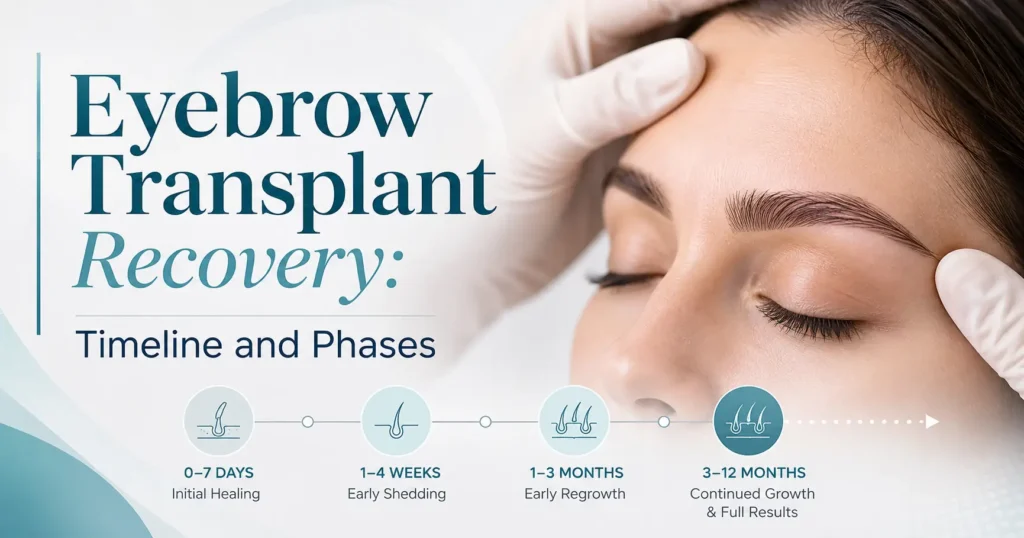
Several aspects of the eyebrow transplant show how skin and hair heal at different rates. Transplanted hair doesn’t begin developing at the same time as the skin.
This means the eyebrow transplant recovery period includes both early skin healing and a much longer hair growth cycle.
Days Following Eyebrow Transplant Surgery
You’ll see swelling, mild redness and small scabs in the grafted eyebrow area. Touching the area of the transplant can displace the hair follicles.
You may also notice slight discomfort in the donor area.
Sleeping After Your Transplant
The transplant specialist may suggest that you sleep with your head elevated.
The goal is to keep fingers and other surfaces away from the transplanted eyebrows.
Every patient is different, so be sure to follow your transplant specialist’s post-operative instructions.
Eyebrow Hygiene After Transplant
In the initial phases of recovery, the hair grafts are still very delicate.
Your transplant specialist should give you aftercare instructions for the first clean of the eyebrows and show you how to care for the grafts without applying pressure.
Returning to Your Normal Facial Cleaning Routine
Do not return to your normal facial cleansing routine until instructed by your medical team.
Days 7–14
You will see continued healing, and the tiny crusts will diminish.
From a distance, your eyebrows will begin to look normal. However, be aware that the process of transplanted hair follicles in the cycling process of hair growth is far from complete.
Why Does Transplanted Eyebrow Hair Fall Out?
A common concern of those who have had hair transplants is seeing their new hair falling out. Rapid shedding of transplanted hairs can occur during the early shedding phase.
Transplanted hairs may fall out while the new follicle remains in place. New growth may appear later.
That is why the early appearance of the transplanted hairs is not a good way to evaluate the end result or graft survival.
The First Few Months
These early months may show no visible signs of change for some patients.
If that’s the case, just be patient. Transplanted hairs do not start to grow at the same time.
For those still considering treatment and not recovering from it, the main eyebrow transplant in Turkey page has details on the procedure, methods, costs and eligibility.
Months 3 to 5
Some patients may begin to have new eyebrow hair that is more noticeable during these months.
The unevenness of the early growth in some areas is not a sign that the final brow is going to be uneven.
Months 6 to 8
By this time in the growth of your eyebrow you will be able to see a significant number of transplanted hairs beyond the ones in active growth.
By this time you may need to start trimming the transplanted hairs because they will grow more than your natural eyebrow hairs.
Do not over-trim the brow just because some transplanted hairs have uneven growth.
Months 9 to 12
During this period the fullness of the brow will become more apparent.
This is a better time to evaluate how the transplanted brow hairs integrate with your remaining eyebrow hair.
Our eyebrow transplant before and after guide will help you understand how to evaluate progress photos at different stages.
When Can You Return to Normal Activities?
When you can return to work and resume your social activities depends on how much redness, swelling and crusting is visible, as well as the type of work you do.
A person who works from home may have less downtime than a person who works outside and does a physically active job.
Before you resume strenuous activities such as exercise and swimming, as well as sun exposure and the use of facial products, ask the clinic.
When Should You Reach Out to the Clinic?
Normal recovery is not the same as complications.
Concerning symptoms such as increasing pain, spreading redness and abnormal discharge should be brought to the attention of the medical team who are treating you.
Do not use other patients’ progress photos to determine if your recovery is normal.
What You Should Know About Follow-Up Appointments
Follow-up appointments give the clinic an opportunity to evaluate how the transplant is healing and growing, and to answer any questions about post-operative care or grooming.
They are especially important for patients who are not able to return to the clinic frequently for additional appointments.
Before you travel, ask how the clinic handles remote follow-up and who you should contact if you have a concern.
Final Thoughts
Recovering from an eyebrow transplant is an extended process that continues well after the initial post-operative period.
The skin heals first, then the hair goes through a cycle of shedding, resting and gradual regrowth.
As with any hair restoration procedure, it is important to understand the recovery time and how long to wait before evaluating the final results.
Medical Sources
- Hair Transplant for Eyebrow Restoration — Indian Journal of Plastic Surgery.
- Restoration of the Eyebrows by Hair Transplantation — Facial Plastic Surgery.
- Clinical Outcomes and Technical Tips for Eyebrow Restoration Using Single-Follicular-Unit Hair Transplantation — long-term clinical follow-up study.