
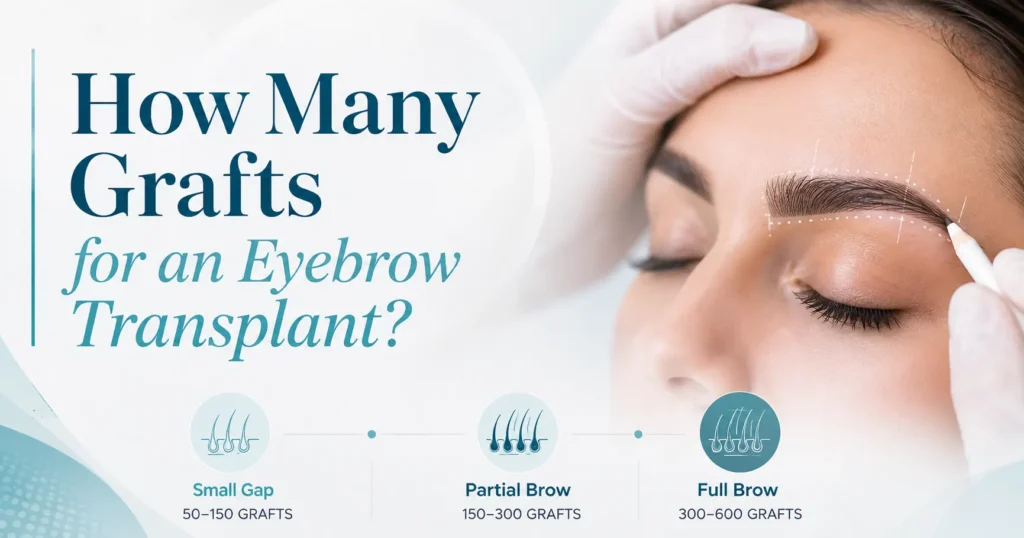
How Many Grafts for an Eyebrow Transplant
Eyebrow transplants do not have a set number of grafts required. A few examples that would require different amounts of grafts are: filling in small gaps, fixing a thin brow, and reconstructing the entire eyebrow.
Your personal amount of grafts would rely on your available and existing eyebrow hairs, the size of the brow, and the desired eyebrow density of the hairs. The surgeon would also consider the available hair for the transplant since they would prefer a sufficient number of single hair follicles.
What is Actually in an Eyebrow Graft?
A graft is a small unit of hair that is removed from the donor area. A graft can consist of a few different quantities of hair follicles, or follicular units. However, eyebrow transplants are removed and placed using single hair follicles.
This is especially important when considering the shaping of the eyebrow area, since larger clumps of hair would be uneven and too dense compared to other areas of the brow.
What Makes Eyebrow Graft Counts Different?
Even though two people may have similar looking eyebrows, they could require very different eyebrow restoration procedures.
The team would have to consider many factors such as the shape and size of the existing eyebrow hairs, and any gaps that may be present, as well as the available donor hair, and the desired design. All of these would contribute to the graft count.
Some people would require a lot more grafts especially in the case where there are not many existing eyebrow hairs.
Restoring Partial Eyebrows
It is also possible to restore only a small section of the eyebrow as opposed to the whole eyebrow. This would typically be done on an isolated area of the eyebrow.
Eyebrow restoration may focus on thin brow tails, gaps, and overall asymmetry.
In these instances, the surgeon will have to work with the hair that exists. At this point, the surgeon has to evaluate the direction of the existing brow hair, because for the restoration to be successful, the transplanted hair will need to integrate with the existing.
Thus, the number of grafts needed will be determined by the gap and the existing brow hair.
Total Brow Reconstruction
This is much more complicated.
For this, the surgeon constructs the head, body, arch, and tail of the brow, and each of these is in a different orientation. This will require much more than just more graft placement.
For a full restoration, our eyebrow hair transplant in Turkey guide details the transplant procedure, available donor site, type of transfers, and the design of the treatment.
Does More Grafts Equals A Better Result?
Not really. More grafts does not mean a more natural successful restoration of the brow.
A very dense brow may look heavy, and even with graft take, they may be poorly positioned and may remain in a perpendicular orientation.
The surgeon must take all of this into account, along with the spacing between the existing hairs and the direction the existing hairs are growing.
Thus, the placement of the grafts may be just as important as the number of grafts placed.
Can Eyebrow Shapes Impact Graft Numbers?
Brow shape can mean different graft numbers.
An adjustment to an already existing brow may differ from a more extensive plan to accommodate wider eyebrows or longer eyebrow tails. Natural brow hairs may also dictate how many regions need filling.
Because of this, graft numbers must accommodate brow shape instead of forcing brow shape to fit a certain graft number.
Do FUE and DHI Impact Graft Numbers?
The approach to the procedure may differ when choosing to go with DHI or FUE, but graft numbers are mostly dependent on the design of the patient’s brow in both approaches.
Most patients start off contemplating procedure names, unaware of the differences until they educate themselves. FUE, or follicular unit extraction, is one part of this discussion. Our FUE vs DHI for eyebrow transplant guide explains the procedure, the naming and placement of each in the sequence of the entire procedure.
Can the Quality of Donor Hair Impact the Design?
Yes, especially if the donor region does not have hair of a certain quality.
The surgeon assesses donor hair based on thickness, texture, curl, and overall quality of the follicles. Donor hair that is thinner may be better for brow designs that aim to have softer brows.
The surgeon may also alter brow design based on the quality of donor hair in comparison to the existing hairs of the brow.
The quality of donor hair may also impact how many grafts are used in the design.
What Is the Impact of Single Hair Grafts?
Eyebrow hairs have different hair growth patterns compared to densely packed scalp hair.
Single-hair follicles work well at the tail or border of an eyebrow. A dense application of grafts makes an eyebrow outline look sculpted and unnatural. The number of grafts and the type of grafts both matter. An eyebrow composed of less dense hairs can still look natural.
Does Hair Direction Affect the Result?
Natural brow hairs can change direction throughout the brow. Hairs at the inner brow do not grow in the same direction as those around the arch or tail. Also, a greater number of grafts will not fix poorly directed transplanted hair.
Can You Know the Exact Number Before Consultation?
You can get a rough estimate at the cost of submitting an application online, but you will not be able to convey important features like hair texture, scar quality, and donor hair density from an online application. Evaluating the donor area and the brows in person will reveal the bulk of the design and planning.
Why Do Two People Seek the Same Brow Design and Get Different Estimates?
Instead of asking how many grafts were assigned, you should ask the reason for that graft number.
The team should explain graft placement and the positioning of low-density areas of the brows to show how the new hairs will align with and integrate among the existing hairs.
For this reason, it should matter how grafts are explained and not just how they are sold when comparing eyebrow transplant clinics in Turkey.
The factors for how many grafts are recommended should be the design and overall placement of the brows, and this should align with their proposal.
Final Thoughts
How many grafts are suggested for a particular brow should be determined by the characteristics of that particular brow, and different approaches are required depending on the varying levels of thinning or reconstructive needs.
This is important because it requires precision and a great deal of care to ensure that the appropriate number and types of follicles are selected and positioned in such a way to replicate the natural growth patterns of eyebrow hairs.
Medical Sources
- Hair Transplantation — NCBI Bookshelf, U.S. National Library of Medicine / National Institutes of Health.
- Hair Transplant — NHS (UK National Health Service).
- Cosmetic Plastic Surgery Overview — Johns Hopkins Medicine.