FUE vs DHI for Eyebrow Transplant
In discussions of modern hair and eyebrow transplantation, FUE and DHI come up almost interchangeably. The names might make you think they are different operations altogether, but that is not necessarily how they work in eyebrow restoration.
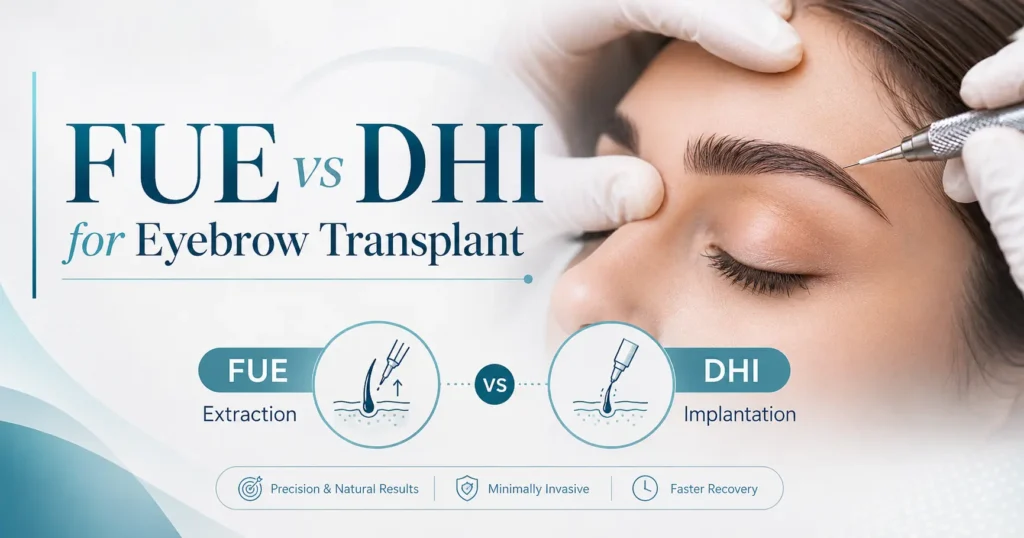
FUE describes how follicles are extracted. DHI, on the other hand, describes how the prepared grafts are placed during hair implantation.
The technique used is important, but so are graft handling, eyebrow design and the angle of the hairs that are placed.
What Is FUE Eyebrow Transplant?
FUE stands for Follicular Unit Extraction.
This describes the extraction process, where the follicular units are taken one by one from the donor area. The team is then able to inspect the grafts and take the ones that best fit the design of the eyebrow.
Fine, single-hair follicle grafts are useful since eyebrows do not grow as thick as hair on the scalp.
What Is DHI Eyebrow Transplant?
DHI is generally used to describe the implantation process when a specialized implanter pen or device is used.
In this case, the prepared graft is placed in the implanter and the device is used for graft placement in the desired recipient area of the eyebrow.
The device used has no bearing on whether the eyebrow looks natural. DHI requires the same amount of care, spacing and placement as any other technique.
Are FUE and DHI Direct Alternatives?
Not necessarily.
FUE might be used to extract the hair follicles, while an implanter device might be used in the implantation process. This is why patients need to be careful when comparing FUE and DHI based on the names only.
When comparing FUE vs DHI for eyebrow transplant, make sure to specify how the follicles are extracted and, separately, how they are placed into the recipient site.
Why Eyebrow Restoration Is Different
The way eyebrow and scalp hair grow differs.
Eyebrows contain hairs that grow more horizontally and closer to the skin. A hair that is misaligned and grows vertically in a certain spot on the scalp may not be as noticeable, while that same hair may be much more visible on the face.
As a result, eyebrow design, graft placement and the angle of the hairs are critical considerations for the procedure.
The complete guide on eyebrow transplant in Turkey explains the role of donor selection, brow design and placement in the overall hair restoration procedure.
Does DHI Create More Natural Eyebrows?
No matter the implantation method, there is no way to ensure a natural look based on the technique alone.
If the implanter provides the medical team with a certain method to handle and place the grafts, poor planning can still affect the result.
Natural-looking eyebrows depend on the correct hair follicle choice, careful graft handling and placement in an appropriate pattern.
Does FUE Leave Scarring?
The large linear scar associated with the strip method will not be present with FUE.
Follicular unit extraction still involves removing follicles from the skin, so patients should not view FUE as meaning that the donor area is completely untouched.
The condition of the donor area depends on the extraction method, healing and the patient’s skin.
Which Method Requires More Grafts?
It should be the design of the eyebrows that determines the number of grafts, not whether the clinic uses FUE or DHI.
For example, a patient who wants to fill an incomplete eyebrow will have very different requirements from a patient who wants to create an entire eyebrow.
Our guide on how many grafts are needed for an eyebrow transplant covers the factors that affect the final graft count.
Does Graft Handling Matter?
The grafts need to be handled carefully between follicular unit extraction and placement in the recipient area.
How long the follicles remain outside the body, how they are handled and how they are inserted can all form part of the treatment process.
For the patient, this is another reason to look beyond the name FUE or DHI and ask how the clinic manages the grafts throughout the procedure.
What Should You Ask the Clinic?
You can ask about the graft design, extraction and implantation team.
You can also ask how they pick single-hair follicles, how the implanter pen is used and how they manage the hair growth angle.
You’ll get more meaningful answers asking these questions than simply asking for a technique name.
The same details can help when choosing an eyebrow transplant clinic in Turkey, since technique names do not tell you who actually performs each stage.
Is One Technique Better for Everyone?
Absolutely not.
Skin, hair, current eyebrow density, hair loss and the target recipient area will affect the plan.
An experienced team should be able to explain the reasons for the treatment plan, and it should not be the same plan for every patient.
What Happens After FUE or DHI Eyebrow Transplant?
The implantation method does not remove the normal healing and hair growth stages that follow eyebrow transplantation.
Some transplanted hairs may shed before later growth becomes visible, and the donor and recipient areas also need time to heal.
Our eyebrow transplant recovery guide follows these stages from the first days through later hair growth.
Final Thoughts
The FUE vs DHI debate is a valid concern, but shouldn’t be the focus of the entire decision.
For eyebrow restoration, the implantation device may be a factor, but so are graft selection, graft survival, eyebrow design and the direction of the hair.
Medical Sources
- The Science and Art of Eyebrow Transplantation by Follicular Unit Extraction — Journal of Cutaneous and Aesthetic Surgery.
- Hair Transplant for Eyebrow Restoration — Indian Journal of Plastic Surgery.
- Use of Implanters in Premade Recipient Sites for Hair Transplantation — Journal of Cutaneous and Aesthetic Surgery.