
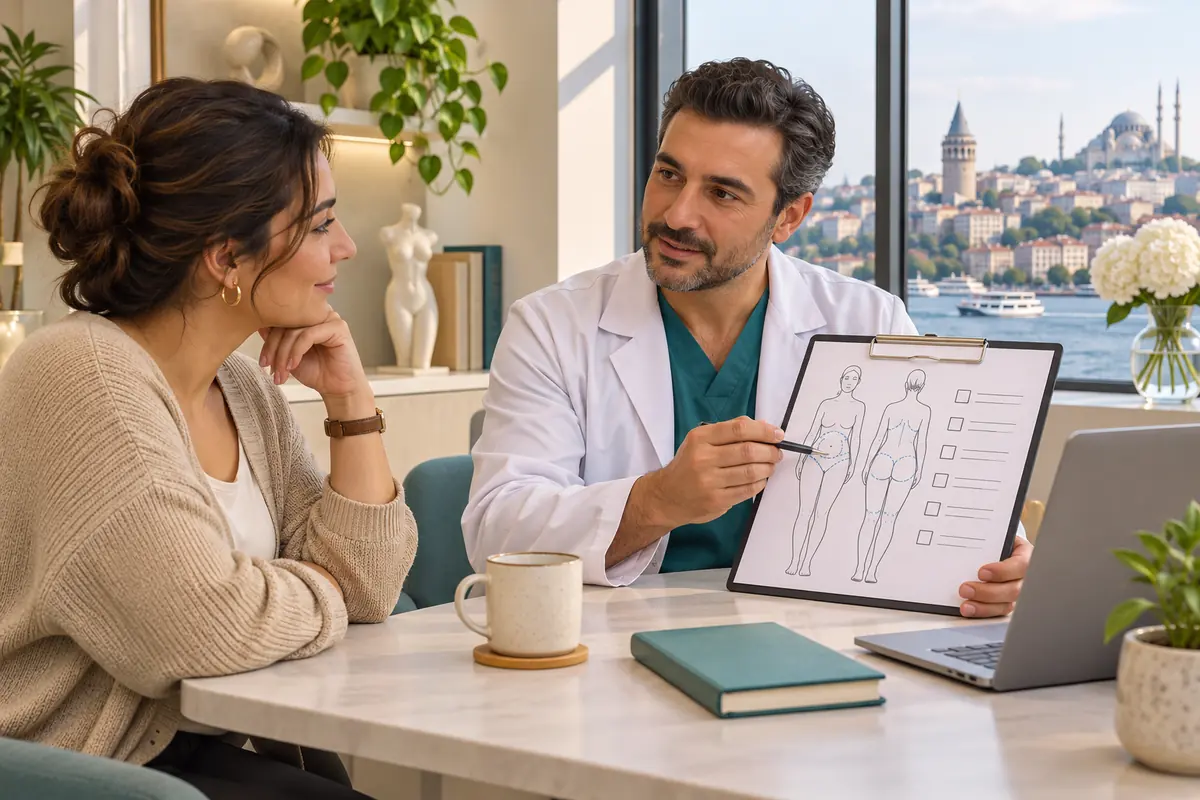
Editorial illustration. The people and room are fictional; they are not Bella Clinic personnel or premises.
Liposuction in Turkey can be considered only after the same safety questions that matter in any country: is the patient suitable, who will operate, where will surgery happen, how will anaesthesia and complications be managed, and who provides follow-up? Turkey as a destination does not make an individual operation automatically safe or unsafe. Liposuction is surgery, and the American Society of Plastic Surgeons (ASPS) lists risks that range from bruising and uneven contour to blood clots and injury to deeper structures. A provider should explain your personal risk before you consent.
For the full procedure overview, see Bella Clinic’s liposuction in Turkey guide.
An overseas booking adds practical questions. The operating surgeon, clinic brand, travel facilitator and hospital may be different entities. Ask for their full names, roles and written responsibilities before paying. The Turkish Society of Plastic Reconstructive and Aesthetic Surgeons’ international-patient checklist specifically advises patients booking through an agency to demand the surgeon’s and hospital’s names. The NHS asks patients to plan aftercare, complications and insurance before surgery abroad.
Is Liposuction in Turkey Safe? A Five-Point Check
| Check | Evidence to request | Why a slogan is insufficient |
|---|---|---|
| Operating surgeon | Full name, surgical specialty, credentials, relevant liposuction experience and a consultation with that surgeon | “Expert team” does not identify who operates. |
| Facility | Exact hospital or surgical centre name and address; status in the Turkish Ministry of Health authorized-facility lists | A marketing office or hotel address is not an operating facility. |
| Individual assessment | Medical history, medicines, examination, intended areas, anaesthesia and whether combined surgery is proposed | An online photo and price cannot establish suitability. |
| Complication route | Named team, urgent contact, where you would receive emergency care, and who pays for extra treatment or stay | “24/7 support” does not describe clinical treatment. |
| Follow-up and travel | Local review, written records, clinician’s travel advice and care after returning home | A return flight is not proof of medical clearance. |
These checks reflect ASPS consultation questions, the Turkish society’s checklist and CDC guidance on medical tourism. They lower avoidable uncertainty; they cannot eliminate surgical risk or guarantee a result.
What Are the Real Risks of Liposuction?
The ASPS liposuction safety page lists anaesthesia problems, persistent altered sensation, deeper injury, deep vein thrombosis and heart or lung complications, fluid collection, infection, contour irregularity, poor healing and possible revision surgery. Ultrasound-assisted liposuction also has a potential heat-injury risk. The exact likelihood of each event depends on the patient and procedure; a short list on a website cannot replace an informed-consent conversation.
| Issue | What to discuss before surgery | What to do if it appears afterward |
|---|---|---|
| Bruising, swelling, soreness or altered sensation | Expected range for your areas, pain plan, when the team will check you | Report a sudden or worsening change rather than judging from a photo alone. |
| Infection, bleeding or fluid collection | Wound and drain instructions, urgent assessment route, who treats a seroma or infection | Seek prompt clinical review for fever, spreading redness, heavy bleeding, new enlarging swelling or worsening pain. |
| Uneven contour, loose skin or poor healing | Skin quality, realistic limits, photo timing and revision terms | Have the surgeon assess the area after appropriate healing; do not assume all early asymmetry is final. |
| Blood clot or pulmonary complication | Your personal clot factors, operation scope, travel plan and prevention instructions | Sudden breathlessness, chest pain, fainting or a painful swollen leg needs emergency assessment. |
| Deeper injury or anaesthesia event | Operating setting, anaesthesia provider and emergency-transfer capacity | Requires immediate medical treatment, not remote reassurance. |
The table is a decision aid, not a diagnostic tool. The NHS liposuction guide describes common side effects and serious complications and advises prompt contact for severe pain or unexpected symptoms. If symptoms are urgent, seek emergency services where you are and state that you recently had surgery.
Is Liposuction in Turkey Safe for You? Individual Risk Factors
A surgeon needs your medical history, previous operations, medicines and supplements, allergies, smoking history and any condition that could affect anaesthesia, healing or blood clots. The treatment plan also matters: one small area is not the same as several areas, a large-volume operation or liposuction combined with a tummy tuck or fat transfer. ASPS says large-volume removal needs special consideration. It is a reason to ask for a personalized plan, not to apply one online cutoff to yourself.
Tell the surgical and anaesthesia teams about every medicine you take; do not stop prescribed medicines on your own. Ask whether a condition should be optimized, an operation reduced or staged, or surgery deferred. A clinic that will not discuss a reason to say no is withholding a critical part of the safety decision. ASPS’s consultation checklist includes “Am I a good candidate?” and “What are the risks and complications associated with my procedure?”
Liposuction is for contouring localised fat, not treating obesity or removing excess skin. The NHS notes those limits. When loose skin or separated abdominal muscles drive the concern, compare the goals in Bella’s existing liposuction versus tummy tuck guide before agreeing to a larger liposuction package.
How Can You Verify a Surgeon in Turkey?
First obtain the operating surgeon’s full name in writing and ask to speak with that person, not solely a sales coordinator. Request their medical and specialist qualifications, experience with your exact operation and where they have permission to operate. The Turkish plastic-surgery society advises checking credentials and offers a member search and a separate board-certified-member list. Membership is a useful cross-check; it is not by itself proof that this surgeon is licensed for the proposed operation at the named facility or that outcomes are guaranteed.
Ask the surgeon to explain why this technique and area plan fit you, what they would not treat, alternatives, expected limitations, complications and their own process for handling them. ASPS’s question list also covers facility accreditation, hospital privileges, recovery and revision options. US-specific board titles on that list are examples of credential questions, not Turkish licensing criteria. If a coordinator cannot disclose the operating surgeon or arranges a substitution, delay the decision until you can verify the actual operator.
How Can You Check the Hospital or Surgical Facility?
Ask for the legal name and exact address of the place where the operation will occur, then compare it with the Turkish Ministry of Health’s current lists of authorized hospitals, medical centres, private practices and other healthcare facilities. The Ministry’s page was updated on 5 October 2026 when this article was prepared; recheck it at booking. HealthTürkiye explains the health-tourism authorization system for facilities and intermediaries.
An authorized travel intermediary is not the same thing as the operating healthcare facility. A facility’s appearance on a list shows a regulatory status at a point in time; it does not certify a particular surgeon’s skill, infection rate, emergency capacity for your operation or result. Ask who supplies anaesthesia, how patients are monitored, whether overnight care is planned for your case and where complications would be treated. If the name on the booking agreement differs from the operating facility, obtain a written explanation of each entity’s role.

Conceptual checklist, not a real credential, Ministry approval or Bella Clinic certificate.
What Should a Proper Consultation and Consent Include?
The operating surgeon should review your history and examine the areas before the final decision. Agree on the exact zones, proposed technique, amount and limits of fat removal, anaesthesia, possible additional procedure, scars, expected recovery and whether your skin is likely to retract. Make sure the consent form and quote describe the same plan. If a BBL or another fat-transfer procedure is proposed, it has its own risks and consent; it is not automatically included in “Lipo 360.” Bella has a separate BBL overview for that different procedure.
Ask for risks in terms you understand, including what would make the surgeon change or cancel the operation. The NHS advice for cosmetic surgery abroad emphasizes consultation with the surgeon treating you, rather than meetings only with sales staff. Do not let a discount deadline replace time to read the consent and seek an independent opinion. Before-and-after photographs can help discuss realistic contour changes, but they do not establish the safety of the operation or the quality of aftercare. Bella’s results guide is relevant when evaluating photos.
Can a Risk Rate Tell You Whether Turkish Liposuction Is Safe?
No single trustworthy Turkey-wide liposuction complication or death rate was established by the sources reviewed for this article. A rate from one study or clinic can depend on the number of patients, definitions, procedure types, follow-up period and whether problems after patients return home are captured. It cannot simply be labelled “the risk in Turkey.” The supplied keyword data measures search interest, not deaths or clinical outcomes.
If a provider quotes “99% safe,” “zero complications” or any precise percentage, ask: How many operations were counted? Over what dates? Which operations were combined? What counted as a complication? How long were patients followed? Were events after travel home included? Ask for a source you can read. A low figure without a denominator or follow-up method is a marketing claim, not a personal risk estimate. The CDC cautions that outcome data and follow-up practices can vary in medical tourism.
Does a Lower Price Mean an Unsafe Operation?
Price alone cannot classify a surgeon or hospital as safe or unsafe. A market check in November 2026 found an indicative €2,600–€5,200 for 1–3 areas hospital-group range. That is not Bella Clinic’s price or a Turkey-wide average. Compare only offers for equivalent zones and inclusions, and ask what medical care the price buys.
Ask whether the written amount includes the operating facility, surgeon, anaesthesia, preoperative tests, garment, medicines, overnight stay, local follow-up and what happens if a complication requires extra treatment or extra hotel nights. CDC guidance notes that follow-up may be charged separately, while the NHS advises checking insurance and emergency-return costs. A fuller price comparison belongs in the separate cost guide; safety depends on knowing exactly what the quote excludes as well as what it includes.
What Aftercare and Emergency Plan Should Be Written Down?
Before surgery, identify who will review you in Turkey, how to reach a clinician after hours, which hospital handles a serious complication, what happens if you cannot fly as planned, and how much additional care could cost. After surgery, obtain an operation summary, medicine list, wound and garment instructions, follow-up dates and a contact that a clinician at home can use. The CDC recommends obtaining records before returning home.
Travel adds blood-clot concerns. CDC says surgery and air travel independently increase clot risk; NHS guidance asks patients to plan when they can fly. Your surgeon must apply current guidance to the areas treated, any combined operation and your health. Bella’s liposuction recovery guide covers garment, recovery-stage and flight questions in detail. A chat message can support routine follow-up but cannot replace emergency or in-person assessment for new concerning symptoms.
Warning Signs in a Booking Process
- The operating surgeon or actual facility is not named before payment.
- A salesperson promises a “risk-free” or guaranteed result, or provides a precise risk rate without evidence.
- The proposed operation is approved from photos alone without a proper medical assessment and consent discussion.
- A “package” bundles extra procedures without separate indications, risks or written prices.
- The operating location changes without a fresh explanation and verification.
- There is no written plan for complications, after-hours clinical help or follow-up after returning home.
- The return flight is treated as fixed even if clinical recovery might require a delay.
These are reasons to pause and obtain answers, rather than diagnoses of a particular provider. The Turkish society, ASPS and NHS each emphasize named professionals, direct consultation and planning for complications.
Watch: How Liposuction Removes Fat and Shapes the Body
Video credit: American Society of Plastic Surgeons (ASPS). © ASPS. Educational material, not Bella Clinic footage or a patient result.
Frequently Asked Questions
The city does not establish safety. Verify the operating surgeon, exact facility, your suitability, anaesthesia arrangements and the written complication and aftercare plan. Check the facility against the current Ministry of Health list; a listing alone does not guarantee your outcome.
ASPS lists blood clots and cardiopulmonary problems, deeper-structure injury, anaesthesia complications and infection among possible serious risks. Their likelihood depends on patient and operation; discuss your own risk with the surgeon.
The sources reviewed did not establish a reliable Turkey-wide rate for cosmetic liposuction. A search query or a figure from an unrelated study cannot answer this country-specific question. Ask any provider quoting a rate for its population, definitions, dates and follow-up method.
The device name alone does not show that a proposed operation is safer. ASPS lists potential heat injury with ultrasound-assisted lipoplasty alongside risks shared by liposuction methods. Compare the surgeon, technique, areas and your health rather than a marketing label. Bella’s live VASER guide covers that technique separately.
Get the legal name of the operating facility and search the Ministry of Health’s updated facility lists. If you booked through an agency, verify the agency and facility as separate entities. Ask the provider to explain any mismatch in names or addresses.
An urgent problem requires local emergency or in-person medical care. Bring the operation records and contact the original surgical team so the clinicians can exchange details. Before booking, establish what follow-up or revision the overseas provider will supply and what your insurance covers; NHS and CDC recommend planning this in advance.