
The organization of travel associated with getting a hair transplant, the transplant, and post-surgery services in Turkey is appealing to patients who cross international borders. However, the safety and success of a hair transplant is more about diagnosis, the capacity of the donor, operational planning, handling, and quality of service and follow up, rather than about the location.
Hair transplants relocate viable follicular units from the donor area (usually the back and sides of the scalp) to areas that have hair loss. Advanced techniques of transplantation can give natural results in the right patients, but a hair transplant cannot add new hair to an unlimited extent. Thus, planning and patient selection is important. For anyone researching a Turkey hair transplant, the quality of the hair transplant surgery and the medical team should matter more than the destination alone.
Why Do International Patients Choose Turkey for Hair Transplants?
International patients are drawn to medical tourism destinations for cost savings, convenience, and care that can be combined with travel. The CDC indicates that the international travel of patients for cosmetic and medical procedures is of great concern, and Turkey has developed a health tourism infrastructure with Ministry-approved healthcare and international patient services.
While that indicates an available health tourism system, it does not assure high quality standards for all services. The UK Foreign, Commonwealth & Development Office cautions that within the same country there can be massive variances in standards and recommends against relying solely on company sponsored websites, and that patients considering treatment in Turkey should research thoroughly.
Why Istanbul Is a Major Hair Transplant Destination
Istanbul’s role in the international healthcare market is significant throughout all of Turkey. The country’s official health tourism systems prominently feature Istanbul. Patients searching for a hair transplant in Istanbul still need to evaluate the individual hair transplant clinic rather than assume that location determines quality.
For a patient, there may be better ways to decide where to go for health care than through Istanbul’s international healthcare market.
So who is the best clinician to assess your hair loss? Where will the surgical steps be performed? Where will the surgery site be? How will the donor area be protected? How will your post-surgery recovery be managed?
Medical Tourism and International Patient Services
International patient services help schedule your appointments and transport you to and from your destination. The HealthTürkiye system enables the planning of your treatment to include services such as accommodation and transport.
Combined services can help make health care trips more convenient. Some all-inclusive packages may also promote accommodation, transfers, or even a luxury hotel. However, these services should be distinct from the medical decisions. An easy hotel stay and airport transfers will not provide the patient with a satisfactory diagnosis, an adequate graft placement, or a proper infection control plan or an effective post surgery follow up.
Who May Be a Good Candidate for a Hair Transplant?
A good candidate for a hair transplant has to understand the reason for hair loss. Pattern hair loss, including androgenetic alopecia, is the most typical condition for hair transplantation. Other conditions such as scarring, inflammatory, diffuse, or other types of alopecia may require surgical or other types of treatment.
How Hair Loss Patterns Change Over Time
When you decide on a transplant, you must consider the likely future pattern of hair loss, rather than the bald patch that currently exists. If the hair that is adjacent to a transplant continues to become thinner over the years, the transplanted hair will become disconnected from the native hair, leaving a transplanted hairline that looks disconnected and strange.
Therefore, the age, progression, diagnosis, and stability of hair loss, as well as family history, will play a role in the decision process regarding potential medical treatment. In some cases, surgical hair restoration may be seen as a last resort for hair loss, even if that involves a patient taking a combination of medical treatments as a temporary management plan. Thinning hair and the expected progression of hair loss should therefore be considered before the procedure.
The Area Used to Donate Hair
The area used to donate hair is finite. The density of the donor area, the position of the follicular units, the thickness of the hair shaft, how curly the hair is, how much contrast is achieved between the hair and the skin, and the number of procedures that have been performed will all impact how much coverage can be achieved.
It is important not to remove too many hair follicles to achieve a good coverage result. The donor area must be left unbothered. Therefore, the focus should be on removing an ample number of donor grafts from the optimal locations, rather than achieving the maximum number of removals.
Managing Expectations After a Hair Restoration Procedure
It must be made clear that a hair transplant relocates hair to various areas, but cannot restore the original hair density. Therefore, in cases of severe hair loss, areas of the scalp, including the front, the hairline, the mid-scalp and the crown will need to be prioritized given the constraints of the donor area.
Hair calibre, curl, and contrast of hair and scalp also affect the perception of density. Two patients receiving the same number of hair grafts can have completely different levels of coverage. Careful graft planning must be done based on the individual case and not strictly based on the number of grafts offered.
Hair Transplant Techniques Available in Turkey
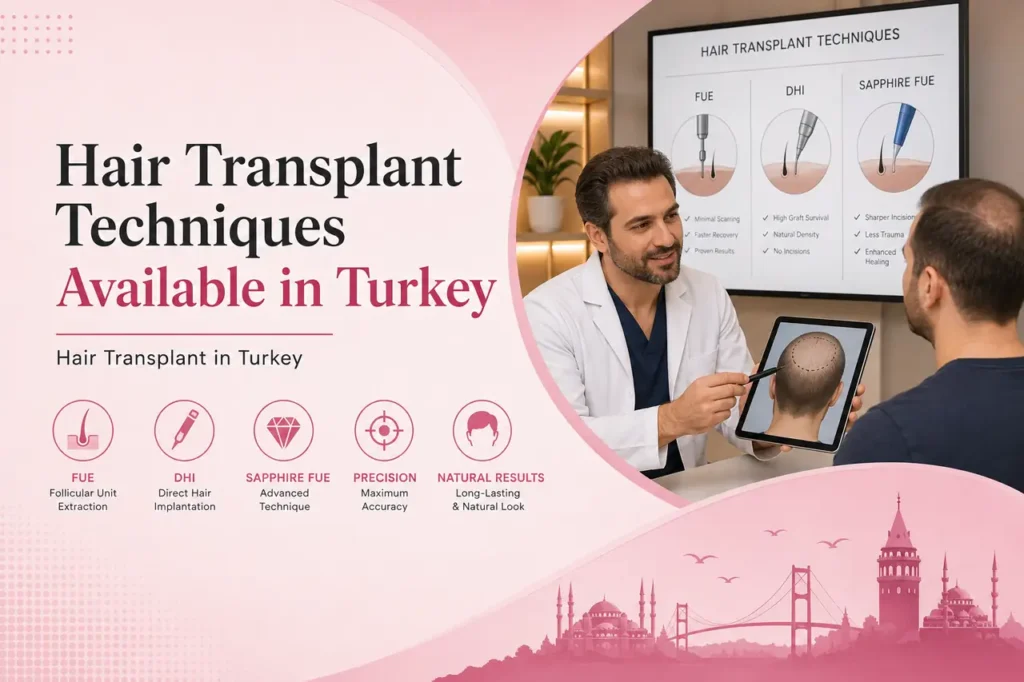
There are many commercial terms in hair transplantation, but they often describe the same procedures. It is helpful to distinguish hair transplant techniques based on the method of harvesting versus the method of implanting. FUT, or follicular unit transplantation, is another harvesting approach and should not be confused with FUE.
FUE Hair Transplant
FUE is formally defined by the International Society of Hair Restoration Surgery as Follicular Unit Excision, though many patients and even websites continue to use “Follicular Unit Extraction.”
In FUE hair transplantation, each follicular unit is excised from the donor site using small punches, and is then prepared for transplantation. The ISHRS (International Society of Hair Restoration Surgery) has explained that FUE is a surgical method of harvesting and should not be described as a simple nonsurgical extraction.
DHI Hair Transplant
DHI, or direct hair implantation, should not be considered a separate method of harvesting donor hair.
Grafts may be harvested using FUE, and then, using an implanter device, may be inserted. A Choi implanter pen holds a follicular graft in a needle-like device, and once inserted, places it at the desired angle and depth in the recipient site.
This distinction is important when considering DHI hair transplantation vs FUE, as a patient could actually undergo FUE donor harvesting followed by an implanter based transplantation technique.
Sapphire FUE Hair Transplant
Sapphire FUE essentially is FUE, yet the recipient site is made with a sapphire blade.
Just because the word “sapphire” is used, it does not mean that the method used is better and will surely deliver better results. Instrument studies used to evaluate recipient site blades have given contradictory results and hence, while the blade used in surgery is one of the many factors, so are the others including the planning and design of the surgery, the placement method, density, graft survival rates, and aftercare.
So, Sapphire FUE should be seen as a variation in the technique used to perform the surgery. The same caution is useful when commercial terms such as Sapphire DHI are used to describe a hair transplant method.
How Is the Right Technique Decided?
There is no one technique that is ideal for every patient. There are many factors that dictate the right technique, including the donor conditions, the desired recipient area, hair characteristics, graft count, etc.
The right comparison for different techniques is not which technique has a better sounding acronym; it is how the techniques will impact the surgical plan. This is especially important when comparing FUE with DHI for a patient.
Hair Transplant Cost in Turkey: What Affects the Price?
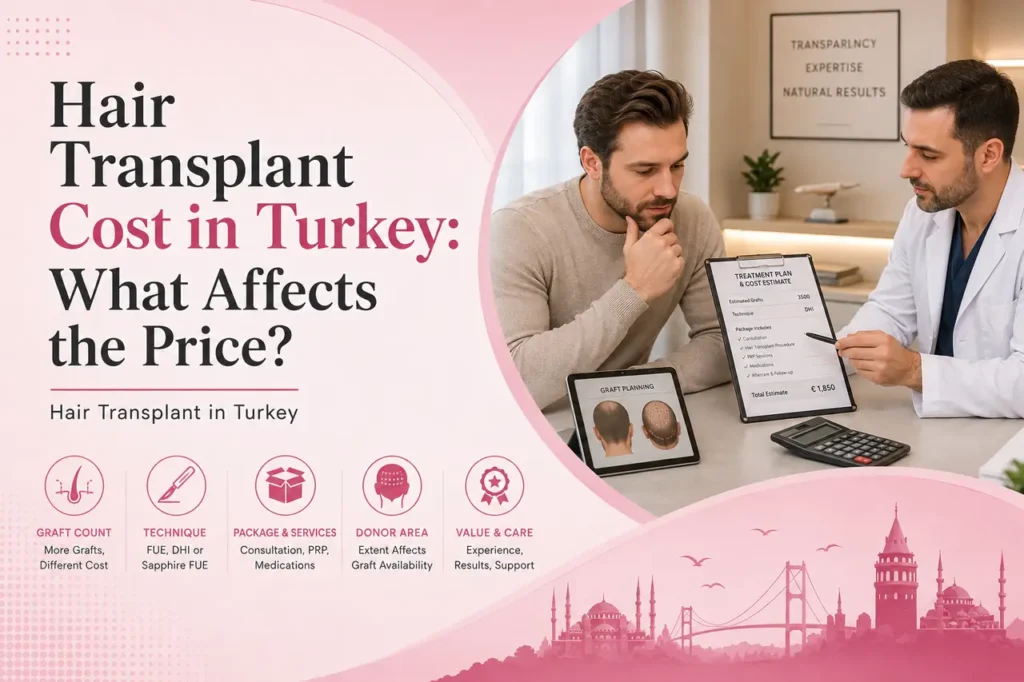
Unlike certain other countries that have uniform pricing for hair transplant procedures, Turkey sees no such legislation. Consequently, hair transplant cost in Turkey varies by numerous factors, with different medical tourism companies quoting different prices. The Turkish Ministry of Health has stated that touristic health services are allowed to operate and charge as usual, within certain boundaries.
Therefore, pricing the services alone are not sufficient to evaluate the quality of hair transplant procedures and services in Turkey. A more useful comparison is the complete hair transplant pricing and package rather than the headline price alone.
Number of Grafts
More grafts mean longer surgery time, so more harvesting and implanting work. And while more grafts may seem to indicate more coverage, a donor assessment should determine the precise number of grafts required. Donor stress should not be unnecessarily caused by harvesting.
A quote for 4,000 grafts does not equate to better value than a quote for 3,000. Whether 5,000 grafts are appropriate should also depend on donor capacity rather than on the size of a package.
Technique and Treatment Plan
Price cannot reflect surgical plan, because the length of the harvesting session, the use of an implanter, recipient site preparation, the complexity of the hairline and the length of the session are just a few of the factors which have an impact on the cost of the surgery and which should be considered when the plan is created.
Medical Team and Clinic Standards
There are other variable costs such as the number of clinic staff, levels of physician participation, follow up care and how much time the clinic staff devotes to each patient.
These all contribute to the final price for hair transplantation in Turkey.
Cheaper initial quotes for services for international patients may be less attractive in the end if complications arise that require more follow-up treatment once they have returned home. The CDC has published data concerning travel related cosmetic procedures that outlines the importance of infection prevention and the need for continuity of care when treatments are provided outside of a patient’s local healthcare system.
What Is Included in a Package?
Packages may include the procedure and accommodations, meals, transfers, medications, post-operative washing, and/or post-operative follow-up. Airlines may or may not be included.
Everything should be confirmed before payment. Patients should understand if the price includes additional testing, if it covers the cost of additional nights, changes in graft numbers, and the cost of additional care if the patient’s recovery does not progress according to the expected plan.
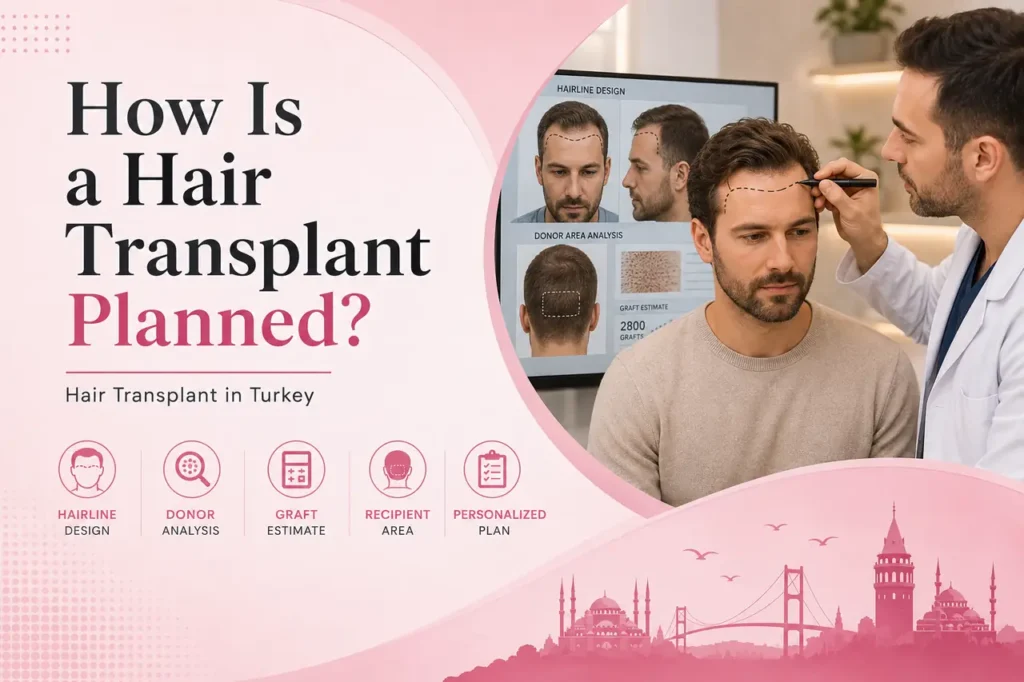
How Is a Hair Transplant Planned?
Packaging should start at least before the patient is in the operating room. Hair transplant surgery should only be proposed and donor grafts utilized if the diagnosis is made, if there is capacity in the donor area, if the expected donor hair loss is considered, if the hairline position is appropriately planned, and if the patient’s needs are prioritized.
Donor Area Evaluation
The donor area should be evaluated for density, miniaturization, scarring, hair thickness, and the quality of the follicles for long-term use.
A donor area that appears dense may not support an aggressive harvest. Long-term thinking should be utilized when planning for the long term.
Estimating Graft Numbers
The number of grafts necessary is based on the area to be covered and the minimal density that can reasonably be expected. The aim is not to create a completely filled opaque area.
The frontal hairline will receive a different distribution from the central scalp or crown because each contributes different elements to the overall appearance.
Hairline Design and Density Planning
A natural-looking hairline needs to consider the patient’s facial proportions as well as anticipated hair loss. Growth direction and angle also play a role.
A technically successful graft can result in an aesthetically unnatural hairline as a whole if the design is poor. The medical literature on recipient-site planning strongly supports the concept of irregular distribution, direction, and angle in order to provide a natural appearance.
What Happens on Hair Transplant Day?
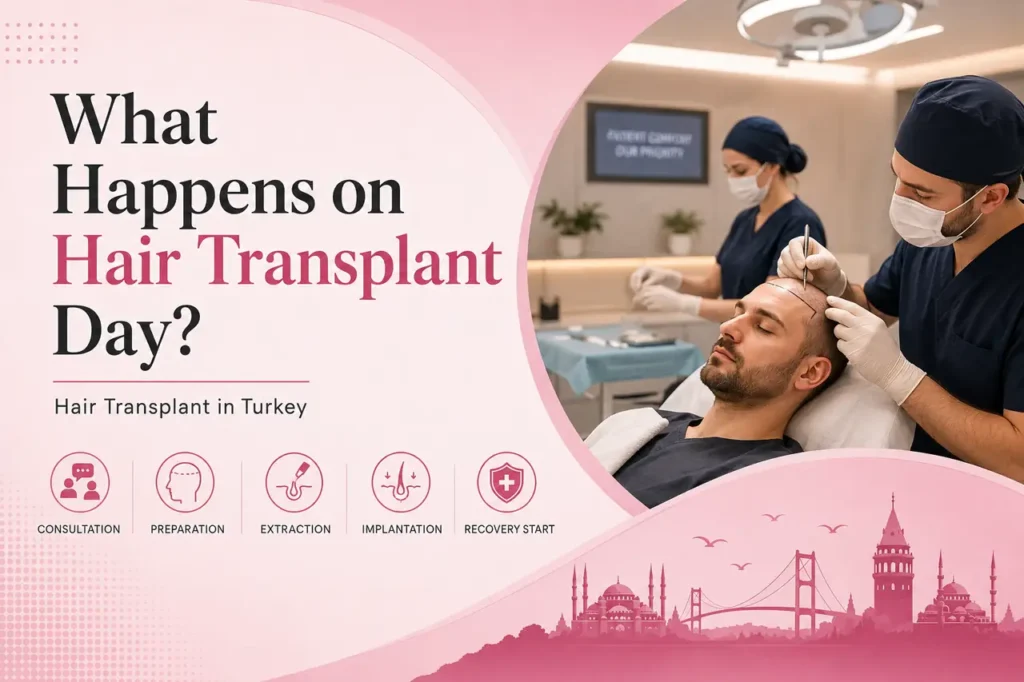
Consultation and Hair Analysis
Prior to surgery, the medical staff should confirm the diagnosis, donor plan, recipient plan, the number of grafts to be harvested, and the client’s medical history. Important changes to these areas should be explained to the client before the surgery begins.
The hair analysis should therefore connect the diagnosis, donor supply, recipient area and expected long-term hair growth.
Hairline and Graft Planning
The client’s hairline and the treatment areas are planned. The donor supply is placed in the areas based on the client’s long-term cosmetic goals.
Donor Harvesting
For FUE, follicular units are harvested by extracting them one by one with a small punch. The integrity of the harvested unit is maintained throughout the process, as breaks or damage can compromise the donor graft.
Recipient Site Preparation and Implantation
Recipient sites influence the direction and angle of the graft, and how the grafts are placed in the recipient site. Throughout the surgical process, the grafts are typically implanted using forceps or implanter devices.
Post-Procedure Care Instructions
Your post procedure instructions must include washing, sleeping, activity and medication instructions, as well as instructions for recognizing concerning symptoms and follow up care instructions. These instructions must be especially detailed the first few days post surgery because the scalp must heal and fully thank the grafted hairs in that time.
What Results Can You Expect After a Hair Transplant?
The results of hair transplantation take several weeks to develop. Immediately following surgery, one cannot expect to see the final result. In fact, surgery-related graft placement does not exclude a graft from undergoing the biological hair growth cycle.
Post-Transplant Hair Growth Cycle
Post surgery, patients can expect to see a loss of hair within days. This is a normal part of the hair growth cycle. Loss of hair does not equate to loss of the hair follicle.
The NHS (National Health Service) in the UK has stated that post surgery, transplanted hair will indeed fall out, but new growth can be expected within a few months.
The Early Stages of Hair Regrowth
Early growth should be expected to be thin, uneven, and sparse. As hairs mature, patients should expect to see a growth with increased density and is more even.
The first few months should not be used as a benchmark to assess the end results. Patients should not expect to see results that resemble photos prior to surgery. Advertised success rates should therefore not replace evaluation of the actual growth pattern and final result.
Hair Transplant Growth Timeline
The NHS also states that new growth can be expected to start post surgery at approximately four months, but don’t expect to see a completely normal head full of hair at this time. It will likely take at least sixteen months post surgery for significantly fuller results.
Because of this, hair transplant growth results should be expected to develop over the course of several months and not from sporadic inspections taken on the same day.
Hair Transplant Recovery: What Should Patients Expect?
First Days
Patients can expect some level of redness, tenderness and swelling in the first days after surgery. They will likely also receive instructions for their first few days after surgery. These will likely include guidelines on their sleeping position, gentle scalp care and the avoidance of transplant contact.
Scabs, Swelling and Shock Loss
Throughout the healing of the recipient area, small scabs will form around implanted follicles. It is also typical for hair transplant patients to see some level of hair loss around transplanted hairs as well as some shedding of surrounding native hairs.
Healing occurs long before the new hair growth, so early stages of the hair transplant recovery timeline should not be confused with the years long growth timeline. Aftercare during this period should follow the instructions provided for the individual procedure.
Returning to Work and Normal Activities
Some patients may be able to return to work in a week, while others may need two. The transplanted area should be treated with special care during the first two weeks and the NHS advises avoiding strenuous activity in this time.
Post-surgery recovery time may be longer for other activities including exercise based on a surgeon’s instructions.
Safety and Clinic Standards for Hair Transplant in Turkey
Hair transplant surgery is generally safe if proper planning and procedures are conducted. There are still potential complications, including scarring, chronic pain, swelling, nerve damage, an unsatisfactory result, and graft failure.
Treatment Risks and Side Effects
After healing, temporary swelling, crusting, and discomfort is to be expected and thus not considered a risk of treatment. These should not be confused with significant damage to the donor area, including infection.
Modern hair restoration surgery has a low complication rate in expert hands, and all complications must be explained to the patient due to the nature of most going under hair transplant surgery in turkey being elective.
Why Medical Supervision Matters
The experience of the surgeon matters most, not the marketing of a clinic. For example, the ISHRS highlights physician-driven hair restoration and encourages member surgeons to perform surgical extractions themselves.
The broader issue of hair transplant safety in Turkey should incorporate medical supervision, infection control, donor management, emergency planning, and adequate disclosure of the procedure participants.
Why Follow-Up Care Matters for International Patients
Follow-up care is much more complex when the patient and treatment team are in different places. The WHO reviews on continuity of care encourage communication and coordination of care between health care workers, while the CDC notes that medical tourists may need treatment in their home country if complications develop after returning.
A written follow-up plan should be an integral part of the treatment plan and decision, not merely an afterthought should a problem develop.
Choosing a Clinic and Medical Team in Turkey
Who Performs Each Phase of the Process?
Prior to booking, it is essential to know who performs the consultation, the harvesting of the donor area, recipient site preparation, graft insertion, anesthesia, and assessment of the patient post-procedure.
The provider has to be able to identify these people individually, not describe a “team” performing a procedure in a general manner.
How Should Before-and-After Photos Be Evaluated?
The best photographs are taken of patients who have similar hair-loss patterns, taken at a consistent angle, and with consistent length of hair.
Before and after photographs also need to be taken at an appropriate time so that the photos can be analyzed to determine the final results of the patient’s hair growth.
Donor-area photographs are also important. An attractive frontal result should not be considered successful if it was achieved by visibly overharvesting the back of the scalp.
Which Red Flags Should Patients Watch For?
There are many red flags patients should watch out for. They include a vague medical diagnosis, no clinician named as the responsible surgeon, unexpectedly high graft assurances prior to donor assessment, promised outcomes, a rush to make payments, evasive answers to concerns about complications, and no clear outline of a post-operative plan.
The Ministry of Health in Turkey provides a list of authorized health facilities and intermediaries for international health tourism to Private Healthcare Services. This should be a jumping-off point for patients to conduct their own research, as the FCDO advises against promoting trust in information provided by clinics.
When patients compare hair transplant clinics in Turkey, a careful clinic and surgeon selection process is a vital part of the medical decision, and not simply a review comparison and price comparison. Searches for the best hair transplant in Turkey or a top-rated hair transplant clinic should therefore lead to verification rather than assumptions.
Hair Transplant Considerations for Different Patients
Female Hair Transplant
Female hair loss can require a different approach to diagnosis, donor assessment and long-term planning. A female hair transplant in Turkey should therefore be considered in relation to the individual pattern of thinning hair and the available donor supply.
Afro and Black Hair Transplant
The characteristic curl of Afro hair adds a layer of complexity and aesthetics, as it is visible above the skin and the curved shape of the follicle beneath the skin. African-focused studies have illustrated the role of skin and follicular curvature in the difficulty and risk of transection during the FUE harvesting process.
Curl and hair caliber can provide significant visual coverage when grafts are adequately preserved and transplanted. Therefore, when planning an Afro hair transplant, emphasis should be placed on the donors’ characteristics rather than making general assumptions based on ethnicity.
Planning Your Hair Transplant Trip to Turkey
How Long Will Your Stay Be?
A hair transplant in most cases is a day surgery, however larger cases may require multiple surgeries. Adequate travel time should be scheduled to accommodate the pre-operative and post-operative assessment periods, as the surgery is often completed in a shorter time frame.
Hotel, Transfers and Clinic Visits
Although the process of scheduling accommodation and transfers is an important part of an overseas trip, the quality of medical care should be the only concern. Before and after surgery, patients must know the clinic visits that are required and the emergency contact options that are available.
Follow-Up After Traveling Home
Patients should be informed of the procedures for reviewing photographs, managing medications or addressing concerns related to their wounds, and what will happen if an in-person assessment is required after the patient travels home.
The CDC advises travelers to research the potential costs and the difficulty of follow-up care in their home country, especially if a complication occurs.
Comparing Turkey to USA or UK Treatments
Cost is one factor in the decision to travel for treatment, but there are others, for example, accessibility and involvement of surgeons, travel time, and follow-up care.
In the UK, it is the combination of factors that makes the comparison between a hair transplant in Turkey and the UK more practical than looking at treatment price alone.
Frequently Asked Questions About Hair Transplant in Turkey
How Long Does a Hair Transplant Take?
The duration of the surgery varies with each case based on the number of grafts required, harvest method, and implantation plan. It is typically completed in a day, although larger treatment areas may require multiple days.
Is a Hair Transplant Permanent?
Transplanted hair retains its characteristics, however, there is always the potential, as with natural hair, for the hair transplant to thin over the years.
How Does a Hair Transplant Feel Like?
Scalp numbing is done before hair transplant surgery using local anaesthesia and the patient may be given sedation. Despite the local anesthesia, a patient experiences aching, tightness and tenderness as the scalp heals post surgery.
What’s the Upper Limit for Hair Grafts in Transplant Surgery?
There is no upper limit. The number of grafts depends on how much hair is left for future hair loss, the patient’s donor area, the scalp, previous surgeries, the recipient area, the patient’s age and more.
Whether 5,000 grafts or another number is suitable should therefore be based on the individual donor area rather than a standard mega-session number.
How Long Before I Can Fly After Hair Transplant?
There isn’t a specific time answer, but travel is advised after the post-surgical review by the treating doctor and how extensive the surgery was. The CDC further advises that patients consider the risks of surgery and the risk of blood clotting especially after extensive surgical procedures.
For international patients, the least risk itinerary is one that allows for early post-op checks and has a direct route for accessing medical care when they reach their home country.