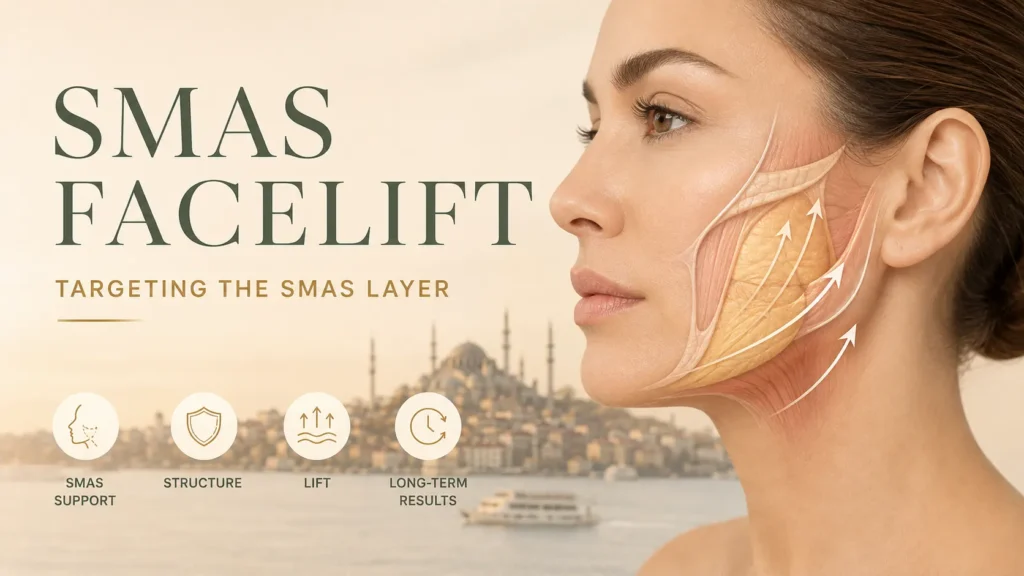
There are many ways a surgeon can perform SMAS facelift surgery because the procedure and technique will vary for each surgeon. The term SMAS (superficial musculoaponeurotic system) refers to an important layer of facial soft-tissue support.
Working on the deeper layers of facial support means operating beyond the skin and avoids the problems of relying on pulling and removing skin as the primary method of support. SMAS facelift techniques offer different methods of lifting and repositioning, tightening and reshaping the facial support.
Patients comparing facelift techniques more broadly can also review our main facelift in Turkey guide.
What Is a SMAS Facelift?
A SMAS facelift, sometimes written as SMAS face lift, in laymen’s terms, is a surgical method of support and tightening of the facial structures beyond the support and tightening afforded by the skin alone. The SMAS method varies by surgeon. Some surgeons fold or tighten the SMAS layer. Others resect and approximate part of the layer. Still others perform a SMAS method to create a SMAS flap.
Because of the variety and differences in methods, there is no universally standardized method or set of methods that define a SMAS facial lift.
SMAS Facelift Anatomy: What Is the SMAS Layer?
SMAS (superficial musculoaponeurotic system) is a layer comprising part of the facial support.
It is a key component of the facial soft tissue due to its fascial and fibromuscular qualities. Relative to the facial muscles, fat, and retaining ligaments, its behavior changes throughout the various facial regions. There are also numerous other layers which complicate its structure.
This is important when understanding the process of a facelift. A surgeon can’t just lift a muscle.
Due to the plasticity of the SMAS, support can be given to the overlying tissues. The method for doing this largely depends on the technique and the patient’s anatomy.
What Can a SMAS Facelift Correct?
A SMAS facelift is almost exclusively used for the lower face and certain aspects of the cheek, jawline and facial contours when dealing with the issues associated with aging such as:
- Jowls
- Loss of definition in the jawline
- Sagging of the soft facial tissues.
Some SMAS techniques provide more extensive tissue repositioning than others.
For example, a high SMAS facelift technique, as compared to a limited SMAS plication facelift, uses and treats tissues in a very different way, and should not be considered the same as a limited technique.
Sagging skin around the upper lids, forehead sags, or wrinkling of the skin may require additional procedures or treatments. A SMAS facelift will not remove all the signs of aging on its own.
Does a SMAS Facelift Include the Neck?
The face and neck are closely related, but the neck has its own separate structure and requires its own treatments, dependent on the specific patient. It is also untrue to assume that a SMAS facelift always incorporates a neck lift.
Who May Be a Suitable Candidate?
Age doesn’t fully determine candidacy for the SMAS facelift.
The amount and position of facial tissue descent, the quality of facial skin, the existence of jowls and the condition of the lower facial area have a greater correlation to candidacy.
In general, good health is essential; however, a facelift consultation will address your health history along with your medications, previous procedures, smoking history, and other factors that may hamper the healing process.
It is also essential that there is an understanding of what a SMAS facelift is designed to correct and what it is not intended to address.
Candidate selection should not be based on the name or type of facelift alone.
How Is a SMAS Facelift Performed?
The SMAS facelift procedure starts with preparation and choice of anesthesia followed by a surgical plan.
With the chosen form of anesthesia in place, the surgeon makes incisions and accesses the skin and the deeper supporting tissues of the face.
Depending on the choice of technique, the SMAS may be plicated (folded and secured with stitches) or a portion of the SMAS may be removed and the remaining SMAS tissue is re-approximated, or a SMAS flap may be fashioned.
After the deeper tissues have been addressed, the skin is redraped and, if necessary, excess skin is dissected away.
The purpose is not to allow skin to bear the primary burden of the lifting.
SMAS Facelift vs Deep Plane Facelift
For patients comparing SMAS vs deep plane facelift techniques, the comparison is helpful and, to a degree, the two methods should not be viewed as completely separate and unrelated techniques.
Both procedures involve deeper facial tissues and have some areas of overlap. The difference between deep plane and SMAS facelift techniques is mostly in the surgical plane and how much dissection is permitted in relation to the SMAS and retaining ligaments. With deep plane techniques, the dissection extends beneath the SMAS in certain areas, and with SMAS facelift techniques, there are multiple ways to handle the SMAS in the procedure.
Most current systematic reviews show excellent results with both techniques and consistently high satisfaction. The evidence does not show that every patient should receive a deep plane facelift versus a SMAS facelift. The appropriate comparison is therefore not “which is better?”
It is the technique most appropriate for the patient’s facial anatomy and which technique best fits the planned correction.
SMAS Facelift vs Mini Facelift
Comparing a SMAS facelift to a mini facelift is a comparison of two different aspects of a surgery. The SMAS of a facelift describes the tissue layer being lifted. A mini facelift implies that a more limited surgery is being done, which tends to be a surgery with shorter incisions or less dissection. A limited-incision facelift is possible with SMAS plication, and in this circumstance, a mini facelift and a SMAS facelift are not opposite procedures.
Where Are SMAS Facelift Incisions?
The incisions for a SMAS facelift are dependent on the amount of surgery being done. Typical facelift incisions encircle the ear and extend into the hair-bearing area. A more limited technique may use a shorter incision.
SMAS work is done beneath the skin, but that requires surgical incisions be made. Therefore, SMAS facelift scars are expected.
Their eventual appearance is a complication of many factors, including how and where incisions are placed, how tight the wound is, the way each individual heals, smoking, etc.
The placement of the proposed incision should be determined during consultation and not assumed because of the name of the SMAS technique.
More information about incision placement and healing is available in our guide to facelift scars.
What Is SMAS Facelift Recovery Like?
Recovery from a SMAS facelift consists of healing tissue, swelling and bruising.
There will be bandages on or around the face of the patient, and there may be temporary drains. The patient will be given instructions that will include the proper way to take care of the healing incisions, the medications to take, what activities are restricted, and when to return for follow-up.
Each patient has their own individual SMAS facelift recovery time.
Recovery will depend on the extent of the SMAS facelift and if there were any other procedures done at the same time.
Returning to work or social activities will be before the patient is completely healed. There may still be swelling, changes in sensation, and scar maturation.
The broader stages of healing are covered in our facelift recovery timeline.
What Are SMAS Facelift Risks and Complications?
Like other surgical procedures, all facelift procedures have recognized risks, and SMAS facelift complications may include bleeding, formation of a hematoma, infection, fluid build-up, poor wound healing, changes in sensation and nerve injury.
Complications may also include prolonged swelling, poor scar formation, loss of hair along incisions, and weakness of the facial muscles.
Different studies on various types of SMAS facelifts have shown different risks associated with the techniques, which shows how important the actual technique is, and not just the SMAS label.
That does not mean these complications are expected. Risk is largely dependent on the individual. It is affected by health, smoking, individual anatomy, previous procedures and the extent of the procedure.
More general facelift safety information is available in our guide to facelift risks and complications.
How Long Does a SMAS Facelift Last?
A SMAS facelift will not stop the aging process.
Tissue continues to change after surgery as we age.
More recent systematic reviews of different SMAS facelifts have noted such lifts can result in improvement that can be long-lasting; however, a permanent number of years cannot be ascribed to every lift.
There are many things that can affect the aging of the face after any given surgery, including: the quality of the skin, changes in weight, smoking, sun exposure and the original surgical plan.
Because of these variables, when a patient asks, how long does a SMAS facelift last, a better answer is a range of post-op outcomes, as there is no guarantee of permanent results.
When assessing facelift results through SMAS facelift before and after photos, the facial position, lighting, and timing should be comparable before drawing conclusions about the final results.
Final Thoughts
For facial rejuvenation, a SMAS lift is better understood as a family of techniques rather than a singular, fixed technique.
The SMAS can be one or many of the following: tightened, folded, reshaped, or elevated.
That is why the terms SMAS flap, SMAS plication, and high SMAS should not mean the same thing.
Although a high SMAS facelift may be appropriate for some patients, it should not automatically be considered a deep plane facelift or a mini facelift.
What really matters when considering a SMAS lift is: how will the sagging tissue be treated, what surgical plan does the plastic surgeon have, what level of improvement will be achieved, where will the incisions be made?
Medical Sources
- Evolution of Superficial Muscular Aponeurotic System Facelift Techniques: A Comprehensive Systematic Review of Complications and Outcomes — PubMed.
- Facelift Recovery — American Society of Plastic Surgeons.
- Facelift Risks and Safety — American Society of Plastic Surgeons.