
Facelift in Turkey
A facelift is a term that encompasses more than one single operation. Skin quality, degree and pattern of aging of the face, and the extent of tissue descent may result in completely different facelift techniques for different patients.
When one is contemplating facelift surgery in Turkey, there are other practical concerns beyond what type of facelift. Cost, type of anesthesia, recovery time, amount of time required for follow-up, and how long one needs to remain in the country are all things one needs to consider prior to making arrangements for treatment.
Therefore, the most important thing that needs to be considered during an initial consultation is the surgical plan for the face.
What Is a Facelift?
A facelift, also known as a rhytidectomy, is a surgery performed to address aging concerns by improving the position of tissue in the face and cheeks, and creating a more refined lower face and jawline.
Facelifts are performed by repositioning, adjusting, and sculpting the deeper and outer layers of facial tissue and then redraping and removing excess skin. The tissues that are being improved and the planned surgical technique determine the order of the steps.
As a form of facial rejuvenation, facelifts are distinct from surface skin improvement procedures. Facelifts are not thread lifts, dermal fillers, or other non-surgical cosmetic procedures. While these may help improve the face, the same tissue elevation and repositioning are not achieved and they may instead be complementary to facelift surgery.
A facelift ultimately doesn’t change the face’s ability to age. As time passes after surgery, the skin, the underlying fat, the muscles, and the remaining tissues will continue to age.
What Can a Facelift Correct?
A facelift is often thought of as a way to remove excess sagging skin. However, there are many other facial changes that can be corrected.
Some of these changes include sagging cheeks, jowls, loss of jawline definition, and changes to the soft tissues of the face. As time passes, other people may notice deeper nasolabial folds and lines around the mouth that develop as the mid-face ages.
Different techniques can bring about different levels of improvement to these changes.
A facelift also has its limits. For example, aging eyelids, the forehead, nose, and skin surface may require other more appropriate treatments. Eyelid surgery, brow lift, rhinoplasty and skin procedures address concerns that a facelift itself is not designed to correct.
Who May Be a Good Candidate?
There is no set age that defines when a facelift is appropriate.
Again, take for example two people that are the same age. One person may have sagging skin while the other person has a tight face with no jowls. Examples like this are seen all over the place.
A facelift should also be considered if the person has appropriate overall health and no active medical concerns that may interfere with surgery or healing.
Importantly, nicotine disrupts proper healing. Patients must also have realistic expectations. Facelifts can improve facial contours but can’t stop the effects of time on the face.
The consultation is the first point where an overview of health, medications, supplements, and prior surgeries is most important.
There are also differences in planning for male patients. Hairline position, beard growth, facial anatomy and scar placement may need additional consideration, which is discussed separately in our guide to facelift for men.
Facelift Cost in Turkey
There is not an even price for all facelifts in Turkey.
Patients comparing face lift cost in Turkey should first understand which operation the quote actually refers to.
Feasible surgeries meant for lesser skin laxity can’t have the same price as comprehensive full facelift surgeries that may require more dissection, other surgeries, and more time. That is why the cost should go with the complexity of the surgery and not the other way around.
A quote may involve the surgeon fees, anesthesia, the operating facility and post-operative care, but that should not be assumed for every quote.
This cost also becomes important for international patients because the cost of surgery is also the cost of the trip. Hotel, flights, extra long stays in Turkey and more unforeseen post-operative visits should be accounted for.
This is why an online price should not be seen as the final price until the patient arrives in Turkey and the surgery and preparation have been approved by the medical team.
What Affects the Cost of a Facelift?
What type of facelift can also be a huge factor.
A mini facelift generally involves a different surgical extent than that of a full facelift. Also, a SMAS-based procedure and a deep plane facelift involve different approaches to the deeper facial tissues.
The type of facility where the surgery takes place, as well as the type of anesthesia used, the duration of the surgery, whether multiple surgeries are performed at the same time, and the required duration of postoperative care, can all affect pricing.
Surgeon experience can impact pricing as well.
Rather than simply comparing facelift prices, the better method of comparison involves understanding and analyzing the details of the proposed surgery. It is possible that two different clinics may describe the same surgery, a facelift, but may mean two significantly different surgical procedures.
Patients often ask, “how much is a facelift in Turkey?” The answer depends first on which operation is actually being proposed.

What May Be Included in a Facelift Package?
When evaluating international treatment packages, there is a lot of variability.
Some packages cover only the surgery, while others may also include a hospital stay when this forms part of the treatment plan. Other all-inclusive packages may cover lodging, airport transfers, transportation between the hotel and clinic, translation assistance, medications and postoperative check-ups.
It is important for patients to get a written breakdown.
An important consideration is not whether a package is called an “all-inclusive package,” but the details of the package and what it may exclude.
It is important to find out what patients may be expected to pay if the patient needs to be in Turkey for an unexpected longer duration. Coverage for extra nights in a hotel, extra medications, and extra medical care may not be included in the price.
Some providers also advertise VIP transfers and additional services. These can make travel easier, but they should remain secondary to the surgical plan and medical care.
Why Do International Patients Consider Turkey?
Turkey has an established medical tourism system. International health tourism services are regulated through requirements for healthcare facilities and intermediary organizations serving patients who travel from abroad.
Patients researching face lifting in Turkey may compare surgeons, facilities, travel considerations and the overall cost of the procedure.
That does not equate to all clinics or surgeons being the same.
An international patient must continue due diligence to research who the actual surgeon is, where the procedure is being done, what the aftercare entails, and whether the surgical facility has the appropriate authorization and accreditation for the services being provided.
Taking just the cost of the procedure into consideration is not good practice.
Types of Facelift
The term “facelift” encompasses multiple techniques. Some of the terms describe the different areas of the face, some describe the different planes of the tissues, and some describe the techniques employed by the surgeon.
Due to the imprecision of some of these terms, the patient should be more concerned about what the actual plan is for the surgery, rather than just the name of the surgery.
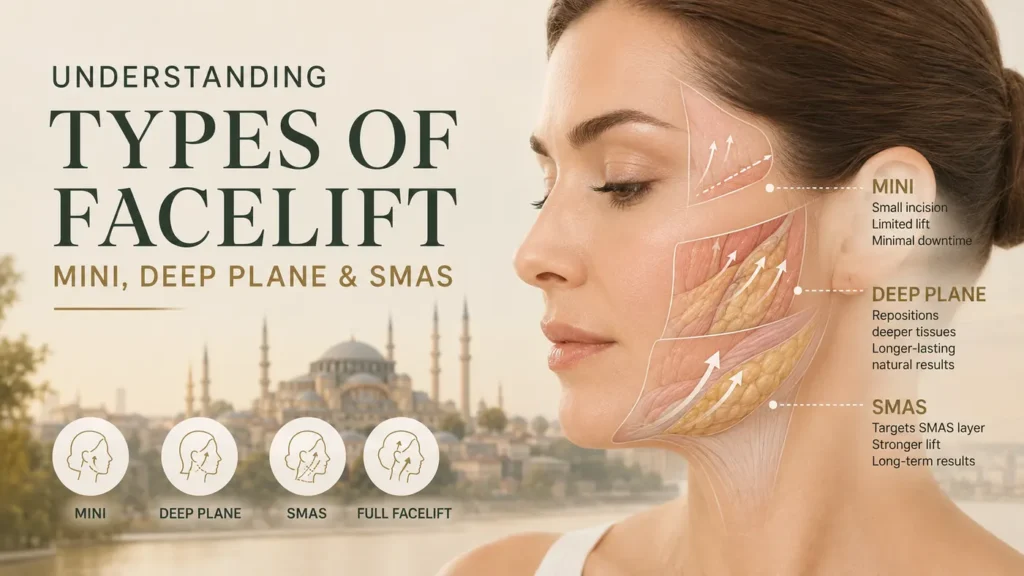
Mini Facelift
A mini facelift is intended for patients who present with less facial laxity.
With a mini facelift, the surgeon may make shorter incisions and perform shorter dissection compared to a traditional facelift. This technique is also appropriate when the laxity is primarily around the lower portion of the face, and lower face sagging is not significant.
The mini facelift is limited in the amount of correction it can provide. If a patient has more tissue descent, a mini facelift will be unlikely to achieve the expected results.
Deep Plane Facelift
A deep plane facelift allows the surgeon to address deeper tissues because the surgeon works below the superficial muscular and fascial layers of the face.
This deep plane technique is especially relevant when addressing changes involving the mid and lower face and jowls.
The technique has garnered significant interest, but it cannot be assumed to be better for all patients. Current systematic reviews show that both deep plane and SMAS facelift techniques can provide strong outcomes, while reported satisfaction and complication profiles vary between studies. The appropriate technique depends on the patient’s facial anatomy and the surgical approach.
SMAS Facelift
SMAS (superficial musculoaponeurotic system) is a layer of tissue involved in many facelift techniques.
SMAS facelift techniques create deeper support by repositioning or adjusting this layer along with the overlying tissues.
There is more than one way to manipulate this layer, which is why “SMAS facelift” does not denote one identical surgical procedure.
The specific SMAS technique used may also influence the surgical plan and complication profile, so there can be variation between SMAS facelift procedures.
Lower Facelift
As the name implies, a lower facelift deals mainly with the lower third of the face.
The main concerns in this part of the face usually relate to jowls and the contours of the cheek and jawline.
A lower facelift is not synonymous with a neck lift. Though they are both surgeries that deal with adjacent anatomic areas, a neck lift is a separate element of the overall plan.
Midface Lift
A midface lift deals with the central cheek and mid-face regions, and is appropriate when midface descent is a primary concern rather than tissue laxity around the jaw.
There are different techniques that can be utilized, including selected endoscopic approaches.
Given the anatomical connectivity between the mid-facial region, lower eyelids, and cheeks, a higher degree of customization is required for each patient for surgical planning in this region.
Full Facelift
The term “full facelift” is a more generalized term, lacking a single, widely accepted definition.
Unlike “mini” or limited facelifts, a full facelift generally refers to a more extensive procedure and may encompass the lower face, cheeks, and associated deeper structures.
Patients are encouraged to ask surgeons what specific areas and structures will be addressed. Additionally, surgeons should clarify if the neck is included in the procedure. The term “full facelift” alone will not adequately describe the procedure being proposed.
How Is Facelift Surgery Performed?
As with any other surgical procedure, the first step involves the application of anesthesia and markings placed on the skin to indicate the planned incision.
In traditional facelift procedures, an incision that varies with the surgical technique may start at the hairline in the temples, continue around the ear, and end in the lower scalp.
The surgeon then begins the work of lifting and repositioning the underlying structures and overlying skin to the desired position. Skin is redraped to the new position and skin tension alone is not relied on for the lift. Any excess is removed and the incision is closed with sutures or another appropriate closure method.
Unlike traditional facelifts, which can require a substantially longer incision, limited facelift techniques may use shorter incisions.
Even with the generic name “facelift,” the actual procedures may vary significantly from patient to patient.
General vs Local Anesthesia
When it comes to planning anesthesia, multiple factors come into play — the extent of the surgery, preferences of the surgeon and facility, and the health of the patient.
Intravenous sedation and general anesthesia are both used for facelift surgery. Local anesthesia may also form part of the anesthetic plan in selected procedures, depending on the extent of treatment and how the operation is being performed.
Patients are discouraged from limiting facelift techniques only to techniques that avoid general anesthesia. The better question should be, what is the appropriate anesthesia plan for the facelift technique that needs to be implemented?
The surgical team should evaluate any previous problems with anesthesia, as well as taking a medical history and reviewing medications and relevant medical conditions.
Facelift Recovery Overview
Patients should be informed that recovery is not over once the bruising fades.
During the initial recovery phase, patients can experience swelling and bruising, a feeling of tightness, and alteration of the normal sensations of their skin. There may be dressings around the face, and in some cases, there may even be temporary drains.
Post-operative instructions may also include head elevation, and some patients may be advised to keep the head elevated while resting during the early recovery period.
The surgical team should provide detailed instructions regarding dressing changes, medications, follow-up appointments and restrictions on physical and daily activities.
While many patients become more presentable within the early weeks, the tissues continue to heal and settle in their new position. Texture, sensation and tightness can continue changing for two to three months.
Return to work also varies according to the surgical technique, the extent of the procedure and the individual recovery process.
Patients who travel out of town for surgery should be informed that there are different milestones of recovery for being able to leave the hotel, being able to fly, and being fully recovered. A more detailed breakdown is available in our facelift recovery timeline and aftercare guide.

Where Are Facelift Incisions and Scars?
Incisions are a must for facelift surgery, which results in scarring.
Where these occur is dependent on the method. Typical incisions are near the hairline. These can then run along the contours of the ear before extending toward the scalp.
Some limited techniques use fewer or shorter incisions.
When possible, the surgeon plans the incision in locations that can make visible scarring less noticeable as healing progresses. However, a shorter or carefully positioned incision does not mean that a scar will completely disappear.
The healing process of a scar is one factor of many that will impact its appearance. Other factors include the tension on the wound, smoking, infection, and the patient’s tendency to form excessive scarring.
The placement of the incision should be disclosed during the consultation; patients should not have to rely on guessing where the scars will be. Our article on facelift scars and incision locations covers this in more detail.
What Are the Risks of Facelift Surgery?
Like other surgical procedures, facelift surgery has potential risks and complications.
These can include bleeding, hematoma, infection, and the accumulation of fluid. Other risks include altered skin sensation, slow healing, unfavorable scarring, prolonged swelling, hair loss around incisions, and issues related to anesthesia. There is also a risk of facial nerve injury or weakness, and some patients may require revision surgery.
Hematoma remains one of the most frequently discussed complications in rhytidectomy research, and studies continue to examine methods that may reduce this risk.
The list of complications does not describe what the outcome will be for every patient.
Risk can be influenced by a patient’s health, smoking, medications, surgical history, the extent of the procedure and the method used.
Instead of asking “is a facelift safe?” the more pertinent question would be “what are the risks of this facelift for this patient?” These issues are discussed separately in our guide, Is Facelift Safe? Risks and Complications.
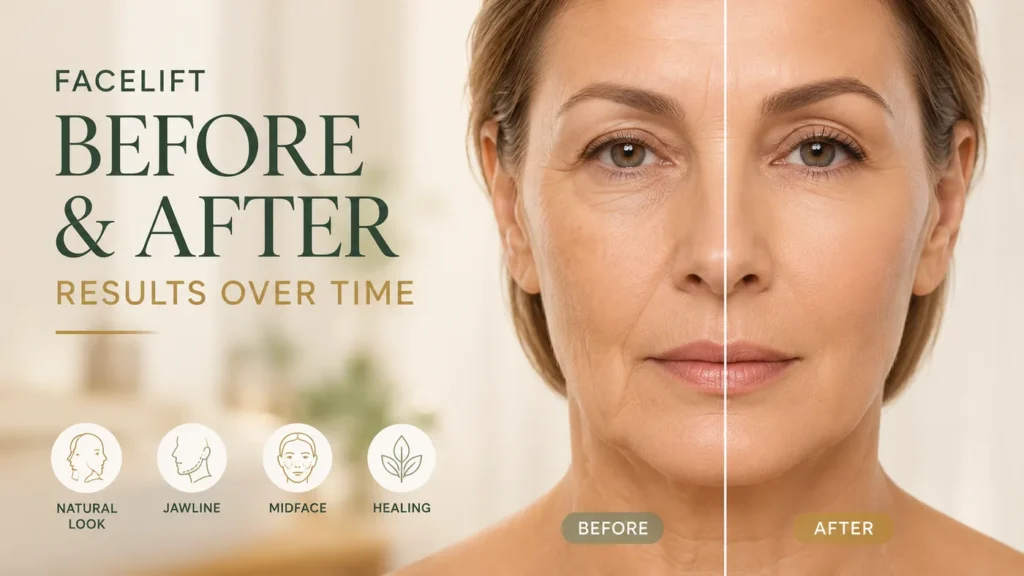
Facelift Before and After Results
Before and after photos are beneficial when attempting to visualize the expected results of a facelift. However, these photos should be critically analyzed rather than blindly accepted.
Before-and-after photos are easier to compare when the lighting, posed facial position and camera distance are similar. Additionally, the time that elapsed between surgery and the after photo needs to be considered.
The post-surgical photos that are taken earliest may still capture facial swelling and immature scars rather than the final result.
The best way to assess facelift results is to analyze the balance of the facial features and the positions and contours of the cheeks, jowls and jawline rather than simply looking for a “tighter” appearance of the overall face.
It is likely that the results from other patients will be different from the patient being analyzed. Each patient has different skin types, levels of skin elasticity, facial anatomy and healing characteristics that will impact the overall results.
Real patient images can help establish realistic expectations, but they cannot promise the same outcome for another person. Our facelift before and after results guide explains how photos can be assessed throughout the healing timeline.
Can a Facelift Be Combined With Other Procedures?
If multiple surgical procedures are performed together, patients should understand why the procedures are being combined.
A facelift does not directly improve the surface quality of the skin or restore every type of facial volume loss. Because of this, other procedures or treatments may be considered when skin quality or volume loss is also a concern.
A brow lift, eyelid surgery, fat grafting, fat transfer or selected volume-restoring treatments may be considered alongside facelift surgery when there is a separate reason to treat those areas.
The face and neck are closely connected anatomically. Aging under the jawline may therefore lead to consideration of a neck lift along with a facelift, but it should not be presumed that all facelifts include a neck lift.
A facelift with a neck lift is not automatically a better option.
Facelifts may be individually planned, but combining procedures may affect anesthesia, the recovery period, and risk.
How Long Can Facelift Results Last?
Facelifts do not have an expiration date.
The face continues to age after surgery, so its appearance will continue changing with time even after facial tissues have been repositioned.
How the face looks years down the line may be affected by the skin’s quality and other factors such as smoking, weight changes, sun exposure and the original surgical plan.
Sun protection and a generally healthy lifestyle may help support long-term skin quality, but aging will continue.
Specific years as an exact lifespan for a facelift should be approached with caution, as longevity is better discussed as an expected range rather than a guarantee.
How to Choose a Facelift Surgeon
Facelift surgery is one area where there is a great deal of subjective judgment by the surgeon. For this reason, the patient should find out how often the surgeon performs facelift surgery, which techniques he or she employs, and the reason for the different approaches when more than one is available.
Experienced surgeons may use different approaches depending on facial anatomy, but the reason for recommending a specific technique should be understandable to the patient.
The patient should also find out where the surgery will be performed, who will provide anesthesia, and how complications will be handled. Then, and not until then, should the patient rely on before-and-after photographs.
Patients should ask about the surgeon’s specialist qualifications, surgical training, hospital or facility credentials, the proposed technique, and complication management. The surgical setting should also be appropriately licensed and accredited for the services being provided.
Patients may also see references to accredited hospitals. They should verify what accreditation, licensing or authorization actually applies to the facility where surgery will take place.
If patients are considering traveling for surgery, they should ensure the facility has the appropriate authorization to provide services related to international health tourism.
We cover these points in more detail in our guide on how to choose a facelift surgeon.
Planning a Facelift Consultation From Abroad
The first step may include an online consultation. However, the submission of photos has its limitations.
Surgeons often request multiple views, as well as medical history and details about medications, smoking, and other surgeries.
Patients should inquire about the duration of their stay for the procedure as well as the schedule and location of postoperative follow-ups and check-ups.
Patients should prioritize the medical plan over the travel plan to ensure that the procedure is not performed under unnecessary time constraints.
Turkey regulates international health tourism services and requires appropriate authorization for healthcare facilities and intermediary organizations operating within this area. The arrangements for post-operative care, however, still need to be confirmed with the individual provider.
The surgeon may also adjust the proposed plan following the in-person assessment. This is especially true when determining the degree of tissue laxity or deciding whether a limited facelift is adequate.

Final Thoughts
When considering a facelift in Turkey, the surgery should be the first focus.
The key issues are which parts of the anatomy require surgical intervention; which techniques are appropriate for which parts of the face; the locations of surgical incisions; and the realistic expectations of the recovery period.
The terms mini, SMAS, deep plane, lower, or midface surgery are not just alternative names for the same procedure. Each of these terms represents a different approach or area of surgical intervention, and the same procedure will not be appropriate for all patients.
In the case of international patients, cost and travel packages are important, but only after the details of the surgical intervention have been established.
After a consultation, the patient should have an understanding of realistic expectations of the improvement that may be made. Additionally, they should have an understanding of the associated recovery, limitations, scars, and risks.
Medical Sources
- Facelift Surgery (Rhytidectomy) — American Society of Plastic Surgeons.
- Facelift (Rhytidectomy): What It Is, Recovery & What to Expect — Cleveland Clinic.
- The Deep Plane versus SMAS Facelift: A Systematic Review and Meta-Analysis — PubMed.
- A Systematic Review of Rhytidectomy Complications and Prevention Methods: Evaluating the Trends — PubMed.
- Prevention of Hematoma in Patients Undergoing Facelift (Rhytidectomy): A Systematic Review and Meta-Analysis — PubMed.
- Facelift — Johns Hopkins Medicine.
- Health Tourism Department — Republic of Türkiye Ministry of Health.