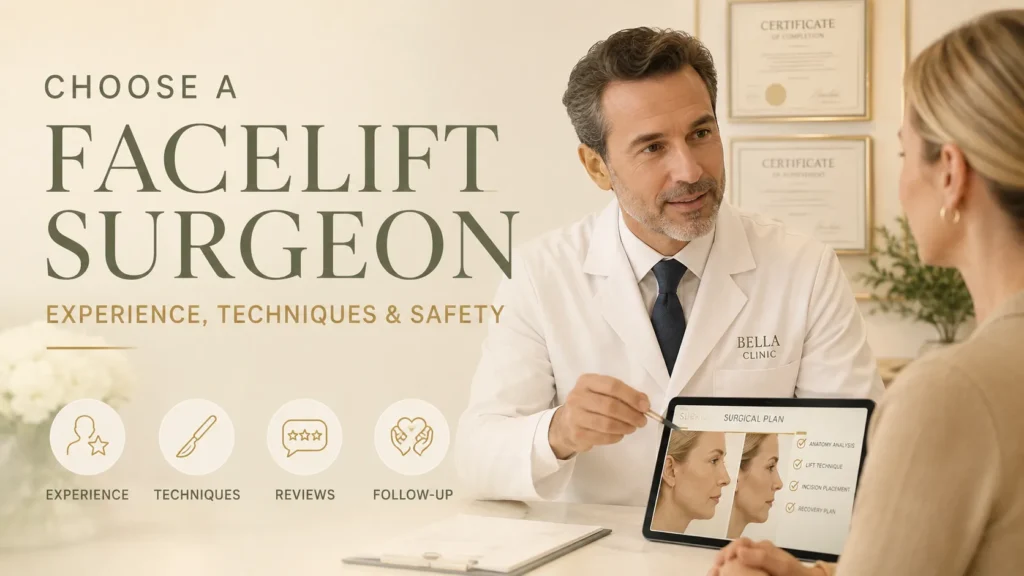
Selecting a surgeon for your facelift is arguably the most important step in the facelift process.
A facelift doesn’t just mean removing loose skin. Different surgeons take different approaches, work at different levels, and have different levels of experience.
When considering how to choose a facelift surgeon, credentials are critical, but they are just part of the bigger picture. Experience with facelift surgery, and how a surgeon plans, the quality of the surgical results, the surgical facility, complication management, and the quality of the surgeon’s aftercare are all important considerations.
The goal should be to choose a surgeon who is appropriate to perform the surgery and develop a plan that is appropriate for the patient rather than endlessly looking for the surgeon who claims to be the best.
Start With the Surgeon’s Facelift Experience
A surgeon may be very experienced in plastic surgery, but if they don’t perform facelifts the same way or with the same frequency as other surgeons, that makes a difference.
To understand how to choose a plastic surgeon for facelift surgery, don’t just ask about broad experience with cosmetic surgery, but rather more specific experiences with facelift surgery.
Examples of possible questions include:
- How many facelift surgeries do you perform on average?
- How many years of experience do you have performing facelifts?
- Do you have specialization in any specific types of facelift?
- Do you treat patients with problems like mine fairly often?
- What is your specialized education for facial plastic surgery?
- How is your licensure verified?
You should also check professional credentials and board certification through the recognized medical board or regulator. There is no need to trust a clinic website.
In the United States, the American Society of Plastic Surgeons recommends that patients choose a board certified plastic surgeon, and their members perform surgery in accredited, licensed, or Medicare-approved facilities.
The title alone is not an accurate answer for everything. A surgeon may have extensive training, but their actual experience with facelift surgery still needs to be considered.
Experienced surgeons can have different practices. Specialization in facelift procedures still applies.
Ask Which Facelift Techniques They Perform
Not every facelift is performed the same way.
There are several different methods of facelifts that can incorporate the SMAS, deeper facial tissues, limited-incision methods, and other surgical techniques. For different levels of aging of the face and the different areas of concern, the appropriate technique will vary.
A surgeon who implements multiple techniques should also be able to justify why one method is preferred over the others.
For example, if a surgeon tells you that you need a deep plane facelift, ask what other methods were considered and what led to the decision that a deep plane method is the most appropriate choice for your case.
You can ask:
- What surgical technique do you use?
- Why is it appropriate for my face?
- Which tissues do you reposition?
- Which areas does it treat?
- Are there other options to achieve my aesthetic goals?
- What are the constraints of the approach?
There are no universal answers to questions such as “what is the best facelift” or “what is the best facelift technique.”
Trying to choose the best facelift based only on the name of a technique can therefore be misleading. Facelift surgery is not a one size fits all procedure.
Suggested techniques are not always the most recent or advanced techniques, but rather are most appropriate based on the patient’s anatomy and goals.
Who Will Actually Perform the Surgery?
Patients are also entitled to know the answer to this question.
There is a significant possibility that the doctor performing the consultation is not the surgeon who will operate.
Ask who will perform the actual surgical procedure, who will assist, who will administer anesthesia, and who will make the decisions regarding the post operative management.
It is very important to know this when there are multiple facial plastic surgeons or cosmetic surgeons within a given practice or when the practice has a dedicated clinical team for consultations.
The person performing the discussion on the surgical process must ensure that the doctor who will perform the surgery is identified.
Avoiding assumptions on who will perform the surgery is possible when patients are informed of who is actually present in the operating room.
Check the Surgical Facility
It is equally important to verify the surgical facility.
The surgeon is only one of the many participants in the surgical process.
Patients should address where the facelift is to be performed and determine if the operating facility is legally licensed and accredited.
It is expected that properly accredited surgical facilities and hospitals implement systems that ensure the safety of anesthesia, infection control, and emergency patient care.
The American Society of Plastic Surgeons expects its members to use accredited, state-licensed or Medicare-certified surgical facilities.
Other parameters of accreditation of surgical facilities include anesthesia, surgery, informed consent, patient identification, safety of medications, and emergency services.
Questions to ask include:
- Where will the surgery be done?
- Is accreditation or licensure from the appropriate organization in place?
- Who will be administering the anesthesia?
- What will be done in the case of a medical emergency?
- What emergency practices and equipment will be made available?
The answers should be as objective as possible prior to the scheduling of the surgery.
How Should You Assess Before-and-After Photos?
Before-and-after photographs can give an insight into a surgeon’s work, but should only be assessed to a certain extent.
It is wise to look for real patient examples that contain facial features pertinent to your facial characteristics.
Focus on the details of the photographs rather than the overall transformation.
Consider the jaw, cheek and neck transitions, scars, and the balance of the face. These photographs can also help you understand the surgeon’s aesthetic approach and whether it matches what you consider a natural result.
Consistency and excellent results across multiple relevant cases should be favored over a single impressive image.
Ask if:
- The images are of the same surgeon’s patients.
- The surgeon performed all of the procedures shown.
- The images were taken under similar circumstance.
- The patients underwent other plastic surgery procedures in addition to the one being shown.
- The images show different healing stages.
Expectations for after a procedure should not be unrealistic based on “before and after” photos.
Our facelift before and after guide shows how healing and results photographs should be analyzed.
Ask About Complication Management
Interviewing a physician means inquiring about more than just results.
Ask how the surgery team plans for complications.
It is not an indication that something will go wrong for a surgeon to describe complications. Surgical procedures are not without potential problems, and complications should always be consideration in the planning process.
Examples of questions are:
- What do you discuss with patients having a facelift?
- What happens if a hematoma occurs?
- What are the plans for the healing of an open wound?
- What happens if there are unanticipated changes in sensation?
- Who should a patient contact if concerns develop?
- Where does treatment occur if it is needed?
A surgeon should define which symptoms relate to expected healing and normal and which symptoms require an evaluation.
Our separate guide on facelift safety and complications covers these issues and risks in detail, so it is not necessary to do so again.
The focus of this discussion is to determine how an individual plans for an unexpected event, not to find one that guarantees that complications will not happen.
Understand the Follow-Up Plan
Consider your care to be part of the surgery; it will continue after the surgery is completed.
Ask what measures are taken to facilitate healing, and what the plan is for the follow-up.
The plan includes checking incisions, changing dressings, taking out stitches, examining the swelling and bruising, as well as monitoring the healing process and the outcome of the surgery.
You also need to know:
- When the first follow-up will happen.
- How many follow-ups will there be.
- Who will be doing the follow-up.
- How to reach the surgical team.
- What happens out of office hours.
- How issues are dealt with in between the follow-ups.
It helps to know how long the surgeon follows the patient after surgery.
Recovery in the early stages is different to the final outcome. Swelling, the settling of tissue, and the formation of scars continue to change for months after surgery before a more long lasting result can be assessed.
Our facelift recovery guide has detailed information about the healing and post-op care process.
Look at Patient Reviews With Context
Patient reviews are more instructive when selecting a surgeon, but should not be the only determinant.
Patient reviews should provide information like communication, organization, and how the surgeon follows up with and overall interacts with patients.
Online reviews, however, have many shortfalls.
A review does not give the whole picture of a surgeon’s history, complications, or how every patient turned out. It can also be hard to confirm if every review is from a real patient.
This is especially true for selecting a facelift surgeon and when trying to find the best plastic surgeon for facelift surgery.
The one with the most reviews isn’t necessarily the best for your surgery. Look for trends instead.
Comments made consistently concerning follow-up and communication can provide more value than singular reviews that are highly positive or negative.
Reviews should complement your research and should not serve as a substitute for verifying credentials, assessing surgical experience, and/or confirming a one-on-one consultation.
What Should Be Discussed During Consultation?
Ideally, a consultation would allow both the patient and the surgeon to decide if the surgery is warranted.
The patient should also feel comfortable asking questions about the procedure, expected results, limitations and recovery.
The surgeon should evaluate the patient, rather than photoface or give a recommendation based on a requested technique.
Comments may concern:
- Concerns about the facial area and its anatomy
- The patient’s medical history
- Prior history of surgery or trauma to the facial skeleton
- Use of supplements, herbs, and/or medications
- The patient’s use of tobacco or nicotine
- Expected outcome
- Which types of facelifts or techniques are applicable
- Photography
- Anticipated anesthesia and analgesia
- Post-operative recovery
- Complications
- Expected post-operative restrictions
- The necessity of post-operative care
This is the point when the patient will understand his/her reasonable expectations and discuss personal aesthetic goals.
A facelift will provide a positive effect on the signs of aging of the face; however, during a responsible consultation, negative outcomes (i.e. failure to predict or provide a guarantee) of the surgery will be explained to the patient.
Questions International Patients Should Ask
When the patient lives a great distance from the surgeon, it is prudent to take the continuity of care into account as well as the surgery.
Distance will affect consultations and follow-up care after returning home.
Concern should be focused on the ability to continue care and on the outcome of surgery.
The following questions are designed to help gauge the practicality of the follow-up system for a patient who is unlikely to remain near the surgeon during recovery.
- Can I have my case assessed prior to travel?
- When will an in-person assessment be arranged?
- How long must I remain nearby the surgical facility?
- When will I be due for a post-operative assessment?
- Who is responsible for my post-operative care?
- How will I be able to contact the surgical team after I have been away?
- What will happen if there is a post-operative complication?
- Will there be medical records available for further assessments if I am seen by other physicians?
- When will it be safe for me to travel normally again?
Travel arrangements should be made based on medical advice rather than the assumption that surgery and travel will be able to be scheduled at the same time.
Final Thoughts
It is not as simple as searching for names and comparing online reviews when selecting a facelift surgeon.
Start with the qualifications, board certification, and facelift-specific experience. Then consider the surgical techniques and aftercare, the surgical facility, the management of complications, and before-and-after results.
When selecting a facial plastic surgeon, focus on how well the provider explains the proposed procedure and the alternatives.
A good consultation is one in which the patient understands the reasoning behind the recommendation.
The same outcome is expected when inquiring how do I choose a facial plastic surgeon. Experience and aftercare are just as important as the surgical process, credentials, and communication.
There is no one surgeon who qualifies as the best facelift surgeon for every patient.
A more important question is if a surgeon possesses the right qualifications to perform a facelift, coupled with the necessary experience and if their surgical approach aligns with your anatomy, overall health, and sets an appropriate expectation.
Medical Sources
- American Society of Plastic Surgeons – Choosing a Plastic Surgeon for a Facelift. Description of what patients should consider when determining a surgeon’s credentials with emphasis on board specialty and surgical center accreditation.
- American Board of Plastic Surgery – Verify Certification. Website to validate board certification.
- American Academy of Facial Plastic and Reconstructive Surgery. Provides information on specialized fellowship training for plastic surgery of the face and evaluation of board certification.
- The Joint Commission – Ambulatory Surgery Center Accreditation. Standards and accreditation pertinent to outpatient surgical facilities.