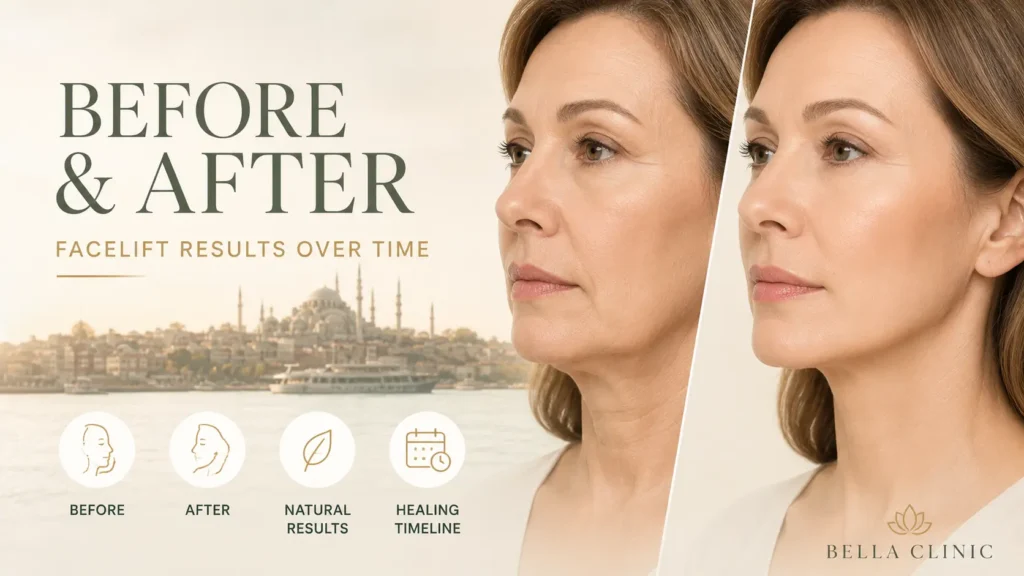
Facelift before and after photos can be very helpful, but only when they are viewed in the right context. A photograph taken a few days after surgery will not show the same stage of healing as a photograph taken several months later. This is why patients should not judge the final result too early.
People also need to remember that facelift surgery is not one single operation performed the same way for everyone. Different facelift procedures may focus on different parts of the face and neck, and the outcome depends on the anatomy, the facelift technique, and the scope of the surgical procedure.
For that reason, before-and-after photos should be used as a guide, not as a promise. They can show what may be possible with lift surgery, but they cannot guarantee that another patient will heal the same way.
What Changes After a Facelift?
After facelift surgery, the most common visible changes are related to the lower face, jawline, cheeks, and sometimes the neck. Depending on the plan, the surgeon may improve jowls, redefine the jawline, and reposition loose tissues that have descended over time.
The skin on the face is usually redraped after the deeper layers are addressed, but skin tightening alone is not the main goal of a modern facelift. The deeper support structures are often more important than the facial skin itself when it comes to longer-lasting improvement.
Some patients also undergo additional procedures including a neck lift, brow lift, or eyelid surgery. In those cases, before-and-after changes will reflect more than one cosmetic procedure.
What Should Before Photos Show?
A good set of before photos should show the concerns clearly. That may include jowls, loose skin, changes in the cheeks, or fullness under the chin and jawline. If the neck is part of the concern, the neck should also be visible.
Lighting, expression, and head position matter a great deal. If the patient smiles in one photo and not the other, or if the camera angle changes, the result may look better or worse than it really is. This is why plastic surgeons and clinics should use consistent photography when showing facelift before and after cases.
Before photos should also reflect the real starting point. The more accurately the problem is shown at the beginning, the more meaningful the comparison will be later.
What Can Results Look Like Immediately After Surgery?
Immediately after facelift surgery, patients should expect healing signs rather than polished results. Swelling and bruising are common. Dressings may still be in place, and in some cases small drains may have been used.
The face may look tight or uneven in the early stage. That does not mean the operation failed. It simply means the tissues are still reacting to the surgical procedure. Bruising, puffiness, and temporary numbness are common in the early days after surgery.
If the operation included a neck component, there may also be cuts under the chin or around the ears, depending on the surgical plan. These early findings are part of recovery and not the final aesthetic outcome.
The First Two Weeks
The first two weeks are still considered an early healing period. During this stage, swelling and bruising may still be visible, and the face may not yet look natural to the patient. One side may also appear to heal a little faster than the other.
Most people who look at facelift before and after photos should understand that results shown only a few days after surgery are still incomplete. The tissues have not settled, and the facial contours are still changing.
In many cases, patients feel more presentable socially during the second week, but that is not the same as reaching the final result. The face often continues to improve well beyond the first several days after surgery.
Weeks 3 to 6
Between weeks 3 and 6, many patients notice that the face starts to look more like itself again. Much of the obvious bruising may be gone, although some residual swelling can remain. Tightness and altered sensation may still be present as well.
This period often gives a better idea of the direction of healing, but it still does not represent the end point. Facial skin, soft tissue settling, and scar maturation all continue beyond this stage.
Patients may return to more regular routines during this period, but recovery time varies from one person to another and also depends on whether other facelift procedures were performed at the same time.
The Following Months
In the following months, the tissues continue to soften and settle. The jawline may appear more defined, the cheeks may look more supported, and the face may appear less puffy than it did in the earlier stage.
This is usually when the final result becomes easier to judge. Even then, subtle improvement may still continue for some time. Scar lines often continue to mature, and sensation may gradually normalize.
When evaluating facelift before and after recovery photos, the timing matters. A six-week result and a six-month result should not be treated as the same stage of healing.
When Is a Facelift Result More Mature?
A facelift result is more mature once the major swelling has resolved and the tissues have had time to settle. That point is not exactly the same for every patient, but it usually takes longer than many people expect.
The final result should not be judged during the first few days after surgery. A more realistic assessment is made later, when the facial contours are more stable and healing signs are less noticeable.
Even after a good outcome, the ageing process still continues. A facelift can improve facial aging, but it does not stop time. This is true whether the patient had a limited facelift, a face and neck lift, or a more extensive cosmetic surgery plan.
How Should Before-and-After Photos Be Compared?
Before-and-after photos should be compared carefully and fairly. The most useful comparisons follow the same standards:
- Similar lighting
- Similar camera angle
- Similar head position
- Similar facial expression
- Similar framing
- A clear timeline showing when the after photo was taken
It is also important to compare patients with similar concerns. Someone looking at facelift before and after jowls cases should focus on examples with similar jowling and tissue descent, not only the most dramatic transformation.
If a patient had procedures including eyelid surgery or a brow lift, the viewer should know that. Otherwise, the facelift alone may get credit for changes that actually came from another procedure.
Can You Evaluate Scars From Photos?
Photos can give some information about scars, but only to a degree. Scar appearance depends on incision placement, tension, skin quality, healing tendency, and the time elapsed since surgery.
A standard photo taken from a distance may not show incision quality clearly. Hair, shadows, and image resolution can all hide or exaggerate scar visibility. This is especially true when a neck procedure or cuts under the chin are involved.
So yes, photos may help, but they are limited. Scars should not be judged from one general image alone.
Mini Facelift Before and After
Mini facelift before and after photos should be evaluated within the limits of that procedure. A mini facelift usually focuses on more limited concerns, often in the lower face. It does not necessarily produce the same change as a larger facelift surgery plan.
That is why mini facelift before and after results should not be compared directly to a much broader operation unless the viewer understands the difference in scope.
Lower Facelift Before and After
Lower facelift before and after photos are often most useful for evaluating jowls and the jawline. These cases may show how repositioning loose tissues can improve the lower face and restore a cleaner contour.
However, the viewer should still ask whether the neck was treated as well. A lower facelift and a face and neck lift are not always the same thing, and that difference can affect the visible result.
Midface Lift Before and After
Midface lift before and after cases focus more on the cheek region and the area below the eyes than on the jawline. The goal is different, so the result should be judged differently as well.
These photos may be relevant for patients concerned with cheek descent, flattening of the mid face, or changes around the nasolabial fold area. They are not the best example for someone mainly concerned with jowls.
Do Photos Guarantee Your Result?
No. Before-and-after photos do not guarantee an individual outcome. They can show what happened in other patients, but every person heals differently.
Plastic surgery outcomes depend on anatomy, tissue quality, the extent of the surgery, healing response, and the experience of the surgeon. This is why before-and-after photos are helpful, but not predictive in an absolute sense.
They should help set expectations, not create certainty.
Can Photos Show Whether Surgery Was Safe?
Not fully. A good photo does not prove that surgery was simple, and an early swollen photo does not prove that something went wrong. Safety cannot be judged from appearance alone.
Every surgical procedure has risks and complications. These may include bleeding, infection, delayed healing, fluid collection, nerve-related issues, and in some cases more serious problems such as a blood clot. A patient should discuss these points directly with the surgeon instead of relying on photos alone.
Photos can show aesthetic change, but they cannot fully show surgical safety, the quality of medical monitoring, or how the patient felt during recovery time.
Final Thoughts
Facelift before and after photography is most useful when it is honest, standardized, and tied to a clear healing timeline. The best comparisons show what changed, how long healing took, and what kind of facelift technique was used.
Patients should pay attention to timing, lighting, expression, and procedure type. They should also remember that the final result takes time and that early healing photos can be misleading.
Whether the surgery was a mini facelift, lower facelift, midface lift, or a broader facelift surgery plan, the most reliable way to judge outcomes is to combine photos with a proper medical explanation from qualified plastic surgeons.