
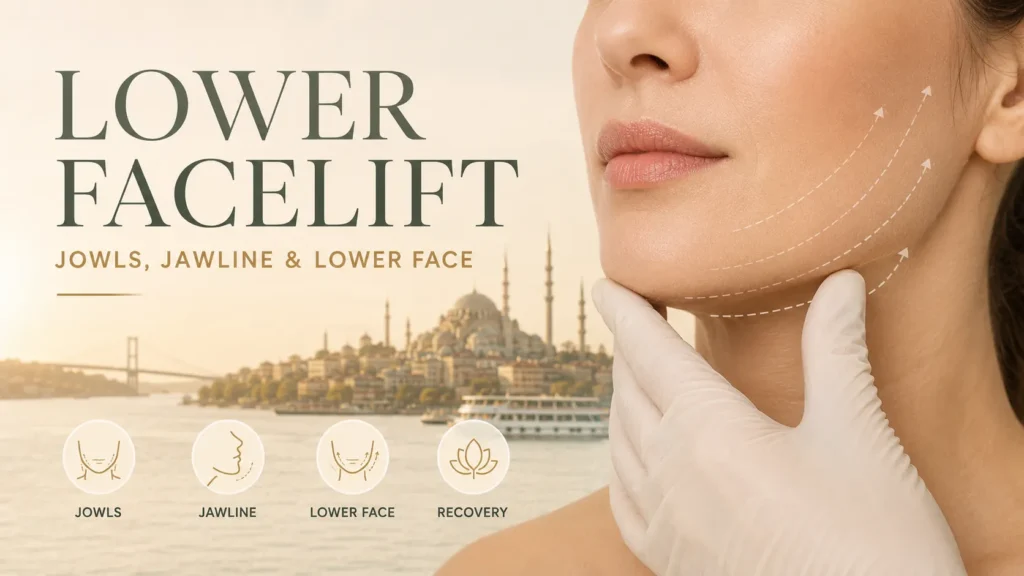
A lower facelift concentrates on the changes of aging in the lower face. Typically, the concerns of this region are loose tissue around the jaw, the appearance of jowls and the loss of a well defined jawline.
While the name “lower facelift” may be commonly used, it is in fact a flexible, customizable surgery and may include a greater amount of tissue and even part of the upper neck.
For these reasons, the interpretation of “lower facelift” by the surgeon is a greater indicator of the surgery than the name alone.
Patients comparing facelift surgery more broadly can also review our main facelift in Turkey guide.
What Is a Lower Facelift?
Lower facelifts are surgeries that focus on the lower part of the face, or the jowls and jaw in particular. There is less emphasis placed on the upper face.
For someone asking what is a lower facelift, the procedure is mainly intended to address aging changes concentrated around the lower facial area rather than every region of the face.
Facelifts, in general, may target sagging along the cheeks and lower jaw, but the surgery is thoroughly personalized, so a lower facelift procedure may require different sagging tissue techniques and deeper repair work along the face and neck.
With respect to lower facelifts, a surgeon’s terminology does not necessarily signal their choice of the type of facelift they will perform.
What Areas Does a Lower Facelift Treat?
Most lower facelift surgery targets the jaw, the lower cheeks, and the jowls.
Some key considerations may include:
- Descent of tissue toward the jaw
- Jowls on the lower face
- Less defined jawline
- Loose skin, sagging skin and skin laxity of the lower face
- Transition of facial skin into upper neck skin
A lower facelift is not designed to address each aspect of the visible effect of facial aging. Issues higher up, like the eyes and forehead, would require a different assessment.
The jawline can also be affected by chin position and the rest of the facial structure. The contours of the lower face depend on more than the appearance of jowls alone.
Can a Lower Facelift Improve Jowls?
A lower facelift for jowls is one of the most common indications for this surgery.
Jowls are a result of the soft tissues on the lower boundaries of the face descending. This, in turn, can give the jawline a less continuous appearance in comparison to its previous state.
People searching for face lift jowls are usually trying to understand whether lifting the lower face can improve this break in the jawline.
With the various factors that affect the appearance of jowls, a lower facelift can improve them, but not always the same way for everyone.
The amount of improvement can depend on deeper tissue descent, loose skin, excess fat and the structure of the jaw itself.
How Can a Lower Facelift Affect the Jawline?
The lower face and jawline are closely connected to the way the lower face ages.
Tissues that descend downwards can blur the chin-jaw angle. A lower face lift for the jawline can address this problem by repositioning the descending tissues.
This can give the lower face a more defined contour in cases of mainly tissue laxity.
This procedure, however, cannot modify the jawbone.
Therefore, patients who have a small or retruded chin, a localized fat pad, or other structural concerns may require a different or additional approach.
We do not aim to elongate the chin or any other part of the jaw in this case. The aim of this procedure is to deal with the symptoms of the tissues descending while preserving the facial anatomy.
Who May Be a Suitable Candidate?
There is not a specific age alone that determines a need for a lower facelift.
A more important consideration is where the signs of aging are most noticeable.
Jowling and laxity of the lower face are different from extensive changes of the cheeks, the lower face, and the neck.
There is also the health of the patient to consider because a lower facelift is a surgical procedure. As with other forms of cosmetic surgery, the patient needs to be in good general health and have a realistic expectation of the outcome.
Smoking and certain medical conditions may create problems for healing and surgical planning.
The patient needs to fully understand that treatment within the lower face is only appropriate when it fits the anatomy in the lower face.
Lower Facelift vs Full Facelift
More comprehensive or complete facelifts can address larger areas and may involve more extensive dissection and incision patterns.
That doesn’t make a full facelift better.
For someone whose main concern is their jowls, they may not need the same surgery as someone who is exhibiting signs of facial aging beyond their lower face.
The same applies in reverse. If aging extends beyond the lower face, a more limited surgery may not satisfy a patient’s additional concerns.
The lower facelift vs full facelift decision therefore depends more on the areas that require correction than the name of either operation.
Lower Facelift vs Mini Facelift
Comparing lower facelifts and mini facelifts can be a frustrating exercise because of the confusion caused by the terms.
In the case of a lower facelift, it is the area being treated. In a mini facelift, the focus is usually on a more conservative surgical approach.
In some cases, the term mini facelift may describe a surgical approach that also focuses on the lower face.
This means that neither a lower facelift nor a mini facelift is synonymous with a full or complete surgical approach.
When considering lower facelift vs mini facelift, what matters is what the surgeon plans to address through the incisions, what they plan to dissect, and what they plan to reposition.
Lower Facelift vs Neck Lift
The differentiation between lower facelifts and neck lifts is important.
Lower facelifts focus on the lower face, while neck lifts focus on aging changes of the neck and the area below the jaw.
Because the face and neck are closely related, a lower facelift and neck lift may be performed in conjunction.
Even when they are performed in conjunction, they are not the same surgery.
Does a lower facelift include the neck? Not necessarily.
If neck laxity is a concern of the patient, it should be clarified whether the neck is included in the procedure and whether a separate neck lift is recommended.
Where Are Lower Facelift Incisions?
Where the lower facelift incisions are placed is directly related to the goals and the technique used.
Facelift incisions typically follow the ear and can extend into scalp-hair regions.
Limited surgeries can utilize shorter incisions.
The lower facelift terminology does not dictate where the incisions will be.
Depending on the surgical plan, repositioning deeper tissues can also leave excess skin that may be removed during the procedure.
Of course, every surgical incision results in a scar.
The appearance of lower facelift scars will vary. Healing, incision location, and tension of the scar are a few of the many factors that will affect scarring.
Patients must know the location of the incisions before the surgery. More information about healing is available in our guide to facelift scars.
What Is Lower Facelift Recovery Like?
During lower facelift recovery, there will be swelling and bruising, which is normal with healing.
There may be numbness or temporary changes in sensation.
There are usually dressings used after surgery and in some cases temporary drains are used. The recovery instructions will focus on caring for the incision and limiting activity with scheduled appointments.
The extent of the lower facelift will affect the lower facelift recovery time.
There are likely differences in recovery for a limited surgery compared to a lower facelift combined with a neck lift or other facial surgeries.
Being able to work does not mean that one is fully recovered.
Bruising and swelling may remain during the early healing period, while more subtle healing may take longer.
Our separate facelift recovery timeline covers the stages of healing in more detail.
How Much Does a Lower Facelift Cost?
A lower facelift is a blanket term for several types of lower face surgical interventions and therefore doesn’t have a specific price.
Knowing the cost of lower face lift surgery requires determining what is included with the quoted procedure.
The lower face lift cost can vary due to the type and extent of surgery, surgeon fees, geographic location, anesthesia and surgical facility costs.
The price can also vary depending on whether a neck lift is included in the surgical plan.
Patients asking how much a lower facelift costs should compare what is actually being performed rather than the name of the procedure alone.
This page should not duplicate country-specific commercial pricing. Turkey-specific pricing and treatment information is covered in our main facelift in Turkey guide.
How Should Lower Face Lift Before and After Results Be Evaluated?
Lower face lift before and after photographs are helpful when context is provided.
The most helpful examples are patients with similar levels of jowling or tissue descent.
The lighting should be consistent.
The angle of the camera with respect to the subject can influence how the jawline is presented.
The final result of a lower facelift should not be evaluated until much of the swelling has subsided.
Before-and-after photographs can help evaluate the type of change that is possible. They cannot dictate the outcome of a procedure for a different patient.
Final Thoughts
The primary concern of a lower facelift is the jowls, lower cheeks and jaw.
One can’t always know the detail and extent of the planned surgery by the name given to the procedure.
Not all lower facelifts are performed the same way. Some may require deeper forms of tissue lifting and tightening, while others may involve an element of a neck lift.
For that reason, comparisons like lower facelift vs mini facelift, lower facelift vs full facelift, and lower facelift vs neck lift depend on the actual discussed surgical plan.
A patient is much better served knowing exactly what tissues will be moved, where the incisions will be, the involvement of the neck, how the recovery will be, etc.
There is always the hope of long-lasting lower facelift results, but surgery does nothing to stop the normal continuing aging process.
With facial rejuvenation, the goal is not simply to choose the smallest or largest procedure. It is to choose a procedure that reasonably matches the anatomy being treated.
Medical Sources
- Facelift (Rhytidectomy): Procedure and Recovery — Cleveland Clinic.
- Facelift — American Society of Plastic Surgeons.
- Jawline Refinement in Face Lifting — PubMed.