
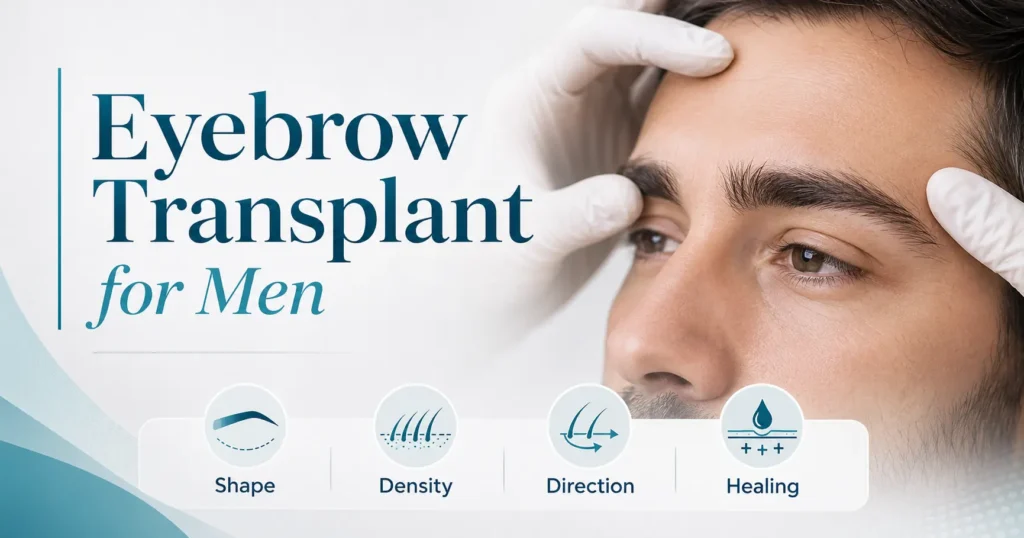
eyebrow transplant for men
There are some common causes of eyebrow loss amongst men and women, but they can have different treatment goals when it comes to eyebrow reconstruction.
An eyebrow transplant for men should be designed around the dimensions of the patient’s face, their existing eyebrow hair and the underlying brow structure.
Why Do Men Consider Eyebrow Transplants?
Some men are born with sparse eyebrows and some develop gaps caused by injury, scarring or hair loss.
Gaps can occur in a small segment of the eyebrow or in the entire eyebrow.
The cause of hair loss should be identified before the team plans permanent hair restoration. Medical conditions or active alopecia may also need to be assessed before a transplant procedure is considered.
Eyebrow Shapes Are Different for Every Man
Fuller and straighter eyebrows are common amongst men, but this should not become a rigid design.
The existing eyebrow hair, the position of the eyes and the shape of the face are more important than a preset eyebrow shape.
The shape should be agreed upon by the patient and the medical team before the individual hair follicles are inserted.
A natural appearance depends on how the brow fits the face rather than simply making it wider or darker.
More Density Does Not Always Mean a Better Brow
A common request is to have as full of a brow as possible, but this can backfire.
A full brow is not always the goal and overly dense brows can look unnatural. Different areas of the brow may need different levels of density.
Natural results depend on the number of grafts, the direction of the hairs and how much eyebrow hair is already present.
Where Does the Donor Hair Come From?
Donor hair is taken primarily from a donor site on the patient’s scalp.
Thickness, texture, curl and color are considered when the follicles are selected.
To help keep the eyebrow outline soft, single-hair grafts can be used in selected areas.
The donor area also needs enough suitable hair for the planned restoration.
Do Men Need More Eyebrow Grafts?
Not necessarily.
This depends on how large the brows are, how many hairs are already there and how much restoration needs to be done.
A fuller frame may change the design plan, but a person’s gender does not dictate the graft number.
Our guide on how many grafts are needed for an eyebrow transplant has more detail on why graft numbers vary among patients.
Hair Direction Is Easy to Notice
Thicker brows will not cover up poorly placed grafts.
If the hairs are placed too far away from the skin, the brows may appear unnatural even if there is a lot of hair there.
The hair angle is important from the start of the brow to the tail.
This is one reason individual hair follicles need careful placement during eyebrow hair transplantation.
FUE vs DHI for Men
For men, both FUE and DHI are likely to be promoted for brow restoration.
Men should not make a choice based upon the misconception that one technique is for men and one is for women.
Follicular Unit Extraction, or FUE, describes the removal of individual follicular units from the donor area. DHI is generally used to describe an implantation approach.
Our FUE vs DHI eyebrow transplant article goes over the two techniques for extraction and placement.
What Happens During the Eyebrow Transplant Procedure?
The details depend on the treatment plan, but the procedure involves selecting donor hair, preparing the grafts and placing them into the planned eyebrow area.
Local anesthesia is commonly used during hair transplantation, while the medical team works with the agreed eyebrow shape and graft plan.
The procedure is surgical, even when the treatment area is small, so realistic expectations about healing and hair growth are important.
What Happens After the Procedure?
The first stages of the healing process may include redness and swelling, along with small scabs around the transplanted hairs.
Some hairs may fall out and then start to grow back later as new hair growth develops.
Hairs that are taken from the scalp may grow longer than normal brow hairs, so they may need regular trimming.
Post-operative care also includes following the clinic’s instructions and avoiding strenuous activities until the medical team says they can be resumed.
The stages are explained in more detail in our eyebrow transplant recovery guide.
Can You Get a Hair Transplant in an Eyebrow Scar?
It may be possible to transplant hair into some stable scars.
The medical team will need to take a closer look before deciding whether the scar is suitable.
The team will also need to consider how hairs may grow through scar tissue, as this can differ from transplantation into unaffected skin.
Published clinical studies have also examined FUE eyebrow restoration in patients with cicatricial eyebrow loss caused by trauma and burns. :contentReference[oaicite:1]{index=1}
What Does a Natural Result Look Like?
A natural result is not simply a brow with more hair.
The transplanted hairs should sit close to the skin and follow the changing direction of the natural eyebrow. The inner brow, body and tail do not all grow at exactly the same angle.
The eyebrow should also make sense with the rest of the face. A shape that looks natural on one man may look too wide, too straight or too dense on another.
Our eyebrow transplant before and after timeline explains what to look for as transplanted hairs develop over the following months.
Choosing an Experienced Surgeon and Medical Team
Experience with scalp hair transplantation does not automatically mean the same team has equal experience with eyebrows.
Ask who designs the brow, who extracts the grafts and who controls their placement. The angle and direction of individual hairs are easy to notice on the face.
An experienced surgeon or hair restoration team should also be able to explain the limits of the procedure and give you realistic expectations rather than promising the same result for every patient.
Our guide to choosing an eyebrow transplant clinic in Turkey covers the questions worth asking before treatment.
What Should Men Discuss During a Consultation?
A consultation is a good time to discuss why the eyebrow became thin, what shape you want and how much donor hair is available.
You can also ask about the expected number of grafts, the donor site, the technique being used and the recovery period.
Tell the medical team about medical conditions, previous facial procedures and any treatment that may have affected eyebrow hair.
The aim of the consultation is not to choose the fullest possible brow. It is to agree on a plan that suits your existing hair, facial features and expectations.
Eyebrow Transplant for Men in Turkey
Men seeking treatment abroad should consider the same things that any patient considering an eyebrow transplant would: medical involvement, eyebrow-specific experience, donor management and follow-up.
Our main eyebrow transplant in Turkey page covers travel, eyebrow transplant cost and the wider treatment process.
What If the Concern Is a Low Brow Rather Than a Thin Brow?
An eyebrow transplant only adds hair to the eyebrow.
If the concern is a low or sagging brow, then a brow lift addresses a different issue because it changes the position of the brow and forehead tissues.
Final Thoughts
Eyebrow transplantation for men should not be based on an idea of a standard men’s brow, but rather on the patient’s individual anatomy.
More important than deciding how wide or thick an eyebrow should be is the selection of suitable donor hair, realistic density and careful direction of the transplanted hairs.
Realistic expectations also matter. Hair transplantation can restore hair to selected areas, but the result still depends on donor hair, graft placement, healing and the original cause of eyebrow loss.
Medical Sources
- Clinical Outcomes and Technical Tips for Eyebrow Restoration Using Single-Follicular-Unit Hair Transplantation — Journal of Cosmetic Dermatology.
- Clinical Effects of Fine Follicular Unit Extraction and Transplantation in Repairing Cicatricial Eyebrow Defects — clinical study including male and female patients with eyebrow defects.
- Head and Neck Restoration in Scar Alopecia: Hair Transplantation in Scalp, Eyebrows, Beard and Mustache — World Journal of Plastic Surgery.