
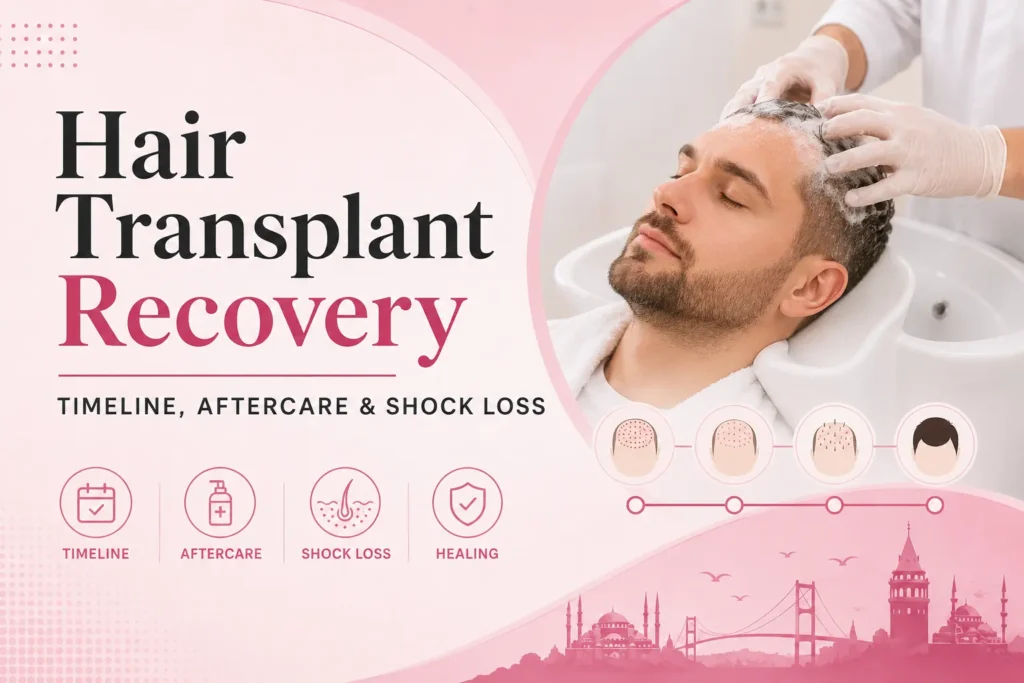
Hair transplant recovery is a multi phase process. The scalp undergoes rapid transformation in the first few days, while the transplanted follicles begin their process, undergoing trauma, healing and shedding, and finally growth in the weeks and months to come.
The most critical part of the early recovery process is protecting the grafts as it is in the healing phase and the donor and recipient areas are still traumatized and undergoing changes.
The healing process involves both the transplanted area and the donor area, although they may look and feel different during the same stage of the recovery timeline.
The NHS states that it is of utmost importance for the patient to be aware and gentle with the hair, as it is in the most vulnerable stage, the first 2 weeks. During this time, and in the first weeks of recovery, mild swelling, discomfort, and the formation of scabs is part of the process.
The recovery time will be impacted by the size of the area operated, the type and method of hair transplant used, how well the patient heals, and the aftercare and post-operative instructions given by the surgical team. Different recovery experiences will be observed in donor areas of FUE, DHI, and FUT, compared to the recipient area. The ISHRS also states that post-operative care and restrictions differ from one surgeon to the other, and therefore the specific instructions must be followed before using general online guides.
These aftercare instructions are intended to protect the transplanted hairs, support graft survival, and allow both the donor and recipient areas to recover.
Hair transplant aftercare therefore covers more than the first few days. The complete hair transplant recovery process includes wound healing, scab formation, shedding, shock loss, donor area healing and the gradual return to normal activities.
What Is the Hair Transplant Recovery Timeline?
When looking at hair transplant recovery, a timeline can be segmented into different phases. In the first few days, mild to moderate swelling, soreness and redness are observed, and small scabs form in the transplant area. The scalp must be protected from trauma (rubbing, scratching, and other forms of attack).
The hair transplant recovery timeline can also be viewed day by day during the first week and then week by week as the surface of the scalp heals.
A week-by-week timeline is useful because wound healing, shedding and the later hair growth cycle do not happen at the same time.
Over the first one to two weeks, surface wounds heal and scabs go away. The NHS advises that the first two weeks are crucial for graft care and that patients may be advised to take one to two weeks off work.
In the weeks that follow, it is normal for some of the transplanted hairs to fall out, and the surrounding hairs may fall out due to shock loss.
Some transplanted follicles enter a resting phase before new hair growth becomes visible.
Scabs will fall away from the scalp before the hair transplant before-and-after result becomes clear. It may take months for the transplanted hairs to become visible.
For this reason, hair transplant healing time and hair transplant recovery time should not be confused with the time required for new hair growth.
The hair transplant timeline therefore contains both an early surgical recovery period and a much longer hair growth cycle.
Hair Transplant Recovery: Days 1 to 3
The first few days after the transplant require the most caution.
The grafts will be in the recipient area, and the donor area will contain small extraction sites or an incision.
During this time, the scalp may feel tight and sore, and scabs will begin to form.
Some patients may be given prescribed pain medication or other postoperative care instructions by their medical team during this early stage.
It is most important to let the wounds in the transplant area begin the healing process, even if the scalp doesn’t look normal.
Hair transplant recovery photos during these first few days mainly document the early healing stages rather than the final cosmetic result.
Swelling and Redness
During the early stages of healing, the scalp may become red and swollen.
A recent study of the complications of modern hair transplantation found that swelling of the frontal area and crusting of the recipient sites are common, although their frequency varies among the studies.
Mild swelling isn’t a cause for concern on its own. However, it’s best to check for other concerning symptoms if swelling is accompanied with more redness, increasing pain, odd discharge, fever, or any other symptoms that you wouldn’t normally expect.
Hair transplant recovery swelling should therefore be considered together with the other symptoms and the instructions provided by the treating medical team.
Appearance of Donor and Recipient Areas
The donor and recipient areas will look different post surgery. The donor area will have many small punch sites after an FUE hair transplant. Tiny visible scabs will appear for 1-2 weeks and will clear on their own. The short hairs in the recipient area will have small crusts surrounding them. In the early stages, the appearance may lead you to conclude the density of the recipient area or the survival of the grafts, but this is not the case. The first days post surgery will show healing of the wounds, not the final cosmetic outcome of the hair transplant.
The appearance of each hair shaft above the scalp does not show what is happening to the transplanted follicle beneath the skin.
This is also why hair transplant recovery pictures taken immediately after surgery cannot be used to judge graft survival or hair density.
The planned number of grafts can also affect the size of the treated donor and recipient areas, but the graft count alone does not determine how quickly an individual patient will heal.
Sleeping Position
The main purpose of post operative sleeping protocols is to avoid any accidental contact with the graft area and to control swelling in some protocols. There is no universal sleeping schedule for hair transplants. It is most important that the patient follows the position suggested by the surgical team for the first few days, as the rubbing of the recipient area by the pillow will disturb the grafts. For the first two weeks the NHS recommends that you avoid any pressure or friction against the hair.
Some postoperative protocols recommend sleeping with your head elevated during the early recovery period, particularly while swelling is present.
The exact period for keeping the head elevated should still follow the treating team’s instructions.
Hair Transplant Recovery: Days 4 to 10
Post days 4 to 10, the scalp will begin to look less like an immediate post surgery patient, but healing will still continue.
As small surface wounds dry, scabs become more visible. Wound healing may also lead to itching, though scratching the area may lead to additional trauma.
These days represent another part of the hair transplant healing stages, even when the scalp begins to look less obviously surgical.
Scab Formation
Scabs are a normal part of the healing process after hair transplantation.
The ISHRS indicates that small scabs can form in the FUE donor and recipient areas and can last between 1-2 weeks.
A messy appearance of scabs on the scalp is not an excuse to remove scabs.
Postoperative guidance indicates that scabs should only be removed when the body is ready to let them fall away.
If there are any concerns, such as a thick scab that remains after the normal course of healing, the scabs should be evaluated by the medical team.
Washing the Scalp
The importance of washing the scalp after a hair transplant is emphasized, though the washing must be gentle.
The NHS reports that washing the scalp can generally begin after the 6th day, though it can vary based on the surgeon’s protocol.
The published evidence of FUE complications also speaks to the necessity to manage crusting on the 1st few postoperative days.
Thus, if a day has passed, patients are not encouraged to wash their scalp aggressively, but to follow the protocols set out by their surgical team.
Gentle washing and the correct hair washing technique are therefore important parts of postoperative care.
Hair products should not automatically be returned to normal use until the surgical team says they are appropriate for the healing scalp.
Hair washing is therefore an important part of hair transplant aftercare rather than simply a cosmetic step.
Protecting the Grafts
The transplanted area is still vulnerable, so special care must be taken in this stage.
The NHS reports that the grafts are not secure in the first 2 weeks post surgery.
A lightly touching the scalp will not cause a graft to be lost, but it should not be taken as meaning that lightly touching the grafts is safe.
It does mean that avoiding excessive rubbing, scratching, picking, etc. is important.
Protecting the newly transplanted hair during this period is intended to reduce avoidable trauma while the transplanted follicles settle into the recipient area.
Patients wanting to know the time frame for when hair transplant grafts are secure should use their surgeon’s postoperative clearance, rather than relying on the internet as supposed permission to begin handling the recipient area.
What Happens During Weeks 2 to 4?
During the second to fourth week time period, things can be frustrating for the patient as, while the scalp begins to heal, the transplanted hairs begin to rapidly disappear.
This is the time when patients go from worrying about the wounds to worrying about the normal shedding.
Week by week hair transplant recovery may therefore look less dramatic from a wound-healing perspective while becoming more noticeable from a shedding perspective.
The shedding phase is part of the broader hair growth cycle and should not automatically be interpreted as failure of the transplant.
Scab Shedding
The crusts that form on the skin surface begin to separate as the healing process continues.
The ISHRS states that FUE scabs usually last between 1 to 2 weeks, although it can differ based on the patient and the instructions given by the surgeon.
Once the scabs are gone, the recipient site will no longer have an obviously surgical appearance.
However, the recovery period is not over, as the surface skin may heal, but the follicles have not begun to grow.
The combination of scabbing, shedding and later growth represents separate stages rather than one continuous visible change.
Shock Loss
This period also includes the normal shedding of transplanted hair as well as the shedding of hair that is not transplanted in the recipient area.
This post-operative shedding of hair is generally referred to as shock loss.
The surrounding native hair can also be affected temporarily, particularly in areas where existing hair was already present around the transplanted area.
A recent research paper on the complications of FUE states that shock loss in the recipient area occurs between 2 to 8 weeks after surgery, and hair is generally regrown within 3 months.
During this period of time, seeing hair loss in the recipient area does not mean the transplanted follicles have also been lost.
Shock loss recovery after hair transplant is therefore different from the early healing of donor and recipient wounds.
Donor Area Healing
The appearance of a donor area will vary based on the method of harvesting.
With FUE (Follicular Unit Extraction), the small punch wounds will heal and the surrounding hair will begin to cover the area.
Follicular Unit Extraction removes individual follicular units rather than creating the linear scar associated with Follicular Unit Transplantation.
According to the ISHRS (International Society of Hair Restoration Surgery), donor scabs from shaved FUE will be visible for about a week, although there is a wide range of post-operative policies that vary among surgeons.
With FUT (Follicular Unit Transplantation), donor area healing is different as the incision is closed with sutures or staples. The NHS (National Health Service) states that removable sutures are usually removed within 10 to 14 days after the hair transplantation procedure.
The donor-area difference is one reason the comparison between FUE and DHI should not be based on recovery alone, because extraction, implantation and donor management are different parts of the treatment.
Donor area healing after hair transplant is therefore part of the recovery timeline but can differ according to the harvesting method.
What Happens During Months 1 to 3?
The first three months will feel the slowest when waiting for cosmetic improvement.
Although the surface wounds may have healed, the transplanted hairs may have shed and new growth may not be visible.
The NHS states that after several weeks the transplanted hair will shed and new transplanted hair will appear after four months.
During this resting phase, the absence of visible hair growth does not by itself show whether the transplanted follicles have survived.
For this reason, the recovery of a hair transplant should not be assessed by the density of hair after one or two months.
During this time some patients may have a similar appearance as they did before the procedure.
This is part the normal recovery process from surgery to the hair growth cycle.
Different follicles can progress through their growth cycles at different times, so early growth may not look even.
Post hair transplant recovery during months 1 to 3 therefore looks very different from the early wound-healing phase.
Patients who are concerned about the density of hair growth after six months of their hair transplant should be more realistic and look at the expected hair transplant results rather than the healing of the wounds.
What Is Shock Loss After a Hair Transplant?
Shock loss is a condition where a temporary shedding of transplanted hair occurs after the hair restoration surgery.
It may involve existing hairs near the recipient area or, less commonly, the donor area.
Even though the shaft of the hair may shed after the surgery, the follicle will stay and eventually produce more hair.
The hair shaft and the hair follicle are therefore not the same thing when assessing postoperative shedding.
This is an important distinction.
Just because hair is visibly falling out, that does not mean that the grafts are falling out, or being dislodged, as some may think.
It is recognized that shock loss is a potential complication of hair loss surgery. Some factors that contribute to this phenomenon are the trauma of the surgery, and the density of grafts that are placed.
Pattern baldness and the condition of the native hair may also need to remain part of the longer-term treatment plan after surgical recovery.
When Does Shock Loss Start?
Shock loss generally happens after the healing of the wound is more or less complete. It does not usually happen on the day of the surgery.
According to a recent study, effluvium of the recipient area after FUE surgery generally happens within the first 2 to 8 weeks after the surgery.
It can vary from person to person, of course.
How Long Can It Last?
Generally, shock loss is a temporary phenomenon, provided the follicles are not permanently damaged.
According to the same study, after the effluvium of the recipient area, hair growth usually occurs in about 3 months.
This is not to say that all patients will recover in 3 months.
The transition from a resting phase into new growth is part of the normal hair growth cycle rather than an instant change.
If the shedding of hair is excessive, or continues unabated, and is accompanied by symptoms other than shock loss, such as pain or inflammation of the scalp, then it should be evaluated by a physician.
How Should You Wash Your Hair After a Transplant?
The washing of the grafts should be done with a lot of care to avoid trauma to the grafts, but the healing scalp should be kept clean.
The NHS says patients may usually be able to start hand washing their hair around the 6th day post op, while ISHRS notes that washing and exposure to water post op instructions vary by surgeon.
The first washes should follow the clinic instructions regarding water pressure, shampoo, sprays, and avoiding contact with the recipient area.
Gentle washing should follow the individual aftercare instructions rather than an aggressive attempt to remove crusts quickly.
Do not use fingernails to scratch crusts off.
The goal with washing is not to remove all scabs.
The postoperative care for hair transplants becomes less restrictive as the surgical team observes the healing process for both the recipient and donor area.
How Should You Sleep After a Hair Transplant?
Sleeping becomes a concern primarily in the first few days after the surgery.
The recipient area should not get the wash treatment.
During the first few days after the surgery some of the surgical teams recommend sleeping in an elevated position to avoid swelling.
Keeping the head elevated may also help prevent accidental contact between the newly transplanted area and the pillow.
The safest position to sleep in is the one your medical team advises.
When Can You Return to Work?
The main factor here is the job you have and how obvious the early stages of recovery are.
According to the NHS, after a hair transplant most patients should expect to take between 1 to 2 weeks off work.
Somebody working from home may feel able to resume light work sooner, compared to someone whose work involves physical labor, dust, heat, wearing head protection, or frequent contact with the scalp.
Hair transplant recovery time should include time taken away from work to allow for physical healing and consideration of the work environment.
Patients can return at different times depending on their occupation, healing process and the instructions given after hair transplant surgery.
This is why hair transplant recovery time off work can differ between patients even when they undergo similar procedures.
When Can You Exercise Again?
During the early stages of hair transplant recovery, exercise is usually restricted.
The NHS reports that during the first month scarring is reduced the less the patient exercises, so NHS hair transplant patients may receive this advice.
When it is permissible to resume walking, gym training, running, heavy lifting, or contact sports is dependent on the hair transplant procedure and healing.
Strenuous activity and heavy lifting may therefore remain restricted even when the scalp already looks much closer to normal.
It is inappropriate to assume that the first day the scalp appears normal is the day it is safe to resume strenuous exercise.
Hair transplant recovery instructions should include advice on what exercises are allowed during the recovery process.
When Can You Wear a Hat or Get a Haircut?
There is no specific day when a patient can wear any type of hat or get any kind of haircut.
The first two weeks post surgery, the NHS reports that hair transplant grafts are not fully secured, so anything that rubs against the donor or recipient area should be avoided.
A loose hat, that does not contact the transplanted area, is safe to wear, but tight headwear is not.
The timing of haircuts is also dependent on the healing of the donor site.
Hair products, clippers and other styling tools may also need to wait until the donor and recipient areas have healed sufficiently.
Secure individual agreement from the surgical team for both hats and haircuts instead of relying on a rigid timetable available online.
How Long Does the Donor Area Take to Heal?
The method of follicle harvesting has a significant impact on the recovery time of the hair transplant donor area.
The FUE method leaves several micro extraction sites which need to heal. The ISHRS states that small donor area scabs are usually visible for about one week, although deeper healing continues beyond this when the surface is no longer scabbed.
The FUE hair transplant recovery timeline therefore includes both the visible disappearance of donor scabs and the deeper healing that continues afterward.
Follicular Unit Extraction and Follicular Unit Transplantation have different donor healing patterns even when the recipient area has undergone a similar implantation process.
FUT is a linear extraction method and therefore has a different healing method. It is stated in the ISHRS clinical guidance that patients are usually able to shower by the second to third day after the FUT, taking care to not disturb the sutures. The same warnings are usually applicable for 10 to 14 days, or longer, depending on the case.
Because Follicular Unit Transplantation FUT involves removal of a strip, donor healing includes management of a linear scar rather than multiple individual FUE extraction sites.
The healing time for the donor area after a hair transplant is therefore variable and cannot be described in the same, fixed number of days.
How Long Should You Stay Near the Clinic After Surgery?
There is no fixed number of days that every hair transplant patient needs to stay near the clinic after surgery.
According to the NHS, hair transplantation is usually done as a day surgery and does not require a patient to stay overnight.
This does not mean that every patient is fit for the surgery travel relapse.
The surgical team may need to check the scalp, do the first dressing change, do the first wash, or check if the swelling is reducing and the wounds are healing.
A followup appointment may also be part of the treatment plan before an international patient leaves the area.
Hair transplant patients traveling internationally should arrange their travel plans in accordance with the scheduled follow-up.
For patients arranging treatment abroad, the process of choosing a hair transplant clinic should include how postoperative follow-up is handled after the patient leaves.
The main issue at hand is not how fast someone leaves the city, but how would post-operative issues be evaluated if they arise after someone has already left.
Which Symptoms Should You Report to the Medical Team?
As with any procedure, the majority of symptoms that the majority of hair transplant patients experience during recovery are temporary tightness, tenderness, swelling, and scabbing.
These do not require reporting to the clinic, however, pain or other symptoms that are unexpected should be reported to the clinic. The NHS recommends reporting these to the treating clinic, or calling the clinic, as soon as possible.
Pain medication should only be used according to the instructions provided by the treating medical team.
Symptoms that are improving should be evaluated, but also, significant bleeding, increasing redness, unusual discharge, fever, or other symptoms that would be a sign of infection or other complications.
Bleeding, infection, folliculitis, swelling, numbness, and donor or recipient hair loss are concerns which more recent literature on the subject of hair transplant safety and complications has described.
Recovery instructions do not justify dismissing symptoms that are markedly different than the expected symptoms communicated to the patient by the treating team.
Frequently Asked Questions About Hair Transplant Recovery
How Long Do Scabs Last?
Following the FUE hair transplant, small scabs may remain visible for 1-2 weeks but the time may vary. They should not be removed, but should be managed as per the washing instructions provided by the team. If scabs become thick or persistent, they should be evaluated.
When Can You Sleep Normally?
Pressure and rubbing against the grafts is a concern for the early recovery period, not the first night.
The NHS recommends special care during the initial two weeks for hair transplants. Accordingly, the sleeping restrictions given by the surgeon must be strictly adhered to until the medical team advises otherwise.
When Can You Touch the Transplanted Area?
Touching the transplanted area is strictly forbidden during the early postoperative days.
According to the NHS, hair grafts are vulnerable and can be dislodged during the initial two weeks. Therefore, for the first few days after the bandage is removed, the area must not be touched.
Washing and aftercare must be done as per the instructions given by the surgical team.
When Can You Fly After a Hair Transplant?
There is no universally accepted, evidence-based date that is suitable for all the patients when it comes to flying after a hair transplant.
As hair transplant is commonly a day procedure, it is important to consider the swelling, the aftercare, the need for a follow-up, and the availability of the treating team to attend to any concerns that may arise.
For patients traveling internationally, the first check, washing, or dressing removal must be agreed upon before making any travel arrangements.
Patients comparing treatment and travel logistics between hair transplant in Turkey and the UK should also consider the timing of postoperative checks rather than comparing procedure price alone.
Should Sun Exposure Be Limited During Recovery?
Sun exposure is another issue that should follow the aftercare instructions provided by the surgical team.
The recipient and donor areas are still part of the healing process during early recovery, so hair transplant patients should ask when normal sun exposure and outdoor activity can resume.
Medical Sources
- Hair transplant — NHS. Guidance on graft protection, washing, early recovery, shedding, exercise and return to work.
- FUE Hair Transplant: Benefits, Process & Recovery — International Society of Hair Restoration Surgery (ISHRS). Information on Follicular Unit Extraction, donor healing, scabbing and postoperative restrictions.
- Complications in Follicular Unit Excision Hair Transplantation: Current Evidence and Practical Approaches — PubMed Central. Review of crusting, recipient and donor healing, shock loss and postoperative effluvium.