
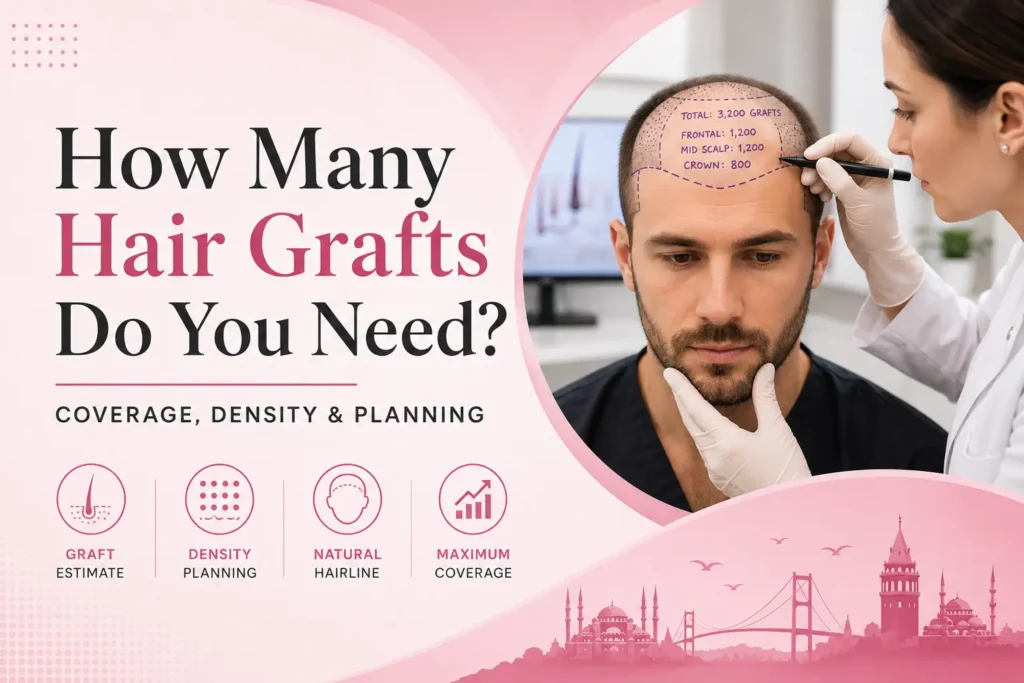
The amount of hair grafts required to fill a balding region cannot be determined by the dimensions of the balding region.
Two individuals with perceived similar hair loss patterns may require a different amount of grafts due to varying donor hair density, existing hair on the donor region, hair thickness and texture, contrast of hair to skin, hairline, and the extent of coverage that is desired.
A transplant of hair redistributes existing follicles, rather than generating new ones. Therefore, planning for a graft has two sides: the number of grafts that are required to fill the recipient region and the number of grafts that can be harvested from the donor region without causing the donor region to appear thin.
Medical literature describes the safe donor region as exhibiting a range of different values in patients. StatPearls reports the normal range of follicular unit density in the mid-occipital area of the safe donor region is approximately 65–85 follicular units per square centimeter. Hair caliber also impacts the degree of visual coverage.
Therefore, whenever someone asks “how many grafts do I need?” they should be prepared to receive an individualized estimate rather than a general graft chart.
What Is a Hair Graft?
A hair graft is a small region of skin that contains one or more hair follicles that is transferred from the donor region to the recipient region of a hair transplant.
In modern follicular unit transplantation, planning for a graft focuses on the preservation of the natural groupings of hairs rather than treating each individual hair as a separate graft. Human scalp hairs naturally grow in follicular units.
Grafts vs Individual Hairs
Grafts are counted by their number, not the number of hairs they contain.
A single graft can hold one through multiple hairs.
This can create confusion for patients when comparing graft numbers. Two procedures that each used 3,000 grafts could potentially use different numbers of hairs.
Distribution of one-, two- and three-hair units can vary and is impacted by donor density.
Follicular Units
Follicular units are naturally occurring groups of hairs that emerge together from the scalp.
Preserving these units allows the surgical team to use various grafts with different strategies based on the location. Single-hair follicular units can provide greater detail at the hairline, while multi-hair units can provide greater coverage behind the hair line.
The quality, and more importantly, the quantity of available follicular units, is more clinically relevant than graft count.
How Is a Hair Graft Count Determined?
There isn’t a single perfect formula for every case.
One planning concept could be to look at the size of the recipient area, its current density, and the increased density that the treatment is hoping to achieve.
In the medical literature, when discussing recipient density, it is typically expressed as follicular units per square centimeter. StatPearls roughly mentions a target of 30 follicular units/cm² in recipient planning while other published articles have described the need for higher ranges based on the circumstance and the technique. These numbers should be thought of as planning ranges, not hard limits, for the treatment of the entire scalp.
Size of Recipient Area
Small Hairline recessions can require less grafts to correct than large hairline, mid scalp, and crown hair loss.
The more recipient area there is to cover, the more grafts are typically needed.
However, just because the recipient area is double doesn’t necessary mean that double the grafts should be done.
Current Hair Density
Some recipient areas have no hair, while some have a lot of hair.
An area with a lot of hair might need less grafts to provide an improvement than an area that is completely bald with the same size.
In preparing recipient sites the medical team has to avoid damaging existing hair.
Hair Characteristics
Hair caliber is a very important factor for coverage. Thick hair can conceal more of the scalp than thin hair even with the same graft count. Coverage can be altered by the color and curl of hair, as well as the contrast to the scalp.
Published medical sources cite a positive coverage effect in large diameter hair shafts.
Desired Coverage
The medical team needs to account for what the patient values. For patients with hair loss, largely focusing grafts in the hairline can make a bigger cosmetic difference than placing grafts evenly and spaced from the hairline to the crown.
Donor Area Capacity
The impact of recipient and donor areas on the graft estimate is the same.
The safe donor area must be analyzed for density, hair caliber, hair pattern, potential for future hair loss, and hair stability.
Hair-transplant practice guidelines suggest confirming hair quality and safe donor area, and evaluating donor density at multiple locations prior to harvesting.
How Does the Norwood Scale Affect Graft Planning?
In the context of hair transplantation, the Norwood Scale refers to male pattern baldness.
As the Norwood pattern advances, the potential recipient area becomes larger. This can increase the demand for grafts while the donor area remains constant.
The Norwood Scale is useful for showing how far hair loss has progressed, but it cannot give an exact graft number on its own.
Two patients at the same Norwood level can have very different donor densities and hair characteristics, and different concerns, and can necessitate different grafting strategies.
According to the published guidelines, there should be additional concern at stage Norwood VI and VII, when donor density is poor, as the available donor supply could be insufficient to restore the hairline to a high density.
How Many Grafts Are Needed for the Hairline?
There is no optimal number for the hairline.
The required a number can vary according to the degree of recession, the location of the new hairline relative to the temples, and the density desired behind the new hairline.
A hairline, which is positioned lower on the forehead, can increase the surface area of the transplant and consume more of the available donor area.
Since hairline design should be conservative for future hair loss, the new hairline should be designed in a way that appears natural should future hair loss occur. Medical literature advises against treating baldness in isolation and, instead, advocates for the planning of natural long-term hairlines.
What Constitutes the Frontal Area?
The frontal area goes beyond the designation of the hairline.
The frontal area may be treated based on the frontal third of the patient’s loss.
The bald frontal area may require a great number of grafts, but an area that is partially filled with hair may only require a small number of grafts.
What is being planned in terms of coverage?
What Constitutes the Crown Area?
Crown area planning is more complicated as the natural whorl requires grafts to be placed in varying directions and in a circular pattern.
The natural crown area may continue to grow due to the progressive nature of hair loss.
Limited donor hair surgery may prioritize the frontal area since the vertex may suffer the consequences of the surrounding hair loss if the limited donor grafts are primarily placed in the crown of the head.
What Can 1,000 to 2,000 Grafts Cover?
A range of 1,000 to 2,000 grafts may be applicable to a small to medium treatment area. This may include the treatment of a limited frontal hairline, recession, or any other specified problem area.
It is important to note that this range may also hold a restriction on the expected level of treatment for the area.
Those with thick, multi-hair follicular units and those with fine hair and lesser numbers of hairs per follicular unit can have divergent outcomes from the same graft number.
When evaluating hair transplantation cases side by side, it is critical to evaluate the entire scene and not simply the reported graft number.
What Can Be Done With 2,500 to 3,500 Grafts?
At this range, one can probably address a broader area of the frontal region.
It can also be allocated as the patient desires.
A 3,000 graft procedure done primarily within the frontal region may have a very different result from a 3,000 graft procedure done in the frontal region, mid-scalp, and crown even if done at the same density.
Graft number cannot determine final density.
What Can Be Done With 4,000 to 5,000 Grafts?
To some, a large recipient area may justify a donor area of 4,000 to 5,000 grafts.
A 5,000 graft procedure does not necessarily mean that the entire scalp can be restored to a very high density.
The number of grafts donated may either be concentrated in a small area or be distributed over a larger area to a lesser degree.
Therefore, it is critical, when doing large-session hair transplantation, to address the donor’s capacity first, rather than an advertising-driven goal.
Are 6,000 or More Grafts Always Possible?
No.
The nature of a patient’s donor may support a large total number of grafts, or the nature of a patient’s donor may not.
A theoretical model for donor-area planning estimated 6,000 harvestable follicular units from a permanent donor zone. The range would be greater or lesser, depending on the initial hair density. This does not establish a safe limit that can be applied to every patient.
The number that can be safely removed is also distinct from the number that might be extracted.
The long-term appearance of the donor area is important.
What Is Donor Area Density?
The donor area density defines the number of hairs or follicular units within a given area of the donor area.
Although hair density and follicular unit density are related concepts, they are not the same. One follicular unit may contain multiple hairs.
The ranges reported for occipital hair in the literature are between 65 to 85 follicular units per cm2. Significant variation is present.
Hair thickness needs to be looked at at the same time.
A donor area with thicker hair can sometimes provide more coverage than another donor area with the same follicular unit density but finer hair.
How Much Hair Can Safely Be Taken From the Donor Area?
There is no one safe percentage that applies to every patient.
It depends on the starting donor density, the size of the stable donor area, the hair itself, the pattern of extraction, and whether more surgery may be needed later.
Present day hair transplantation guidelines state that approximately 10-15 FUE excisions are generally safe for single pass extractions for a person with average donor hair density of approximately 65-75 follicular units/cm2. It should be noted that this guidance does not allow for the same extractive density to be repeated within the same harvesting unit or even for different donor units.
The focus should be on preserving a donor site that is visually acceptable after the extractions.
What Is Donor Overharvesting?
Overharvesting refers to an extractive process that removes a significant amount of donor hair that would result in visible hair loss or that would produce a scarred or discontinuous appearance of the donor unit.
Hair transplantation guidelines are clear about the importance of avoiding overharvesting, and reliable sources describe overharvesting as a cause of visible scarring and pigment disturbances.
Thus, when looking at a quote for hair transplantation services, one should not consider the largest number of grafts, but rather the most reasonable and prudent offer.
Protecting the donor area is just as critical as ensuring that the transplanted hair takes root.
How Does Hairline Design Affect Graft Allocation?
The position of the hairline directly influences the surface area that is affected and, therefore, the extent of grafting that is needed.
The position of an advances hairline also increases the demand for grafts.
When designing a hairline, single hair grafts can be placed along the leading edge, while larger units can be placed behind to provide additional coverage.
Planning must consider the potential need for future hair loss.
This is why the most acceptable hairline design is not one that brings the hairline as close to the forehead as possible.
What Is Graft Survival?
Graft survival refers to whether transplanted follicles remain viable and later produce hair.
Grafts must be undamaged for a high graft count to be valuable. Damaged grafts happen during harvesting, preparation, and implantation.
The NHS mentions that there is even the small chance that a transplant may not take and transplanted hair may be lost.
Handling and Storage
Harvested follicular units should be handled carefully.
According to StatPearls, atraumatic removal and placement into a chilled holding medium are methods used when implantation of grafts is not done immediately.
Damage to the follicle during harvesting and handling decreases a graft’s value, regardless of total number of grafts harvested.
Implantation Technique
Recipient sites have to receive the grafts without unnecessary damage to the transplanted follicles or the native hair around them.
The technique itself does not guarantee survival.
Patients considering FUE or DHI should look at the entire process rather than assume one method of implantation results in better graft survival.
Recipient Area Conditions
The recipient area also needs to be assessed as part of the treatment plan.
Existing hair, scar tissue, scalp conditions and the amount of coverage needed can all affect how recipient sites are planned.
Healthy scalp and patient selection have been recognized to be vital in successful transplantation.
Postoperative Care
Grafts protect and heal the area early on.
Transplanted grafts are not fully secure for the first 2 weeks, and washing and recovery instructions are given.
Our hair transplant recovery guide covers this period in detail.
Does the Number of Grafts Influence Hair Transplant Cost?
Yes, requiring more grafts is just one of the elements that can influence a treatment’s cost, though it certainly is an important one.
When hair transplant clinics determine their pricing, other factors come into play, including the technique, how extensively the medical team is involved in the procedure, the complexity of the treatment and what the treatment package includes.
While patients trying to compare treatment costs in Turkey will find our article helpful, patients should be very careful if they receive two quotes with the same graft numbers because it is entirely possible that one quoted treatment is vastly different from the other.
Can Online Graft Calculators Be Trusted?
An online calculator may provide a general idea of how much a given hair transplant procedure may cost, but it does not take into consideration the donor density, the quality of the patient’s hair, the distribution of the hair, the condition of the patient’s scalp, etc.
It may also give a patient a false idea as to how many hair grafts may be necessary, as it may propose an improper hairline, and there is no way for the calculator to determine how much hair should be maintained in the donor region to provide for future hair loss.
It is important to understand that in the absence of an assessment of both the donor region and the recipient region of the scalp, the estimate is necessarily very general and imprecise.
Therefore, when considering hair transplant clinics, patients should ask how many grafts have been calculated for the procedure rather than blindly trusting an online calculator.
Frequently Asked Questions on Hair Grafts
What Does 3,000 Grafts Mean?
While 3,000 grafts indicate a larger hair transplant session, how many grafts are appropriate may be determined by the donor supply as well as the recipient region.
A better question is what areas of the patient’s scalp will be addressed by the grafting procedure with the 3,000 grafts, and how much donor supply will be compromised.
Can 5,000 Grafts Address the Entire Scalp?
Not necessarily.
Five thousand grafts spread out over a large portion of a bald scalp to create density would be very different compared to the same number of grafts in the frontal and mid-scalp areas.
The characteristics of the hair and the amount of existing hair also affect how much is visually covered.
Can the Donor Area Run Out?
The amount of usable donor hair is limited.
If you extract too much, there will be visible thinning and it will also reduce the available number of grafts for future surgeries.
Therefore, when you plan your donor area, you must consider all your lifetime hair-loss situations, not just the first transplant.
Can You Have a Second Hair Transplant?
A second procedure may be possible if enough suitable donor hair remains and the scalp and treatment plan still support another surgery.
Having one transplant does not mean there will automatically be enough donor hair for another large procedure.
The donor area must be re-assessed before deciding to do additional surgery.
Medical Sources
- Hair Transplantation — StatPearls / NCBI Bookshelf
- Hair Transplant Practice Guidelines — Journal of Cutaneous and Aesthetic Surgery / PubMed Central
- Hair transplant — NHS