
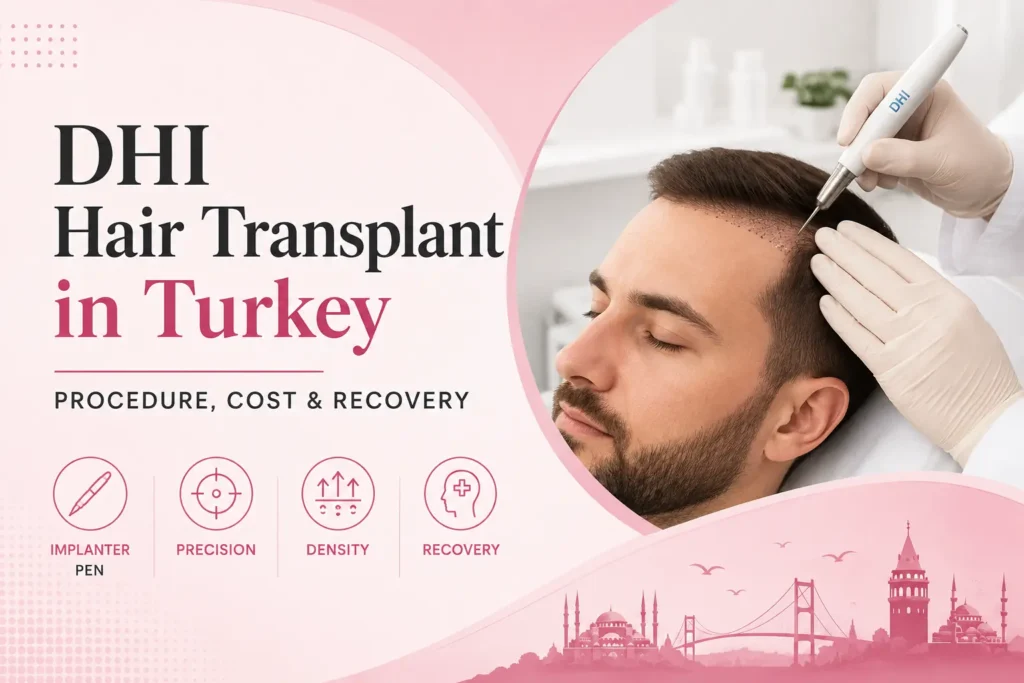
A DHI Hair Transplant in Turkey is typically the harvesting of donor hair grafts, and the placement of these grafts into areas of your scalp experiencing hair loss using an implanter. In most cases, the donor hair grafts are harvested using FUE, where DHI describes how the grafts are placed into the recipient area.
It is important to note that, no matter what marketing techniques DHI clinics may use, DHI is the methodology which describes the implantation of hair grafts harvested by FUE. From a medical perspective, the harvesting of hair grafts and the placement of hair grafts are two separate steps of a hair transplant. The patient should not pick a technique based on its name, but should have an understanding of the entirety of the surgical plan.
In DHI hair transplantation, the implantation process is therefore one stage within the wider transplant process.
As with any hair transplant in Turkey, the final result will be dictated by the diagnosis of the patient, the donor supply available, the design of the hairline, the direction of grafts implanted, the long-term plan as well as the integrity of grafts after they are harvested. The device used to implant the grafts is just a part of the process.
People searching for the best DHI hair transplant in Turkey should still compare the full surgical plan rather than the method name alone.
What Is a DHI Hair Transplant?
DHI stands for Direct Hair Implantation. The term is most commonly seen to describe a method of hair transplantation in which grafts, whether they be single or a small number, are placed into the recipient scalp using an implanter.
The concept of using an implanter graft device is related to other methods which aim to reduce manipulation of grafts, and to insert them more accurately. The use of implanters to place grafts has been documented for many years, and modern devices allow the implanter to incorporate control over depth of insertion, and the graft’s orientation and angle.
This hair implantation method is often described as DHI direct hair implantation.
DHI does not account for how donor grafts are harvested. Donor grafts may be harvested by FUE and transplanted by Choi–or some other– implanter.
When FUE is used for harvesting, follicular unit extraction remains a common term used to describe that donor-harvesting stage.
What Does Direct Hair Implantation Mean?
The word “direct” has a lot of providers perplexed because they use the word in different ways.
One described direct hair transplantation using the FUE harvest method. Grafts are implanted as opposed to being left outside the body for a long period. The authors of the paper considered their method a variation of FUE, rather than a new technique.
In reference to patient understanding, DHI is related more to implanter-based graft placement.
This means the most critical part of the process is how the grafts are harvested, how long they are out of the body, how they are handled, if recipient sites are prepared prior, and what stage of the surgery each individual performs.
How Is a Choi Implanter Pen Used?
A Choi-type implanter is a device used to place harvested follicular grafts, and is done through a needle or similar structure.
The Choi implanter pen is one example of an implanter pen used for precise control during hair implantation.
The implanter is used by placing the graft into the needle, and advancing the tip of the implanter to the target site. Some implanter designs have combined site making and graft placement or have been simplified to placements in prepared sites.
An implanter does not remove the need for careful planning. There are many factors that can adversely affect the outcome of a hair transplant including, but not limited to, incorrect angulation, depth, loading of the implanter, and pressure.
Who Is a Good Candidate for DHI?
DHI has its own set of standards when it comes to candidates, but these differences are minor when compared to other forms of hair transplant surgery.
The candidate should have a hair loss pattern that is either stable or controlled, along with a healthy scalp, enough donor hair, and realistic expectation regarding coverage and density. The surgery should only be performed once the diagnosis is confirmed, as different types of alopecia behave differently during the surgery.
The assessment also considers existing hair, bald areas, the donor area and the recipient areas.
Hairline Restoration
Implanter-based placement is useful for situations where a large amount of attention is placed on the direction and angle of each hair placed near the frontal hairline.
This does not mean that DHI always creates a more natural hairline. A number of other factors play into hairline restoration, including the concentration of hairline grafts, irregular distribution, and the angle of hair growth. Recipient-area planning is still the most important aspect of the surgery.
A poorly designed hairline cannot be corrected by a precisely controlled implantation device.
Smaller and More Defined Recipient Areas
DHI may be used if graft placement is to be done in a precisely defined recipient area.
Frontal hairs are often included in such areas, although there is no limit to the treatment that can be indicated for the recipient area of a frontal hairs. The treatment plan must dictate the form of graft placement selected; the technique must not dictate the treatment plan.
Donor Area Requirements
DHI will not add donor hair.
Density, miniaturization, Donor characteristics, procedures performed on the Donor, and the long term safe Donor area will dictate the maximum possible donor units. Analysis of the donor site and the recipient site is an essential need when planning hair transplantation.
The major concern when FUE is used to harvest the grafts preceding DHI transplantation is regarding overharvesting. Removing excessive follicular units can result in reduced visible donor density and can limit the options for performing further surgery.
How Is DHI Hair Transplant Performed?
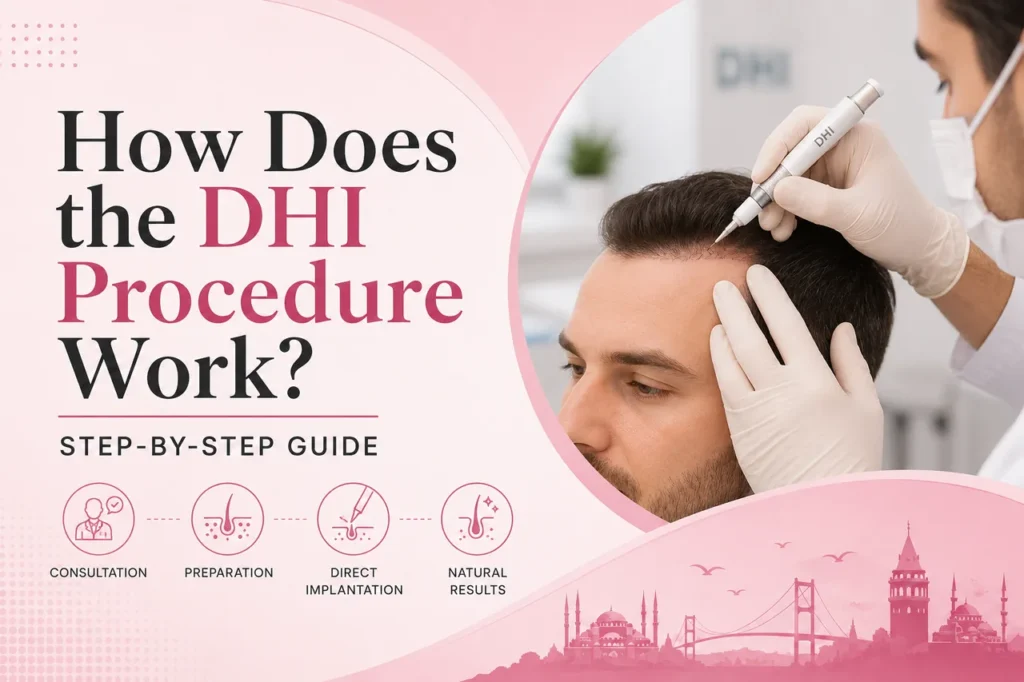
A DHI hair transplant consists of multiple steps. The order and the details of the individual steps may vary among patients and treating physicians, but typically the process involves examination of the patient, harvesting of the donor grafts, processing of the grafts, and placement of grafts.
Hair transplantation is defined as a process involving the collection of hair follicles, cleansing of the donor site and recipient site, and creation of recipient sites.
Hair transplantation in Turkey can therefore involve different hair transplant techniques within the same operation.
The procedure is generally performed with local anesthesia.
Consultation and Hairline Planning
Around the time of the consultation, planning of the hairline and the treatment area is performed. This is done considering the patient’s hair characteristics, the hair supply, and the facial characteristics and the projected hair loss.
Hair analysis helps determine how the planned grafts relate to the existing hair and the areas of hair loss.
It is important to consider the number of grafts that will be needed to achieve the planned hairline based on the examination of the patient, rather than the DHI package.
Graft Extraction
DHI most often performs FUE in the donor region.
In this case the patient is receiving FUE transplantation and DHI-style implantation in the recipient region.
Both FUE and DHI methods have adherents that defend their use as standalone procedures; however, one has to be careful not to promote them as mutually exclusive.
Graft Loading
Grafts must be treated gently.
The individual follicular units must be loaded into appropriately sized tips, and the orientation of the graft unit and the tip must be appropriate, because excessive mechanical stress during the procedure may damage the fragile follicular structure.
Careful handling is relevant to the graft survival rate because each hair follicle can be damaged before implantation.
When a large number of grafts are to be loaded, there must be a well-organized team; because the procedure is repetitive and time consuming.
Direct Implantation
Once loaded, the implanter is placed over the recipient area site, and the apparatus is used to place the graft at the designated depth and direction.
The aim is to implant hair at an appropriate depth and direction while maintaining control of the graft.
Some approaches use implanters to open and place grafts, while other approaches use implanters to place grafts into recipient sites that have been made by other means. Thus, the use of an implanter does not necessarily mean that recipient sites have not been made.
This is a good question to ask when comparing the DHI methods in use.
How Does DHI Affect Hairline Design and Density?
As a procedure, DHI does give the operator a measure of control in the placement of individual grafts; however, the final density is not a consequence of the DHI device.
Density is appreciated by the number of hairs in each follicular unit, thickness of the hair shaft, the degree of curl, color contrast, the distribution of grafts, and the available donor strip. Design of the hairline and placement of recipient sites also affect the efficiency of placement in achieving desired coverage.
Implanting as densely as possible is not the best goal.
The goal is to achieve natural-looking results with the available donor supply rather than simply maximize density.
The recipient area should offer support to grafts, whereas the donor area should be distributed throughout the area of highest importance. Direction and angle are very important in the frontal hairline since small discrepancies are noticeable.
How Many Grafts Can Be Implanted With DHI?
There is no upper limit to grafts that can be utilized with DHI.
The amount that can be transplanted depends primarily on the donor and recipient areas. Factors also include the length of the procedure, graft management, and whether the surgical team is able to control the workflow.
Considering the above factors, one should not consider the graft number that is offered for DHI and assume this is the maximum number for all patients.
A patient with a limited frontal recession might need lesser donor hair compared to a patient with frontal, mid-scalp, and crown loss. In such a scenario, one should plan the graft number keeping in mind the largest treatment package available should not be the primary factor.
How Much Does a DHI Hair Transplant Cost in Turkey?
There is no single, official DHI hair transplant price in Turkey for every patient.
Your keyword data also shows that cost is one of the strongest secondary search intents around DHI, with queries like dhi hair transplant cost in turkey, dhi hair transplant turkey cost, dhi hair transplant turkey price.
From a medical point of view, the quote should be in line with the treatment plan and not just DHI.
What Influences DHI Pricing?
There are several factors that can influence the price of a DHI hair transplant in Turkey. These include the number of grafts, the length of the procedure, the staff required, the level of physician participation, the donor site, the size and type of the implanters, and any add-ons provided.
In implantation-based methods, there is often considerable loading and placing work. When considering other methods of graft placement in the past, it has been noted that implantation methods differ in terms of the length of the procedure, staffing, and cost structure.
As such, DHI may sometimes be quoted at a higher price compared to other types of implantation, but a high price should not be considered to represent medical superiority.
Those who wish to find the best DHI price should consider the price of full hair transplant packages, not just the price of the DHI method.
A DHI package may include non-medical services, but an all-inclusive package does not determine surgical quality.
This also applies when looking for DHI hair transplant Istanbul cost; there is no one DHI price that reflects all medical teams and treatment plans.
If you are comparing a transplant clinic in Turkey, check what the quoted price includes and who is involved in the procedure.
DHI Hair Transplant Recovery
How quickly individuals can recover from DHI typically depends on the harvesting method of the donor grafts and how extensive the work was in the recipient region.
If FUE was used to harvest the donor grafts, this results in multiple small extraction sites in the donor area, and the recipient area has implanted grafts that go through the normal healing process.
For DHI hair transplantation recovery, the NHS states that individuals would likely have some soreness, tightness, and swelling, and the grafts would need protection during the first weeks.

First Days
Redness, soreness, and swelling are common for days following the transplant.
Patients receive instructions for washing, sleeping and activity positions, and how to minimize interaction with the recipient scalp.
Postop care can include hair wash instructions and activity restrictions during the early recovery period.
Procedure size, individual healing, and the number of surgeries performed at once contribute to the length of the healing process. Therefore, the layered healing instruction schedule must come from the treating medical team.
Scabs and Shedding
When the grafting sites heal, tissue around the newly transplanted follicles will start to scab over. This is part of the healing process
Even though the follicles remain in place, grafted hair can still shed after the surgery. This shedding is part of the post-surgery process, and does not indicate a failing graft.
DHI cannot block this process.
Shock Loss
It is normal for some nearby hair to also shed as a result of the surgery. This is known as shock loss, and can affect both the transplanted and the surrounding native hair.
The entire hair recovery process needs to be distinguished from the even longer process of the growth of mature hair.
When Do DHI Results Appear?
DHI cannot manipulate follicle growth to circumvent the hair growth cycle.
The hair growth cycle is why transplanted hairs take months to mature.
New hair growth may begin to be noticeable around four months after surgery. The final results of transplanted hair may take 10 to 18 months to become visible.
Published literature on direct hair transplantation suggests that results and assessment be done over a period of several months after surgery, instead of a few days.
The before and after effects and results of DHI should be determined based on photos taken after the healing process. Photos taken during the early recovery process should not be used for determinations.
What Are the Risks and Limitations of DHI?
Because DHI uses surgical hair transplantation, it carries the same risks.
During hair transplantation, patients may develop infections or scarring. Some grafts fail to grow and loss may appear temporarily or occur in an unnatural hairline. Most issues can be avoided through surgical planning and patient selection.
Though hair transplantation does successfully grow hair, there are still many technical limitations.
Grafts that are loaded must not be traumatized and must be implanted at a correct angle and depth. The surgeon must control the trauma inflicted upon the graft and its final position. Guidance for sharp implanters describes the importance of all of these controls through depth and correct handling.
Published success rates should not be treated as guarantees of graft survival rates or a natural result.
A second major limitation is that DHI cannot change a poor donor area. It cannot add more follicles or prevent loss of natural hair.
Safety and medical supervision of hair transplant surgery should be of the utmost importance to all patients, even international patients, over the branding of the implantation device.
DHI vs FUE Hair Transplant
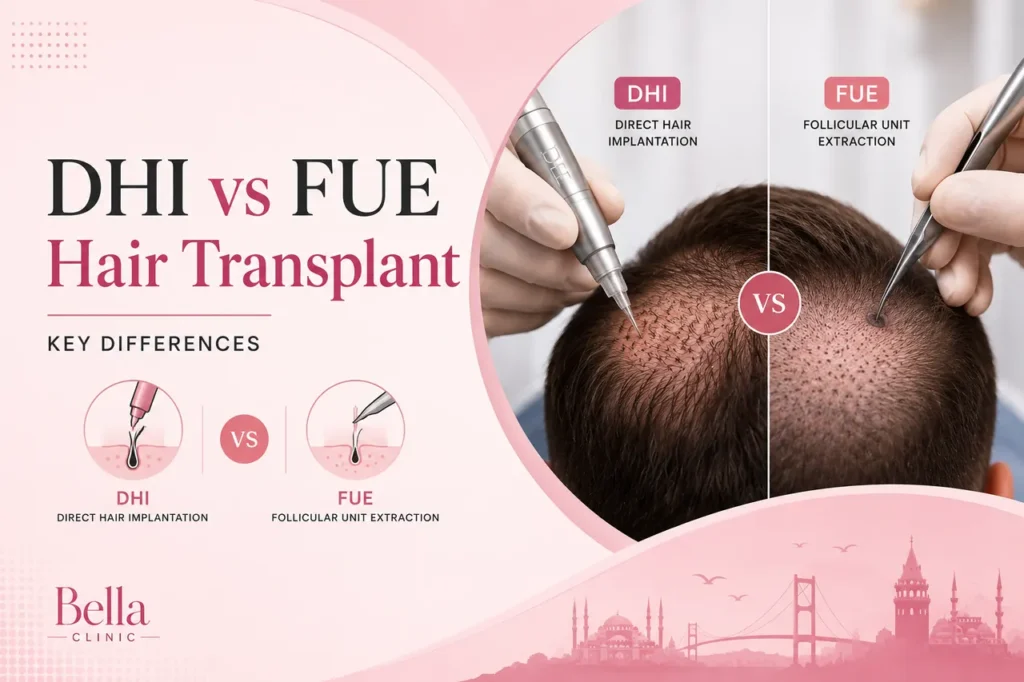
The difference is that the terms describe different steps in the same surgery.
Extraction of each donor hair graft can be described as FUE. The implantation step of DHI is done with an implanter.
Therefore, FUE harvesting can be paired with DHI implantation.
Asking which of these is “better” is too absolute.
DHI vs FUE is therefore mainly a comparison of different surgical stages rather than two completely separate hair transplant methods.
A more relevant FUE vs DHI comparison considers donor site harvesting, recipient site preparation, implantation, graft manipulation, time and the preferences of the patient.
DHI vs Sapphire FUE
When careful thought and analysis are put into each step of the surgical process, DHI and Sapphire FUE can overlap rather than be opposing step-by-step processes.
Sapphire FUE refers to the use of sapphire blades for recipient site preparation paired with FUE harvesting. DHI (Direct Hair Implantation) typically refers to placement using an implanter.
So, for the comparison of techniques, there are the differences in various technical steps.
A Sapphire FUE hair transplant should not be prioritized over DHI because an implanter was used instead.
The choice has to be made based on the overall planning of the surgery.
Frequently Asked Questions About DHI Hair Transplant
Does DHI Require Shaving?
Shaving with DHI is not absolute. Shaving as part of DHI is more procedure-related than surgical step-related.
With partial shaves, no shaving and long hair FUE methods, suitability is dependent on several factors, most importantly individual patient factors and the surgical workflow.
Is DHI Better for Hairline Work?
An implanter is able to provide extremely fine control of graft depth and direction. This may be beneficial for the hairline.
However, it cannot be said that DHI improves hairline outcomes for all patients. Again, more important than the use of an implanter is the design and execution of the surgery.
Does DHI Heal Faster Than FUE?
This question is misleading, as DHI and FUE may be used within a single surgical session.
Even with FUE graft harvesting and implantation using a device, the area from which the graft was donated still needs to heal. The recovery of the recipient site is determined by the method used to create the site (site creation), how the site was filled (site density) and how extensive the grafts were placed (the extent of transplantation).
Therefore, claiming DHI has an overall faster recovery is not valid.
Is DHI More Expensive Than FUE?
Answering this is more complicated.
Factors that can increase the cost of DHI include 1) the use of more implanters, 2) more members of the team, 3) more expensive equipment, and 4) more grafts. Different clinics also use different models of pricing.
The price of DHI does not determine the quality of the result.
Medical Sources
Hair transplant — NHS, UK.
Hair Transplantation — StatPearls / NCBI Bookshelf, U.S. National Library of Medicine.
A Practical Guide to Hair Graft Placement Using the Sharp Implanter Method — Journal of Cutaneous and Aesthetic Surgery / PubMed Central.