
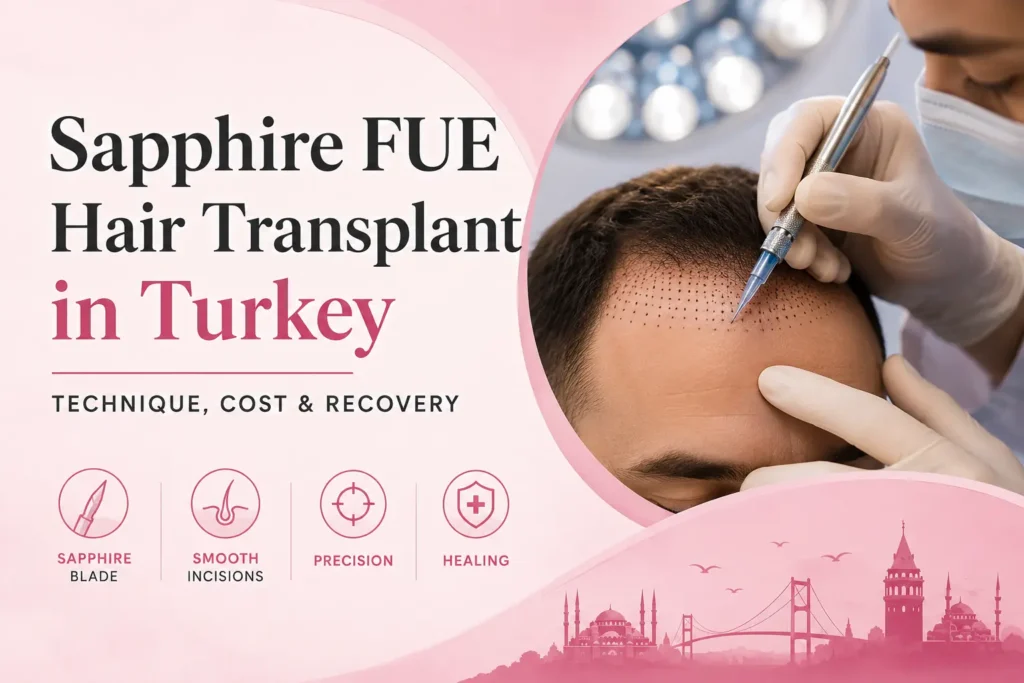
Sapphire FUE Hair Transplant in Turkey
Sapphire FUE is a variation of an FUE Hair Transplant. This variation trims follicular units from the donor area and transplants them to the area affected by hair loss. The word Sapphire is used to describe the blade used to craft the recipient area channel (referred to as Sapphire).
Sapphire FUE is basically an FUE Hair Transplant. There are two distinct stages of this procedure. First the follicular units are extracted from the donor area. The second stage of this procedure is the crafting of the recipient area using a Sapphire blade.
The FUE hair transplant procedure is one of the hair transplantation procedures used in surgical hair restoration. Follicular unit extraction is also a commonly used patient-facing term for the donor harvesting stage.
The patients considering a Sapphire FUE Hair Transplant in Turkey should pay attention to the other aspects of this procedure that do not involve the blade used. Donor quality, graft handling, hairline planning, and the direction of the recipient area, and the skills of the medical staff involved will greatly affect the result. The ISHRS states that the depth of the recipient area, and the angle, spacing and graft selection, will determine the appearance of the hair that grows after the transplant.
The aim is natural results that work with the patient’s existing hair rather than simply placing the highest possible number of grafts.
The same principles apply when assessing a broader hair transplant in Turkey.
FUE vs FUE
Sapphire FUE is an FUE Hair Transplant that uses a blade manufactured from synthetic sapphire to craft the recipient area.
For an FUE Hair Transplant, follicular units are removed one by one from the donor area as opposed to removing a strip of scalp as done in traditional Hair Transplant procedures. The NHS states that in an FUE Hair Transplant, individual grafts are removed and placed into small recipient cuts.
The Sapphire component of this procedure is performed later.
Minute channels in the recipient site are created after positioning hairline grafts and extraction of donor grafts. In Sapphire FUE, a sapphire blade rather than any other blade is used for channel creation in the recipient site.
The hair transplantation method therefore combines FUE donor harvesting with a separate recipient-site stage.
Therefore, Sapphire FUE Turkey is not a novel technique for donor harvesting when compared with standard FUE. The main difference is in the construction of the recipient site.
How Is Sapphire FUE Different From Traditional FUE?
The fundamental difference between the two techniques is the instrument used for recipient channel construction.
For both procedures, the FUE harvesting principle remains the same.
The graft extraction in the donor site is the same in both techniques, as is the construction of recipient sites in the recipient site.
The principle of sapphire blades does not affect the FUE extraction in the donor site, since these blades are used for recipient site construction.
The hair transplant technique therefore differs mainly during recipient-site preparation rather than follicular harvesting.
Graft Extraction
The graft extraction in the donor site is the same in both techniques, as is the construction of recipient sites in the recipient site.
The principle of sapphire blades does not affect the FUE extraction in the donor site, since these blades are used for recipient site construction.
The donor hair and individual hair follicles still have to be harvested according to the normal principles of FUE.
Recipient Site Construction
Recipient site construction is done after graft extraction in the donor site.
Recipient sites are constructed as per the requirement of the area to be covered. The direction, angle and interval of recipient sites affect the emergence of the transplanted hairs from the scalp.
Creating recipient channels for grafting goes beyond simply creating an opening.
This stage requires precision control because recipient sites influence the direction and positioning of the transplanted hairs.
Sapphire Blades
Sapphire blades are used to create the small recipient incisions for later placement of grafts.
Sharp sapphire blades are therefore associated with the recipient phase and not the extraction of donor follicles.
A recent prospective observational study examined the difference in graft survival when hair transplant surgery was performed with a sapphire versus a steel blade. Evidence of this kind does not allow conclusive statements to be made about the potential benefit of the use of sapphire blades to hair transplant surgery to all patients in all situations. The opinion of the surgeon is still important.
The precision of sapphire blades is one variable within the wider transplantation process.
Using blades of particular material is one of many variables in a much longer and more important process.
Who May Be a Candidate for Sapphire FUE?
Candidates for Sapphire FUE need to fulfill the same basic requirements as those candidates for FUE.
The person needs to possess adequate donor hair, an appropriate diagnosis, suitable expectations and a recipient site that can be sufficiently addressed by the transplant.
Hair loss pattern, existing hair and available donor hair should all be considered before choosing the procedure.
Having extensive hair loss but limited donor hair will not allow one to obtain complete coverage by just using a different type of recipient blade.
The same applies to progressive hair loss. Transplanting an aggressive hairline without considering future thinning can leave an unnatural pattern, regardless of whether steel or sapphire instruments were used, and should not be granted on the basis of the word “sapphire” being more advanced.
How Is Sapphire FUE Performed?
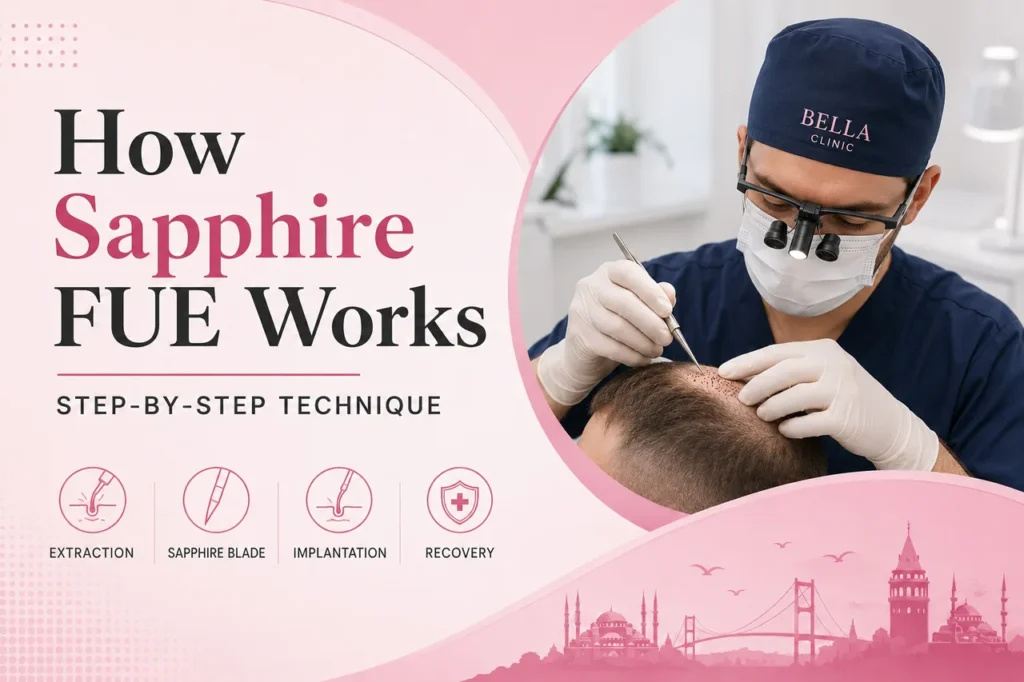
A Sapphire FUE hair transplant is a step-by-step process consisting of donor evaluation, planning, removal of grafts, creation of recipient sites, and placement of the grafts.
Although they occur concurrently, each stage of a hair transplantation method has a separate function.
Like other hair transplantation surgery, the transplant process includes both donor and recipient stages rather than a single surgical step.
Donor Area Evaluation
The donor area informs the surgeon of the available resources.
Factors such as the donor area’s density, hair caliber, and composition, the safe donor area, and the distribution of follicular units determine the potential harvested graft supply.
The number of grafts should therefore be planned according to the donor supply rather than a fixed treatment package.
It is imperative to plan for the patient needing transplantation again later in life.
Sapphire blades are not a substitute for an inadequate or overharvested donor area.
Hairline and Density Planning
Prior to making the channels, the recipient area’s assessed.
Based on the patient’s hair characteristics and the donor supply, the position, direction, and distribution of the hairline, as well as the desired coverage, are planned.
According to ISHRS, hairline formation is done with single-hair grafts. Larger follicular units are placed behind them to provide enhanced density.
Natural hair characteristics should also be considered when planning how transplanted hair will blend with the surrounding area.
Going for maximal density by over packing will only lead to graft damage.
Graft Extraction
The harvesting process is done in accordance with the principles of FUE.
One by one, individual follicular units are harvested from the donor area. The NHS states this results in a number of small scars instead of the single linear scar associated with strip transplantation.
Considerable care must be taken to avoid damage to grafts as injuries sustained at this stage cannot be repaired by changing to a different recipient-site blade.
Graft survival depends on more than recipient-site creation because the follicles also need careful handling during extraction and placement.
Sapphire Channel Creation
Once the recipient area’s planning has been completed, the channels are made with sapphire blades.
These should be of the required depth, distance, and grow in the correct direction.
Here’s the step that mainly distinguishes Sapphire FUE from normal FUE with another recipient-site instrument.
Graft Placement
While the grafts are harvested, the recipient sites are made.
Essentially, as long as the correct direction and a specific depth is maintained, the grafts should not be traumatized.
The recipient site and the placement of the grafts are mutually beneficial. An appropriately placed graft, even in a properly made channel, retains the recipient site.
The implantation process should also protect graft survival while keeping the planned direction of the transplanted hairs.
What Are the Potential Benefits of Sapphire FUE?
Considering the design and shape of sapphire blades, it’s possible that recipient incisions may be even more precise than they are with standard steel blades. Research is just beginning to look at the relationship between the design of blades and the survival of grafts as well as other outcomes related to surgery.
A 2026 prosthetic observational study with 1000 participants reported better graft survival in the sapphire group as compared to the steel group. However, it should be noted that, in absence of randomized control studies, such observational studies can only support the arguments as against advocating the superiority of Sapphire FUE in all circumstances.
A reported success rate or graft survival rate should therefore not be interpreted as a guarantee for an individual patient.
The question that matters to the patients is not whether the surgeon uses a sapphire blade, but rather whether the surgeon has the skill to assess the donor area, anticipate the patient’s long-term needs, and resourcefully use the existing hair to produce a natural hairline.
What Are the Limitations of Sapphire FUE?
The main drawback is that changing the recipient blade will not improve the rest of the transplant.
Sapphire FUE will not increase the donor hair density.
Sapphire FUE will not decrease the harvests.
Sapphire FUE will not guarantee natural surgery outcomes.
It cannot prevent the patient’s remaining natural hair from continuing to thin post-surgery.
The NHS states that even after hair transplantation, existing hair will continue to thin and so the design of permanent transplants should take this into consideration.
Hair growth after transplantation also remains dependent on the normal growth cycle rather than the material used for recipient-site creation.
Therefore, one needs to exercise caution with claims of Sapphire FUE increasing density, completely scarless surgery or of a faster recovery being universal.
How Much Does Sapphire FUE Cost in Turkey?
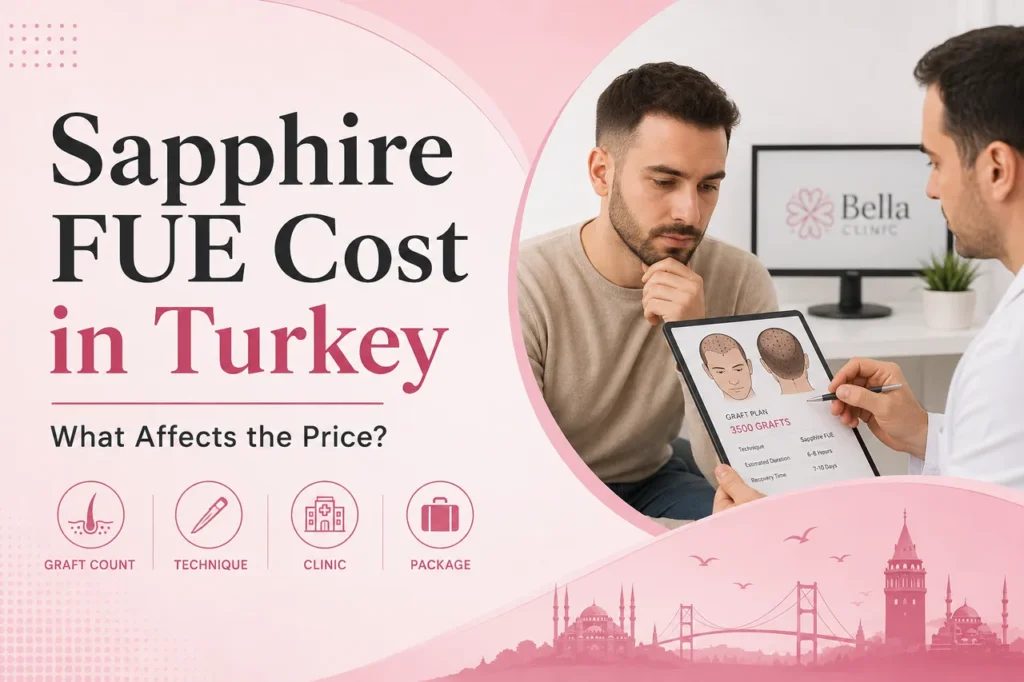
There is not a single official Sapphire FUE hair transplant Turkey cost that applies to every hair transplant patient.
Factors like the extent of hair loss, characteristics of the donor region, length of the procedure, as well as the medical team and the services provided, can all alter the final cost.
A small frontal procedure and a large transplant involving several areas do not represent the same amount of work.
The name Sapphire FUE should therefore not be used on its own to evaluate whether the stated price is reasonable.
The hair transplant cost should reflect the treatment plan and not only the type of blade used.
When patients compare Sapphire FUE hair transplant Turkey prices, they should consider the services included, how many grafts have been planned, the surgical steps, and the post-operative care.
Postoperative care can also form part of the services included after surgery.
The cost of Sapphire FUE should be evaluated in the context of the full treatment plan to be sure that a higher price of a sapphire transplant does not automatically guarantee a better Sapphire FUE hair transplant surgery.
Transplant costs in Turkey can also differ according to whether accommodation, transfers or other services are included.
A hair transplant package or inclusive packages may therefore include services beyond the surgical procedure itself.
A hair transplant clinic in Turkey may structure these packages differently, which makes the actual inclusions more useful than comparing headline prices alone.
For more detail, the broader hair transplant costs in Turkey should be considered separately from the choice of recipient blade.
How Long Is Sapphire FUE Recovery?
The recovery from Sapphire FUE is the same as any other FUE hair transplant.
The donor area contains a lot of small grafts, and the recipient area has new implanted grafts.
The NHS states donor grafts need protection for at least 2 weeks and that most patients take one to two weeks away from work.
During this early period, there may be discomfort and swelling and tightness.
Small crusts may form around the grafts; this is normal and will an eventual resolve.
Hairs may fall out even with the follicle still implanted.
Postoperative care during this period should protect both the donor area and the newly implanted recipient sites.
The time for your natural hair growth is much longer than your Sapphire FUE recovery time.

When Is the Best Time to Evaluate Sapphire FUE Results?
During the early weeks following surgery, evaluation of Sapphire FUE results is not possible.
This is because the transplanted hairs will be in a phase of shed and it will be some time before new growth is evident.
According to the NHS, new growth is usually visible four months after surgery and it will take ten to eighteen months for the results to be fully visible.
During this time, the hair will continue to grow and fully mature.
The final result should therefore be evaluated after sufficient hair growth rather than during the early recovery period.
For this reason, Sapphire FUE before and after pictures must be taken and shown at various stages of the recovery so the results are not perceived to be fully complete and based on photographs taken very early in the process.
Sapphire FUE vs FUE
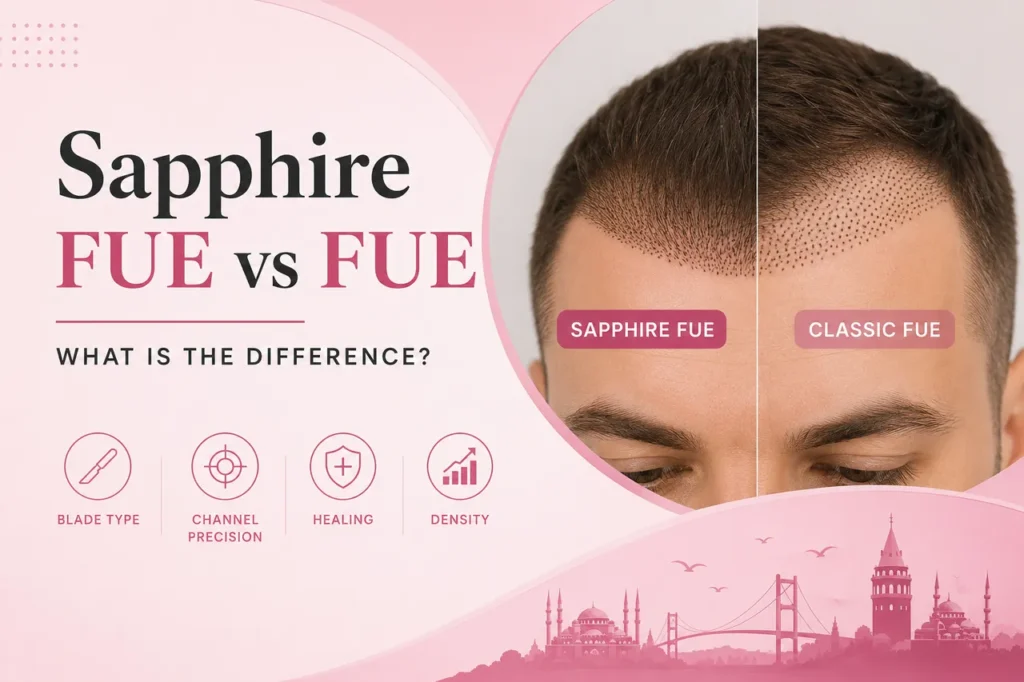
When someone says Sapphire FUE vs FUE, they mean to say Sapphire FUE is the same as FUE.
In both instances, FUE is used to harvest hair follicles.
With regards to recipient sites, Sapphire FUE is an innovation to FUE and uses a sapphire blade, while standard FUE uses another blade or instrument.
Therefore, these are not two completely different procedures.
The comparison should include the entire process: extraction, graft handling, recipient-site preparation, and implantation, as well as the level of experience of the medical team.
A vs FUE comparison is therefore more useful when it focuses on the recipient-site instrument rather than presenting them as unrelated hair transplant methods.
Sapphire FUE vs DHI
Sapphire FUE and DHI describe specific steps in the procedure.
In the literature, Sapphire FUE refers to the FUE harvesting procedure where the recipient sites are made with the use of sapphire blades.
DHI refers to graft implantation using an implanter device.
DHI hair transplantation is therefore mainly associated with the implantation process rather than the material used to create recipient channels.
In most cases, the main difference is in the recipient phase.
Neither term should be assumed to mean more grafts, better density, or a better aesthetic result.
Hairline design, donor management and excellent graft placement still matter, regardless of the recipient technique.
Frequently Asked Questions About Sapphire FUE
Is Sapphire FUE Better Than Standard FUE?
Not necessarily.
While some studies have shown favorable outcomes with the use of sapphire blades, current evidence indicates that for most patients, sapphire blades cannot be considered superior to other options.
The quality of the entire surgical plan is more important than one instrument.
Does Sapphire FUE Leave Scars?
Yes.
FUE extraction with the use of Sapphire FUE blades creates multiple small donor scars that take time to heal.
The NHS has stated that FUE leaves many small scars that, in most cases, are less noticeable than the linear scar left behind with the FUT procedure.
Sites that have been recently implanted also need to heal.
How Many Grafts Can Be Transplanted?
There is no fixed upper graft limit with Sapphire FUE.
The limit is determined by the available donor area, the size of the recipient area, the existing density of hair, the anticipated future hair loss, and the safe donor hair that can be harvested.
Using sapphire blades for FUE does not produce additional donor follicles.
The number of grafts should therefore come from the individual hair analysis and donor assessment.
How Long Does Sapphire FUE Take?
The overall time frames for the procedure will be determined by the number of grafts to be inserted and the overall complexity.
The NHS states that a typical hair transplantation session takes around 6-8 hours; however, larger areas can extend the sessions to multiple days.
Therefore, the overall complexity of the surgical plan is the most important factor in determining the length of a Sapphire FUE hair restoration.
Medical Sources
- Hair transplant — NHS, UK.
- Importance of the Recipient Area in Hair Transplantation — International Society of Hair Restoration Surgery.
- Accuracy in Hair Repair: Assessing Sapphire FUE, Forceps Methods, and Treatment Times in Contemporary Hair Transplantation — PubMed / Rajiv Gandhi University of Health Sciences.