
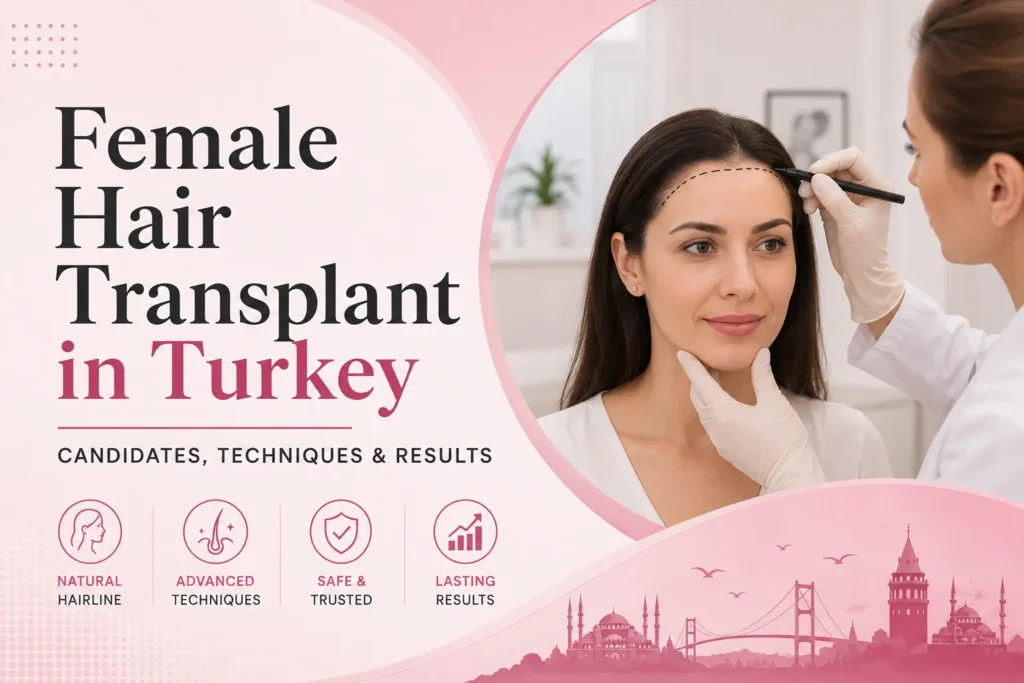
A female hair transplant in Turkey may be an option for women with permanent hair loss and enough stable donor hair to support transplantation.
Hair loss in women may have characteristics that differ from men. Some women experience diffuse thinning over the central scalp while others are bothered by a naturally high hairline, a receding hairline, temple recession, loss of hair due to traction, or an area of stable scarring.
As such, a female hair transplant should begin with a diagnosis without immediately jumping to a surgical technique or number of grafts. The recent review on hair transplantation in women encourages the assessment of systemic causes, diffuse thinning, scarring, and traction alopecia and the preservation of the donor area.
For women who wish to have hair transplant in Turkey, the question should not only be whether or not hair can be transplanted. Donor density, recipient area, pattern of hair loss, and long-term treatment must also support surgery.
Can Women Have a Hair Transplant in Turkey?
Women can certainly have a hair transplant in Turkey under the appropriate circumstances involving pattern of hair loss and donor area.
Limited forms of female hair loss have been treated with hair transplantation. Female pattern hair loss is the most common of these. Stable areas of hair loss may also be treated. Modern reviews state that hair transplantation has a limited use for androgenetic hair loss and selected stable forms of cicatricial hair loss for men and women.
Although hair transplantation for women is not a routine procedure and each woman is different, women have varying degrees of thinning and some women may also have less donor hair. For this reason, the transplant donor and recipient areas should be assessed for diffuse thinning.
Individually planning each hair transplant for women is essential.
Which Female Hair Loss Patterns are Suitable for Hair Transplantation?
The cause and stability of hair loss and the donor’s availability are the crucial factors that determine hair loss.
Female Pattern Hair Loss
Hair loss due to female pattern baldness may be progressive and may occur in the upper part of the scalp or in the central part.
The most common hair loss pattern in women is female pattern hair loss for which hair transplantation has been performed successfully in extensive studies. In a large retrospective study on women who underwent surgical treatment for female pattern hair loss, the limiting factor was the donor area.
Thinning can also become noticeable around the part line.
Thinning in the donor region may lead to less stable grafts available for transplantation.
To avoid surprises, the potential progression of the patient’s hair loss must be incorporated in evaluation of donor density for female hair restoration in Turkey.
Receding Hairline
Some women desire transplantation to correct a frontal receding hairline, rather than to treat diffuse thinning. Hairline restoration can only be considered for selective regions of the frontal area.
The hairline must be planned based on long-term stability and the proportions of the face, donor availability, and the existing hair.
Traction Alopecia
Continuous pulling caused by certain hairstyles can result in traction alopecia.
If the pulling has stopped and the area has become stable, a transplant is an option.
Transplantation should not be relied on to reverse the ongoing damage to the transplanted and/or existing hair follicles.
Trauma Related Treatment Regions
Selective stable regions due to trauma, surgery, or tumor excision, and inactive scarring may be treated with hair transplantation.
Transplanting into scar tissue may require a different approach because the recipient tissue is unlike the normal scalp. Modern literature expands the use of hair transplantation to stable cicatricial alopecia, but emphasizes good patient selection.
Unsuitable Cases for Female Hair Transplantation
Thinning hair should not be treated with hair transplantation unless the thinning hair is of sufficient density to be an attractive surgical option.
Diffuse Unstable Thinning
This type of thinning can affect a vast area on the recipient site and gradually spread to the donor area.
The guidelines on hair-transplant practice advise that female patients be examined for diffuse thinning in both sites.
The permanence of the surgical outcome is based on the stability of the donor follicles.
Active Hair Loss Conditions
The surgery is also only advised once the active inflammatory or progressive hair-loss conditions are resolved.
This also applies if hair loss is a consequence of an underlying medical or nutritional concern. The practice principles for women suggest an evaluation of the systemic concerns and nutritional concerns instead of automatically adopting a surgical approach for all thinning.
Insufficient Donor Density
Since hair transplantation involves shifting hair from one area to another, there is no possibility of creating more hair.
Therefore, a woman with a deficient stable donor density may not have adequate hair to ensure significant improvement without adversely affecting the donor site.
Why Is Hair Loss Diagnosis Important Before Female Hair Transplant Surgery?
The primary reason for diagnosis is to ascertain whether transplantation is a suitable option.
Female pattern baldness may have multiple reasons that are indistinguishable in photographs. The retention of the pattern and stability of the donor area are determined by an assessment of the medical history and the scalp examination.
A recent review of hair transplantation in women has also emphasized the need to evaluate for systemic contributors and assess for traction and scarring alopecia.
Diagnosis is also important as post-operative hair loss may occur in a circumferential pattern.
The NHS notes that existing hair around a transplant can continue to thin, which is why the design should take into consideration the possibilities of thinning.
Therefore, a female hair transplant should be the first step in a long-term hair restoration plan rather than a way to fill in every thinning area.
How Is the Female Donor Area Evaluated?
The donor area needs to be assessed to determine the final graft number.
The donor area density, the thickness of the hair, the distribution of the hair, the degree of possible miniaturization of the hair, and if the thinning extends to areas from which grafts are expected to be harvested, all need to be analyzed.
Current hair-transplant practice guidelines recommend that the donor area is examined multiple times to evaluate the donor hair, and that a safe donor area is established before harvesting.
Women need to be assessed specifically, since female hair loss can occur more in a diffuse pattern as opposed to the frontal male pattern loss.
Hence, the number of grafts to be harvested should follow donor assessment instead of being harvested from a standard graft pack.
Female Hairline Design and Hairline Lowering in Turkey
Female hairline lowering in Turkey happens when a high forehead is the main concern.
It can also happen when a patient does not like the natural hairline.
When lowering the hairline, the shape of the hairline, the frontotemporal area, facial proportions, donor supply, and blending of transplanted hair should be considered.
When female anterior hairline pattern and characteristics are discussed, the instructions become more specific and thus more detailed, outlining the need to perform a more complex planning approach to restore the anterior hair line.
Single-hair follicular units are effective to address concerns in the frontal hairline, excess hair grafts can be used to create more density back there. Lowering the hairline can increase the surface area to be covered and can increase the graft requirements.
What Hair Transplant Procedures and Techniques Can Be Used for Women?
Technique should be selected after diagnosis, donor evaluation and recipient plan.
Women are able to undergo FUE, FUT or implantation based DHI methods depending on the case.
FUE Hair Transplant for Women: Follicular Unit Extraction
An FUE hair transplant is the removal of follicular units from the donor area.
The NHS describes FUE as the removal of individual grafts followed by placement of the graft to the recipient area. It often involves shaving the donor area. However, with some techniques, shaving may be limited.
For women with longer hair, donor-area visibility may become important.
DHI Hair Transplant for Women
A DHI hair transplant is an implantation based DHI method.
DHI should not automatically be considered a superior method for women.
The important question is whether the extraction and implantation method is appropriate for the woman’s donor area, existing hair, and required recipient sites. Our page where we compare FUE to DHI explains the technical differences.
Hair Transplant Without Shaving: Non-Shaven or Limited-Shave Hair Transplant
The option of avoiding extensive shaving is particularly important to female patients.
Some techniques may include limited donor area trim or even designed approaches to conceal the harvested area under longer surrounding hair.
There are limitations with all shaving procedures. Some patients or graft requirements will be better suited to alternative options.
For example, women should not assume that a female hair transplant requires no shaving. They should ask how much hair will be shaved.
How Is a Women’s Hair Transplant Procedure Performed?
A women’s hair transplant begins with assessment and treatment planning.
The medical team evaluates the pattern of hair loss, the donor area and the recipient areas before estimating the number of grafts.
The proposed hairline or density treatment is then planned.
Donor hair follicles are then harvested using the selected technique and prepared for placement in the recipient area.
According to the NHS, hair transplantation is usually undertaken with local anaesthesia and sedation, with grafts then placed into recipient sites.
The length and complexity of the surgery will depend on the treatment area and the number of grafts which are transplanted.
How Many Hair Grafts May a Woman Need?
There is no absolute number of grafts for women.
A small hairline lowering surgery may require very little grafts, for example, in comparison to treatment of a large central thinning area.
The size of the recipient area, existing hair density, donor density, caliber and characteristics of the hair, hairline, the level of coverage required and potential long-term effects of donor surgery all determine the amount of grafts required.
The total number of grafts to be expected normally depends on where specific grafts will be placed.
The full planning principles are covered in our hair graft guide.
Female Hair Transplant Cost in Turkey
There are many factors that contribute to hair transplantation costs, depending on the complexity of a female patient’s case. For this reason, the hair transplantation costs in Turkey are adjusted for each patient instead of having a single national price.
The complexity of the treatment, the number of grafts required, the technique selected, the medical staff and what is covered within the package are all factors in determining the cost.
A female requiring a treatment to restore a small frontal zone would receive a different treatment plan than a patient requiring the restoration of a larger central recipient area.
For this reason, an individual treatment plan should be used to determine the cost of hair transplantation for a female patient, as opposed to a single national price.
Hair Transplant Packages and Transplant Cost in Turkey
When comparing packages, it is also important to note the distinction between a medical and logistical package, as logistical packages do not cover the medical aspects of the plan.
Our hair transplantation costs in Turkey guide has more details on packages, grafts, and the techniques available.
Female Hair Transplant Recovery Time and Postop Care
The recovery process for female hair transplantation is very similar to the other hair transplant recovery process.
After the transplantation, there may be some temporary tenderness, swelling, and crusting, and shedding of the graft.
The NHS states that hair transplanted grafts should be handled with extra care until they are fully healed, which usually takes two weeks. They also state that it is common that transplanted hair falls out after some time, and then regrowth happens.
Longer haired females may have more concerns on how to wash and style their hair to conceal and protect the donor and recipient zones during the healing phase.
Hair wash instructions and postop care are particularly important during this early period.
Our hair transplant recovery process guide explains the different stages of recovery from scabbing to sleeping to post-op showering.
Female Hair Transplant Results: 12 Month Hair Growth Timeline
Female hair growth takes time.
Hair that is transplanted usually falls out after the surgery to make room for regrowth. After 4 months, new hair growth can be seen, but full regrowth takes 10-18 months. A hair transplant is a long-term process, and some of the first pictures may seem like good results, but they really may not reflect the full final outcome.
Because of the length of time between a hair transplant and the final outcome, women should understand that their non-transplanted hair may also continue to change.
When looking at pictures of hair transplants, before and after, it is most helpful to look at similar cases of hair transplants. That includes the starting pattern, hair characteristics, and the transplanted area.
Natural results depend on more than early hair growth alone.
Risks, Shock Loss and Limitations of Female Hair Transplant Surgery
The general risks of a hair transplant also apply to a female hair transplant.
There is also the risk of the hair transplant not growing as planned, and indicated by the NHS, can include pain, swelling, scarring, folliculitis, altered sensation, and even loss of hair that was not previously affected (telogen effluvium).
Temporary shock loss is therefore also relevant when discussing recovery and early hair transplant results.
There is also the consideration that not enough hair is available to be a donor for a successful hair transplant. Hair that is successfully transplanted will not prevent future hair loss, and grows to a limited density.
Potential patients should research the safety of hair transplants in Turkey to learn more about the potential risks, safety standards, and unsafe practices of the profession.
Female Hair Transplant Turkey Reviews and Reddit
Looking for reviews of female hair transplants in Turkey by other patients is also important. Hair transplant reviews Turkey female are among the most searched terms.
Reviews and forums can help provide answers to some common questions concerning how hair transplants affect communication, shaving, and recovery, and how they impact the appearance of the donor area and the follow-up care. These should be treated as supplemental sources only and should not be used in replacement of a medical assessment.
A review cannot possibly help the reader determine if they have the same hair loss diagnosis, donor density, or graft requirement as the patient being reviewed.
A quoted success rate should also be viewed in the context of the individual patient, donor area and treatment plan.
In some instances, before-and-after photos of female patients with similar hair loss can be more relevant than focusing on male patients exclusively. That said, those photos should be taken with similar lighting and after the same amount of time following the procedure.
Female Hair Transplant Istanbul and Medical Tourism
The same should apply to female hair transplantation in Istanbul.
The name of the city alone is not the defining criteria upon which a female hair transplant should be evaluated. Rather, this should be determined based on the diagnosis, donor evaluation, treatment planning, medical care, and follow-up.
It also has its own search presence in the data, and so it is more appropriate to include it here than in other areas of the article.
For international patients, medical tourism also makes follow-up planning important.
How Should Women Choose a Hair Transplant Clinic and Experienced Surgeons in Turkey?
Before deciding on any clinic, potential patients should know who evaluates the hair loss, who determines the stability of the donor area, who designs the hairline, and who performs every single step of the surgical procedure.
Women should also ask about the experience of the hair transplant surgeon and the medical team.
Additionally, patients should know what type of support the clinic will offer to the patient after the surgical procedure.
A hair transplant clinic should be evaluated as a medical and surgical provider rather than only as a travel service or cosmetic package.
Consultation at Bella Clinic Istanbul should follow the same order for women under consideration. This includes diagnosis, assessment of donor, selection of technique, graft planning, realistic expectations, and follow-up. By following this order, Bella clinic can offer treatment options in Istanbul without endorsing an unsubstantiated claim that any clinic is the best in the world.
For a more detailed description of qualifications, exam results, previous patients, standards, and warnings for Turkey clinics, please refer to our guide for selecting a hair transplant clinic in Turkey.
Female Hair Transplantation in Turkey – Frequently Asked Questions
Do I Need to Shave My Entire Head?
This is not necessary.
The extent of shaving or trimming is dependent upon the method of harvest, the total grafts, and how much the surgical team requires access to the donor area.
It is recommended that women know the details of the shaving plan before the surgery to prevent any confusion caused by assuming hair transplantation can be performed completely unshaven.
Can Hair Transplantation be Used for Treatment of Alopecia Diffusa?
In some situations, yes.
Diffuse alopecia requires careful assessment.
If the donor area is affected by the same process of diffuse alopecia, the supply of stable follicles may be inadequate.
Hair-transplant guidelines specifically state that careful assessment should extend to the female donor and recipient areas.
Can Women Have Their Hairline Lowered?
Yes, provided the donor area is suitable, hair transplantation can be used to lower a naturally high frontal hairline or to correct an otherwise receded hairline.
This should be undertaken bearing in mind the donor area, density, and the stability of the transplanted hair.
Is Female Hair Transplant Permanent?
Transplanted follicles are picked from donor sites that should be less prone to changes in the future, but that does not mean the patient’s hair will be unchanged.
Native hair continues to thin, so long-term planning remains necessary.
How Much Does a Women’s Hair Transplantation in Turkey cost?
There is no fixed cost.
The cost is determined by the treatment area, amount of grafts, type of methodology used, treatment plan and what the treatment agreement includes.
A quote has to be evaluated relative to what will actually be done.
Medical Sources
- Hair Transplantation in Women — PubMed / Facial Plastic Surgery Clinics of North America. Reviews female assessment for hair transplantation, diffuse thinning, preservation of the donor area, traction alopecia and scarring alopecia.
- Hair Transplant Practice Guidelines — Journal of Cutaneous and Aesthetic Surgery / PubMed Central. Clinical recommendations for assessment of female donors, diffuse thinning, safe donor areas, and hairline planning for women.
- Hair transplant — NHS, UK. Assessment and reviews female hair transplantation, methodology, risks, recovery, results and long term adjustments.