
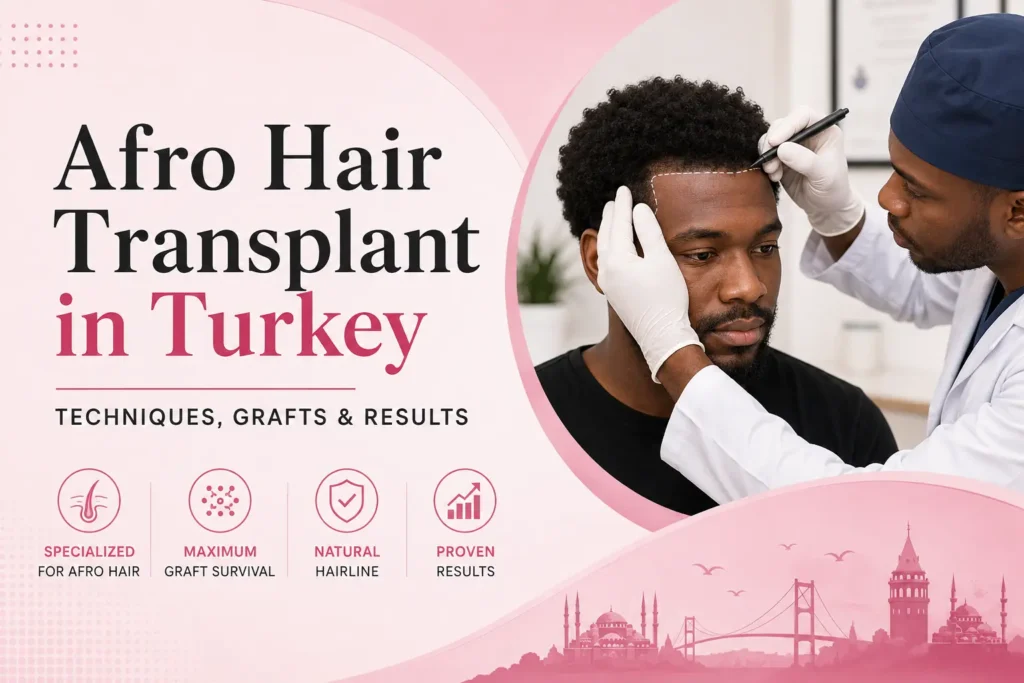
An Afro hair transplant in Turkey goes beyond a regular hair transplant because of the curl pattern of Afro-textured hair. The kinks and coils in Afro hair can extend to the hair follicle which would make extraction surgically more difficult.
It is important to know that during an FUE procedure, the follicular unit must be extracted without damaging or cutting the follicle, and in some patients, traditional extraction techniques can cause a high rate of transections (the follicle dies) when the instrument used for extraction does not adhere to the curvature of the follicle beneath the skin.
While the curl pattern of the hair may provide low density, strong visual coverage can be achieved by curly hair due to the difference in contrast of hair and scalp, and the caliber and composition of follicular units.
For patients seeking a hair transplant in Turkey, a treatment plan should be designed by analyzing the hair and scalp characteristics of the patient, and not implementing a one-size-fits-all solution of Afro-textured hair transplants and grafts on each patient.
Why Is an Afro Hair Transplant More Complex?
Hair transplantation moves healthy hair follicles from a donor region to a recipient region. Afro-textured hair will require additional consideration, and extraction of follicles should be done with respect to the pattern of the visible hair shaft and the hair follicle.
Curved Hair Follicles Beneath the Skin
Research on patients of African descent has shown that variations in scalp skin thickness and firmness can complicate follicular unit extraction. Because of this, two patients with the same curl pattern might behave differently when a follicular unit is extracted. Curly hair follicles can actually be molded against the skin in an arching manner, curving along a path that cannot be seen by the direction of hair as it leaves the scalp.
One study of 18 patients with tightly curled hair determined that in the cases where a rotary instrument was used, excessive follicular transection occurred, whereas the use of a device designed to address curvature of follicular units reduced transection.
While the size and the nature of this particular study limit the conclusions that can be drawn from it, it does provide some insight into the importance of the shape of the follicle during the extraction process.
Hair Curl, Calibre and Visual Density
The visual density of tightly curled hair will give the appearance of greater coverage than hair that is not tightly curled. The greater caliber of hair can also give the appearance of volumetrically greater coverage.
This does not mean there are fewer Afro-textured hair grafts. Recipient area size, existing hair, donor density, hair line design and the number of hairs per follicular unit will still impact the treatment.
Why Hair and Skin Characteristics Affect Extraction
Extraction of hair from different ethnic backgrounds is just like getting hair from someone of a different race, hair type differs and so does skin type. Afro-textured hair, like other ethnic hair types, is not a monolith.
Some people have tighter coils and some have looser curls. There is also variation in the firmness and thickness of the scalp. A study done in different countries on folks from an African background, found that the hair type and skin characteristics impacted the attrition of grafts and the difficulty of extraction.
Because of this, extraction should not be done based off of ethnicity, but on what is best for the individual.
Who Is a Good Candidate for Afro Hair Transplant in Turkey?
A stable hair loss process that is amenable to treatment, and a sufficiently large donor region, is all that is needed to be a good candidate.
African American Hair Transplant in Turkey and Afro-Caribbean Patients
In the context of Black and Afro-Caribbean communities, a good candidate is informed about the hair loss process, and the limitations of hair restoration in Black and Afro-Caribbean communities.
These communities comprise the vast majority of the people doing research on hair transplants in Turkey.
Patients should not be evaluated based on other patients of color. Instead, patients should be assessed based on their own hair. An approach that worked for another African American or Afro-Caribbean patient may not work for them.
Afro Hair Transplant for Women in Turkey
Black women can also be candidates for transplantation, but the diagnosis can be even more crucial for women with diffuse thinning, traction alopecia, or scarring alopecia.
Central centrifugal cicatricial alopecia, or CCCA, is a condition that can occur in women of African descent. Hair transplantation has been performed for carefully selected patients with end-stage CCCA when the active inflammation and scarring had healed. CCCA should not be transplanted while the active scarring is still present.
Women can also look at our female hair transplant in Turkey for more information on female donor, hairline, and diffuse-thinning considerations.
When Hair Loss Should Be Diagnosed Before Surgery
A hair transplant cannot address the root cause of every type of hair loss.
Progressive scarring alopecia, active inflammation, or unstable donor thinning can affect candidacy. In such cases, the diagnosis must be certain, and this can only be determined after a clinical examination, trichoscopy, and sometimes other more specific dermatological tests.
How Is the Donor Area Evaluated in Afro Hair?
The donor area should be assessed before an estimate of the potential grafts is made.
Hair- transplant practice guidelines state that donor assessment should take into account ethnicity, hair type (curly or straight), miniaturization, density, calibre and quality. They should consider all the above factors.
Donor Density and Hair Traits
To the untrained eye, a dense hair donor region may seem like the best option, but there is more to this than meets the eye.
For actual assessment, the clinician must consider density of follicular units, number and thickness of hairs, and curvature of follicles and extraction challenge this creates.
Safe Donor Area and Long-Term Donor Management
The aim is not to maximize donor harvest.
Overharvesting results in permanent thinning, scarring and pigment changes in the donor region. Recommended practices include conservative extraction within a safe donor region and state that the limits of safe donor extraction vary for each patient.
Afro Hair Transplantation Techniques in Turkey: FUE, DHI and Sapphire FUE
When researching an Afro hair transplant Turkey, the terms FUE, DHI and Sapphire FUE may be encountered. However, individual surgical planning should not be done by naming a technique.
FUE Hair Transplantation for Afro Hair Transplant
In FUE, follicular units are removed from the donor site one by one.
The main concern in Afro hair type is following the hair follicle unit below the surface without transection. Therefore, proper punch size and depth, as well as skin response, will affect the surgery.
Direct Hair Implantation (DHI) for Afro Hair Transplantation
DHI transplantation consists of hair implantation using a special device.
Implantation is done after extraction. Therefore, for successful implantation, strong curvature of follicles must be addressed.
Because of this, when comparing FUE to DHI, the entire process should be taken into account, not just how grafts are positioned.
Sapphire FUE for Afro Hair
In this type of Sapphire FUE, a sapphire blade is used to create recipient sites.
This method does not change the overall challenge of removing Afro-textured hair follicles in a safe manner from the donor area.
Specialized Techniques, Individualized Selection and Realistic Expectations
There’s not one best technique for all Afro hair.
Skin characteristics, the degree of curl, donor area density, the size of the treatment area, the number of grafts required, and a given team’s experience and preference can dictate which technique is best for a given situation. It isn’t always completely Straightforward.
Why Is Follicle Extraction More Technically Sensitive in Afro-Textured Hair?
Follicle Curvature
Visible shafts of hair may actually be curved while the follicle itself will be along a curved course beneath the skin. As a result, the direction and the depth of extraction will be critical.
Risk of Follicle Transection
A transected follicle is an extracted hair that has been cut.
Because of the nature of tightly coiled Afro-textured hair, this problem has been well described in the literature. Novel techniques avoid treating all follicles as if they follow a straight line.
Graft Handling
Extraction is only the beginning. The extracted follicular units need to be properly handled and stored, and ultimately implanted. A high quoted graft number has limited use when the process has caused unnecessary damage to the follicles.
Experience With Curved Follicles
Surgeons need to have performed many hair transplantation surgeries. However, experience needs to mean more than that.
When evaluating a medical team for Afro hair, it is also important to consider if they have had experience with variability in curl pattern and if they include donor healing and recipient before and after photos for patients with similar hair characteristics.
Achieving Natural Hairlines: How Is an Afro Hairline Designed?
In designing an Afro hairline, your hairline, facial proportions, and the direction and density of your curls should be considered. The hairline should not be drawn low simply based on the number of grafts you have available.
Hairline Shape and Curl Pattern
When designing a hairline, the shape and pattern of the curl should also be considered.
Placement and the curls’ distribution can change how the outline is appreciated.
Single-Hair Grafts and Density Planning
More visual density may be achieved in the posterior regions of the hairline with larger grafts, and smaller, single-hair grafts may be more appropriate at the fronlot ede.
How Many Grafts Are Needed for Afro Hair?
There is no standard Afro hair graft number.
A frontal hairline may require very few grafts, while mid-scalp or crown restoration may require many more.
The recipient area, the area’s existing density, donor density, and hair caliber, as well as the covered area and the number of grafts, should be considered.
Our guide explains how many grafts you may need in more detail.
Why Graft Numbers Alone Do Not Predict Coverage
Two patients receiving the same number of grafts may achieve different levels of visual density.
Though large amounts of Afro-textured hair may create a lot of visual coverage, this should not be extrapolated into a general principle that all patients will require fewer grafts.
Straight Hair vs Curly Hair: How Does Afro Hair Impact Perceived Density?
The appearance of visual coverage on the scalp is impacted by many factors and is not synonymous with the number of hairs or density. Hair caliber, curl pattern and contrast with the scalp creates an optical illusion of coverage. So the goal of a treatment plan is not to increase the density or total number of grafts, but to achieve an optimal level of scalp coverage.
Afro Hair Transplant Before and After: Results & Growth Timeline
Before-and-after pictures gain value if comparable patients have a similar degree of hair curvature and a comparable stage of hair loss. The recipient site should also be similar. For full comparison, pictures of different growth stages should be used.
When Can Results from Afro Hair Transplants Be Evaluated?
New hair growth will ultimately replace all the shedding from the hair follicle graft. According to the NHS, new growth should be visible in as little as four months. However, it is important to note that full transplant results can take between 10 and 18 months.
Our guide on how to compare before-and-after pictures of growth is a useful resource.
How Much Does Afro Hair Transplant Cost in Turkey?
There is no all-inclusive Afro hair transplant cost for Turkey. The total cost is dependent on the required grafts, the degree of difficulty for the extraction, the proposed plan, the medical staff and what the overall cost of the treatment will be.
What Should an Afro Hair Transplant Package in Turkey Include?
Advantages of a package may include convenient logistical services (e.g. accommodations), but a medical package should not be evaluated based on included services.
For more information on hair transplant costs in Turkey, please see our other guide, which details considerations and cost breakdowns, including different techniques and grafts.
What Is Afro Hair Transplant Recovery Like?
The recovery process for an Afro hair transplant is essentially the same as any other hair transplant, though there are some differences in the early stages of the recovery.
Tenderness, swelling, and even some crusting can occur and can be expected. Grafts should be handled with care so that they do not become dislodged before they fully integrate. This Care should be taken for roughly the first two weeks as per the NHS.
The care instructions provided by the clinic should be followed and the hair should not be washed per the clinic instructions since it is curly. Please refer to our guide on recovery for more information on the washing and shock loss processes.
Special Considerations, Risks and Graft Survival for Afro Hair Transplants
Damage to the Donor Area
Harvesting too deeply or in an uneven manner will cause damage to the donor area. Safe and even donor extraction is important so that the appearance of the donor area is not compromised.
Formation of Keloid Scars
Patients with a history of Keloid scarring or a history of other abnormal scarring should discuss this with their practitioners.
Transection of Grafts and Graft Survival
Because of the curved nature of the follicles, the extraction process can be technically challenging for Afro hair. Damage to follicles during extraction may adversely affect the graft count even if the original target graft count was higher.
Hairline and Density Planning
Unsatisfactory outcomes are possible even with successful extractions. Poor planning of hairline, direction or distribution of grafts can still produce a poor result.
Afro Hair Transplant Turkey Reviews: What Should You Look For?
When reading Afro hair transplant Turkey reviews, focus on individual aspects of the procedure (e.g. donor area vs. healing, hair texture vs. results, level of hair density) and not on the quality of hotel accommodations, transfer services or the communication process.
It is helpful to read reviews to understand what questions to ask. However, just because another patient had similar healed donor area, hair texture and results does not mean that patient had the same follicular curvature, donor capacity, and / or diagnosis.
How Should You Choose a Transplant Clinic in Turkey for Afro Hair?
Focus on substantiated, verifiable factors rather than unsubstantiated best rankings when looking for a good Afro hair transplant in Turkey.
Who evaluates the donor area? Who performs the extraction? Who manages the extraction of curved follicles? How is transection controlled? Who puts in the implants?
For international patients, Deputy Minister of Health – International Health Services (ICD) maintains lists of authorized health care providers. Those lists were published recently (2026). Check the lists as part of your verification process.
Relevant Before-and-After Cases
View cases that include a similar level of donor area density and similar hair curl and donor-area photographs.
Hair Transplant Clinic Experience With Afro-Textured and Curved Follicles
When asked what they offer, the clinic should explain changes to their extraction technique to account for hair follicles that curve.
Donor Management
Your surgeon should explain how they would manage your donor area and protect it from future hair loss when making a donor graft plan.
Who Does What?
Patients must be aware of who is responsible for the consultation, assessment of the donor area, extraction, production of the recipient site, and the placement of the grafts.
Our review of hair transplant clinics in Turkey covers these points and includes some of the typical red flag concerns.
Afro Hair Transplant in Istanbul
The standards of medical evaluation for an Afro hair transplant in Istanbul should be the same as those applicable elsewhere.
At Bella Clinic in Istanbul, the evaluation of Afro-textured hair for a hair transplant should not be limited to naming the technique; it should include a thorough assessment of the donor area, valuable diagnosis, and individual follicular characteristics, as well as the management of the donor area, graft planning, and the selection of a suitable technique and the expected results.
Frequently Asked Questions About Afro Hair Transplant in Turkey
Can FUE Be Used for Afro Hair?
Yes, FUE can be used in patients with Afro hair in certain cases.
The extraction of the hair follicles would definitely be more challenging because of the extreme curvature of the hair follicles and would require an extraction technique that is specifically adapted to the patient.
Does Afro Hair Need More or Fewer Grafts?
Neither can be stated.
Dense curly hair provides excellent coverage, but the overall content of the graft required would still depend on the treatment region, existing hair, the desired outcome, and donor coverage.
Can Black Women Have a Hair Transplant?
Yes, a hair transplant can be performed on some Black women.
If there is a suspicion of hair loss due to traction, diffuse thinning, or a scarring condition, the underlying cause must be identified.
Can African American Patients Undergo a Hair Transplant in Turkey?
Patients of any nationality can undergo a hair transplant in Turkey.
Diagnosis, donor supply, follicular unit and skin characteristics, goal of treatment, and the abilities of the treatment team regarding the extraction of the patient are the critical factors.
Does Afro Hair Produce High Visual Density?
Afro hair typically provides good visual density due to the concealing nature of curly hair.
Viewing curl patterns as high follicular-unit density or to predict the outcome of a hair transplant is incorrect.
How Does Transplanted Hair Grow After an Afro Hair Transplant?
Early regrowth is apparent after several months, but the complete outcome of a hair transplant is generally apparent after 10-18 months.
Medical Sources
- Comparative Study of a Novel Tool for Follicular Unit Extraction for Individuals with Afro-textured Hair — Plastic and Reconstructive Surgery Global Open / PubMed. Focuses on extraction of follicular units in Afro hair and related problems with transection.
- Hair Transplant Practice Guidelines — Journal of Cutaneous and Aesthetic Surgery / PubMed Central. Guidelines on assessment of donor and safe donor areas, extraction of follicular units (FUE), overharvesting, hairline and graft management.
- Hair transplant — NHS, United Kingdom. Information on FUE, recovery, protection of grafts, risks, and the approximate timeline for hair growth.