
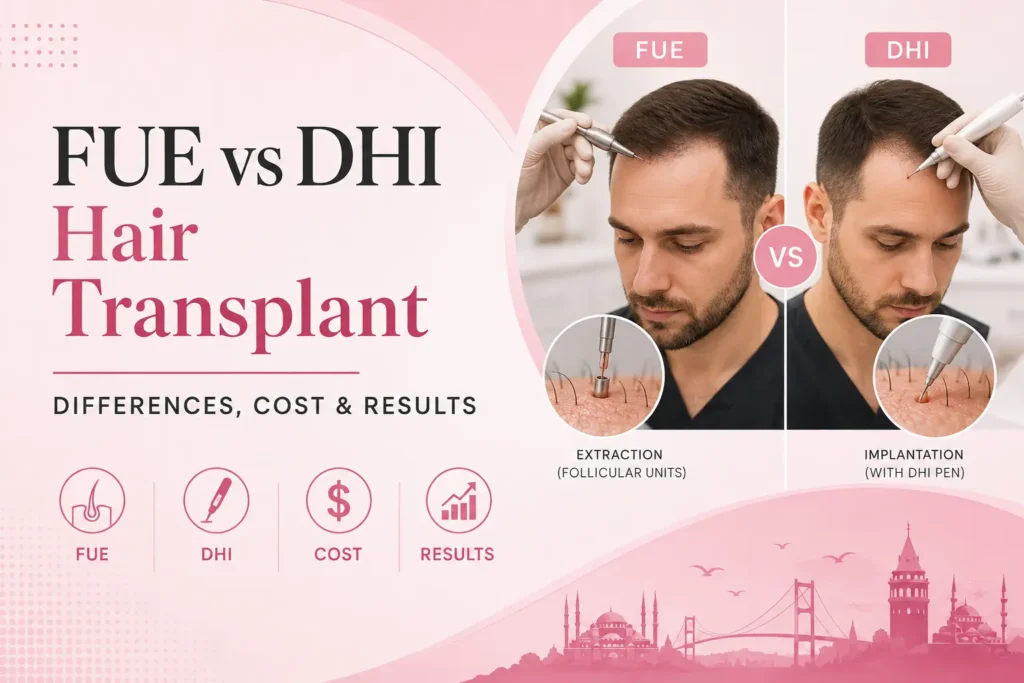
When explaining FUE and DHI, they sometimes get compared against each other as if they are rival hair transplant methods, but it is actually more complicated than that.
Technically speaking, FUE is the name for the method of removing follicular units from the donor region. In this respect, DHI is used to explain the method of using an implanter device to place harvested grafts in the recipient region. In that case, performing a DHI method would require a previous FUE method. In these contexts, both terms are describing different parts of the same hair transplant method, rather than two complete and distinct methods. ISHRS has stated that for FUE, the process actually does involve both incision and excision of follicular units.
When comparing FUE vs DHI from a patient perspective, more important considerations are how the grafts will be harvested, how they will be handled, how the recipient region will be prepared, who will perform each part of the procedure, and whether the method is appropriate for the donor supply and the expected pattern of the patient’s future hair loss.
This makes the comparison relevant to the wider hair restoration and transplant process, not only to the name attached to the procedure.
Neither of these methods is appropriate for the patient just because they have been told that it is newer, more advanced, or more precise. When considering a hair transplant, many other factors outside the method of harvesting the grafts come into play.
A hair analysis should therefore look at the donor area, existing hair and the recipient region before a technique is selected.
FUE or DHI? What Is the Main Difference?

The main difference between FUE and DHI is the stage each of them describes.
In regards to donor harvesting, FUE stands for Follicular Unit Extraction. In the case of FUE, individual Follicular Units are removed by excision rather than by removal of a donor strip. According to the ISHRS, Follicular Unit Extraction consists of a circumference incision around each Follicular Unit.
In the case of implantation, DHI stands for Direct Hair Implantation. In this case, the harvested grafts are loaded into an implanter and placed into the recipient area. In this method, with a sharp implanter technique, site creation and graft insertion can be done in a single motion.
Therefore, DHI vs FUE can not always be understood as one extraction method vs another extraction method.
A patient can undergo FUE extraction and then followed by DHI implantation.
This is also why DHI hair transplantation and FUE can sometimes form parts of the same surgical workflow. The implantation process is one part of that wider workflow.
What Is FUE?
Follicular Unit Extraction is a method of hair transplantation in which individual follicular units are harvested from the donor area using small punch excisions.
The NHS defines FUE as the removal of individual grafts before placing them into small recipient sites.
The harvesting of follicular units is only one part of the procedure.
After harvesting, the FUE grafts need to be protected from unnecessary trauma and then placed into the recipient area. The design of the hairline, the management of the donor region and the placement of the recipient sites also play a part in the result.
The handling of each hair graft and its follicles remains important between extraction and implantation.
When we talk about FUE, we are not describing a specific method of graft implantation.
First, the donor hair is pulled out one graft at a time, and depending on size, the graft is either cut with a scalpel or a perforator tip.
What Is DHI?
In a DHI transplant, the graft harvesting is done using a method similar to FUE and then implantation is performed using an implanter device.
The graft is loaded into the implanter. The device is positioned at the recipient site and is used to place the graft at the desired depth, angle, and direction.
The description in the literature for sharp implanter methods notes that the hair follicle unit can be loaded into the shaft of the implanter prior to skin penetration. The hair follicle unit remains in the opening after skin wound closure.
This explains the reason for the search question direct hair implantation vs FUE. Direct hair implantation refers to the recipient stage and FUE refers to the donor extraction stage.
Different implanter methods may be used for graft placement, but they still depend on correctly harvested and handled follicles.
A Choi implanter or Choi implanter pen is one of the devices associated with this type of hair implantation method.
Is the Extraction of Grafts Different for FUE and DHI?
In theory, not really.
A study describing straight hair transplantation considered it a modification of an existing FUE technique. The authors described the steps of the FUE technique including the extraction of grafts and the placement of grafts.
The important thing here is not that the technique is described as FUE or DHI.
The donor area is still a limited resource. For both techniques, extraction needs to avoid needless damage to the follicles and unnecessarily compromise the donor region.
For this reason, graft survival begins to matter before the implantation stage itself. Graft survival rates are affected by more than the device used for placement.
A DHI implanter cannot compensate for poor donor harvesting.
How Is Implantation Different?
This is where the comparison is more relevant.
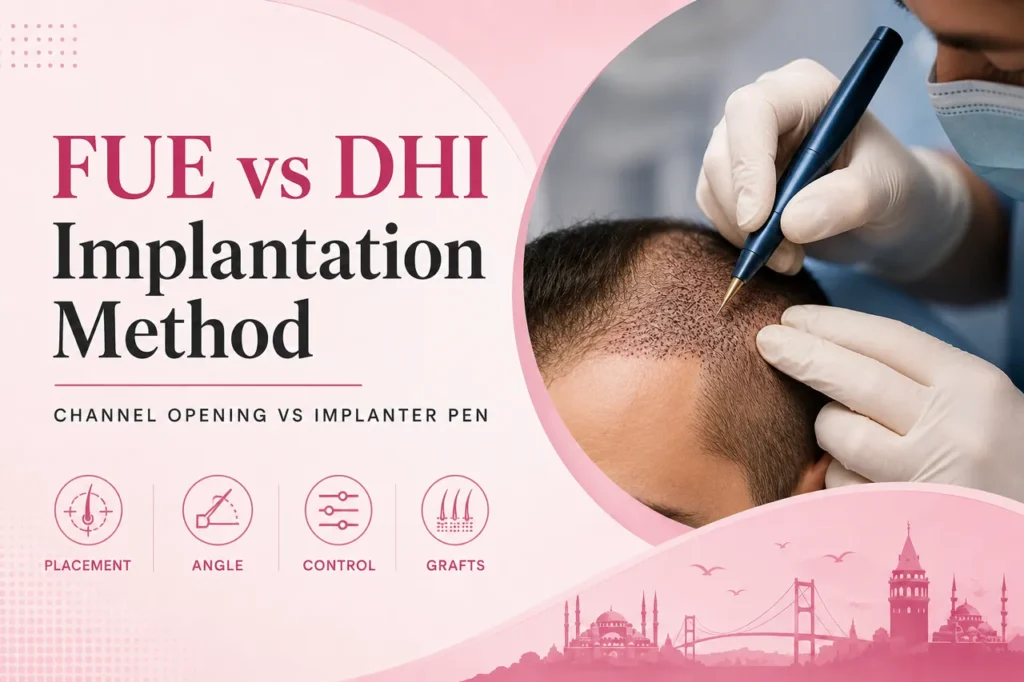
In the typical FUE methodology, recipient sites are created and in a separate step grafts are placed in the recipient site using forceps or other devices.
In an implanter based method recipient site creation and graft implantation are performed as a single step.
The advantages of sharp implanters include the possibility of greater control over insertion angles and less direct pulling of the follicle with forceps. The disadvantages include a high level of post-production work and the risk of graft popping and poor survival with suboptimal use of the device.
The DHI technique therefore changes how the implantation stage is managed rather than creating a new donor extraction method.
Precision control during implantation can be useful, but it still depends on the person using the device.
The use of the implanter does not ensure a good result.
FUE vs DHI for Hairline Design
Design of the hairline requires significant planning. The name of the implantation method is less important.
The frontal hairline must have appropriate direction and angle, irregularity, and selection of grafts. According to ISHRS, the depth, width, and spacing of grafts, their direction, and placement in the recipient area must be considered.
DHI provides the operator with direct control over the placement of individual grafts with an implanter.
This may be valuable in some selected hairline work, especially in cases where placement with a high degree of precision is required.
However, this does not mean that, for hairline work, DHI is superior to FUE when other implantation techniques are used.
A poorly designed hairline is poor planning even with the use of the best equipment available.
The goal with either method is a natural result that works with the patient’s natural hair and existing hair.

FUE vs DHI for Hair Density
Neither technique increases the donor follicles.
Hair density is determined by the supply of donor hairs, the hairs in each unit of follicles, the recipient area, how the grafts are distributed, and the thickness of the hairs.
Dense placement of hair grafts can be achieved through the use of implanters. In published literature, a high density is achieved when implanters are used correctly. The literature, however, emphasizes the importance of experience and correct depth along with the prevention of graft trauma.
In summary, the “Which is more dense, FUE or DHI?” question cannot have a definite answer.
It is important to note that technique does not automatically give density.
Which Technique Can Handle More Grafts?
The number of grafts that predetermines FUE or DHI as a more valuable technique does not exist.
The number of grafts that can be safely inserted relates to the size of the donor area and the area that needs to be covered by the recipient site.
DHI may use a lot of resources once a large number of grafts are constructed and need to be implanted one by one. Implanters may need several people working to keep them loaded and operating.
When a large number of follicular units is required to be harvested and placed, FUE also has many hours of work.
The number of grafts that is the correct value should be determined from the technique of implantation.
Does FUE or DHI Require Shaving?
Neither technique by itself creates a definite shaving rule.
When follicular units have to be accessed to perform traditional FUE, the donor area is shaved. The NHS also states that for their standard explanation of FUE, the back of the head is shaved.
There are several techniques that include modified partial shave and long hair techniques.
DHI does not always mean a no-shave transplant. If FUE is used for the donor grafts, access to the donor area is also necessary.
An unshaven hair transplant may be possible in selected circumstances, but it is not automatically a feature of DHI.
The extent of shaving relates to the length of hair and the number of grafts that are harvested.
FUE vs DHI Recovery
The recovery for both methods can be similar since DHI may still use FUE to harvest the grafts.
Both techniques leave donor site areas and recipient site areas with small wounds.
According to the NHS, patients can expect some aching, tightness, and swelling as well as temporary scabs after the transplant. The NHS suggests patients protect their transplanted grafts from damage for the first two weeks after the transplant.
Factors affecting the recovery from a hair transplant procedure can include the size of the surgery, extraction site type, the recipient-site work, and the rate at which the patient heals.
Postop care after either method is also concerned with protecting the recently transplanted hairs and allowing donor and recipient sites to heal.
Recovery times can vary from one patient to another even when the same technique is used.
Scabbing and Healing
During the early phase of the healing process, small scabs are normal on the grafted area and on the donor site.
Like any surgical site, even sites harvested by FUE, a donor site needs time to heal.
DHI does not close the donor site when FUE has been used to harvest hair.
The appearance of the recovered site can be different based on the methodology of recipient site creation, but claims that one method heals faster than the other should be taken with caution.
Shock Loss
After either method employed, a patient can expect some hair shedding.
Numerous weeks after the surgery, the transplanted hair begins to grow. The NHS notes that transplanted hairs will fall 4 to 6 weeks after the surgery and begin to grow again.
Shedding of hair surrounding the transplant site can also be expected.
This temporary shedding is often described as shock loss after hair transplantation.
Normal Shedding is not affected by DHI technique.
Returning to Normal Activities
How quickly a patient returns to work after FUE or DHI depends more on how the patient’s body heals than the surgical method.
The NHS notes that healing can take from 7 to 14 days and patients may need to take time away from work to recover. During this time activity should be restricted.
The treating medical team should provide instructions based on the extent of the individual procedure.

FUE vs DHI Results
At present, there is no evidence to support automatically treating FUE or DHI as better for all patients.
Both methods, when performed correctly with appropriate donor selection, grafting, hairline design, and recipient siting, have the ability to produce natural looking results.
Implanter design placement shows that mixed results were published with one of the designs. Similar techniques have the ability to achieve natural density and good graft survival.
Shiphras has pointed out that, with each design, precision and skill matter the most when performing recipient-site placement.
The best way to compare DHI vs. FUE results is with ‘after’ photos once the transplanted hair has had time to grow.
The NHS has said that most patients will begin to see hair regrowth around 4 months after the surgery, while final results will take around 10 to 18 months.
The final result also needs to be judged after the transplanted hairs have moved through enough of the normal growth cycle.
Hair growth continues over this period rather than appearing immediately after surgery.
For this reason, photos taken 1 to 2 years post surgery will be more meaningful than photos taken directly after surgery.
Reported survival rates or success rates should not replace evaluation of the final result in the individual patient.
DHI hair transplant results and FUE results should therefore be assessed over an appropriate period rather than by early postoperative appearance alone.

FUE vs DHI Cost
There is no cost differential for FUE vs DHI.
The cost is determined by the number of grafts, the duration of the surgery, the medical team, the equipment used, the recipient site preparation work, and the billing model of the practice.
Implanter-based procedures also require multiple accessories and a coordinated approach for graft loading and implantation. Published descriptions confirm these workflows can be time consuming.
This differential may exist in some practices, but it does not mean that DHI will always cost more.
Patients should consider the total cost of a hair transplant instead of opting for a higher priced procedure, simply because the technique has a different name.
A higher price will not ensure better graft survival or better aesthetics.
What Are the Risks of FUE and DHI?
Because both techniques involve surgical hair transplantation, they have similar risks.
The NHS has listed the risks of surgical hair transplantation to include bleeding, infections, reactions to anesthesia, scarring, thickening of existing donor hair, thinning of recipient hair, poor wound healing, and growing transplanted hair.
Local anesthesia is normally part of the surgical process, but the treatment team still needs to consider the individual patient before the procedure.
FUE has the added risk of decreased donor hair density from extractions.
There are also risks when using an implanter to perform transplant surgery. These risks include graft survival, angle of penetration of the implanter, the amount of pressure applied during implantation, and inflicting too much pressure to the extent that the graft is ejected.
The safety issues of hair transplant surgery are largely dependant on the surgical team and the patient’s condition, rather than which technique, FUE or DHI, is used.
Who May Be Better Suited to FUE?
FUE is indicated in patients with sufficient donor hair who require individual follicular unit transplantation, and in patients in which the treatment plan requires creation of recipient sites and implantation.
It is also appropriate for surgical teams who prefer to create harvest sites and recipient sites in separate procedures.
Patients requiring a larger treatment area are not necessarily suited to FUE.
It is primarily the availability of donor hair which limits the extent of the procedure.
Who May Be Better Suited to DHI?
DHI style implantation is appropriate for patients in whom an implanter based workflow is practical for creation of the recipient area.
It has the ability to perform controlled insertion of individual grafts. This may be useful when a high degree of specific direction and placement is necessary.
This does not imply that all hairline patients or small procedures are now DHI candidates.
Different DHI techniques still depend on the same basic factors of donor supply, graft handling and recipient planning.
The surgeon evaluates the donor, the overall hair picture, the condition of the scalp, the grafts and the size of the area to be treated.
How Do You Choose a Technique?
The focus must be on the patient and not on the technique.
Once the type and extent of hair loss, supply of donor hair, the recipient area, the desired recipient density and what is achievable in the long run are all known), the extraction and implantation techniques can be decided on.
This is the reason you will not find a definitive answer to the question Is DHI better than FUE? FUE or DHI, Which Is better? or Which hair transplant is best FUE or DHI.
The better technique is the one that enables the medical team to maintain the donor area, manage the grafts and achieve the intended result.
This applies to DHI transplants as much as to other hair transplant methods.
Things change when other recipient techniques come into the picture. For instance, the technique of sapphire-assisted FUE does not involve recipient-channel creation and should not be confused with a completely different donor-harvesting method.
The same principle applies when comparing Sapphire FUE with DHI because the terms again describe different parts of the transplantation process.
Sapphire FUE hair transplant techniques should therefore be compared according to the part of the transplant process they change rather than simply by their name.
Frequently Asked Questions About FUE vs DHI
Which Is More Painful? FUE or DHI?
There is no definitive answer as to which technique is more painful.
These surgical procedures are similar in that they both use anesthesia and postoperative discomfort depends on how much tissue was harvested from the donor and how much work was done on the recipient. The NHS notes that post-transplantation discomfort can include a sore and tight scalp with some degree of swelling.
Which Heals Faster?
Healing time for DHI is not shorter than that of any other method.
If DHI utilizes FUE, then the donor area will still contain the individual extraction wounds.
The overall recovery will depend on the extent of the surgery and will take as long as it takes the scalp to heal.
Which Gives More Density?
Neither method will facilitate increased density on its own.
The characteristics of the donor area and how the grafts are distributed will play a more important role.
Implanters allow control of the placement, but require correct spacing, depth, and direction.
Which Is Better for the Hairline?
DHI may provide control when inserting individual grafts, but this does not mean the method would be better for hairline restoration.
The design of the hairline will be more important than the method used to create the recipient area.
Is DHI More Expensive Than FUE?
This may be the case, but it depends.
Factors may include the added cost of an implanter, an intensive graft loading time, and the complexity of the surgery.
When comparing the price, it is essential to focus on the complete treatment plan rather than the specific name of the surgery.
Medical Sources
A Practical Guide to Hair Graft Placement Using the Sharp Implanter Method — PubMed Central / Clinical, Cosmetic and Investigational Dermatology.
Hair transplant — NHS, UK.
Follicular Unit Excision (FUE) Resources — International Society of Hair Restoration Surgery.