
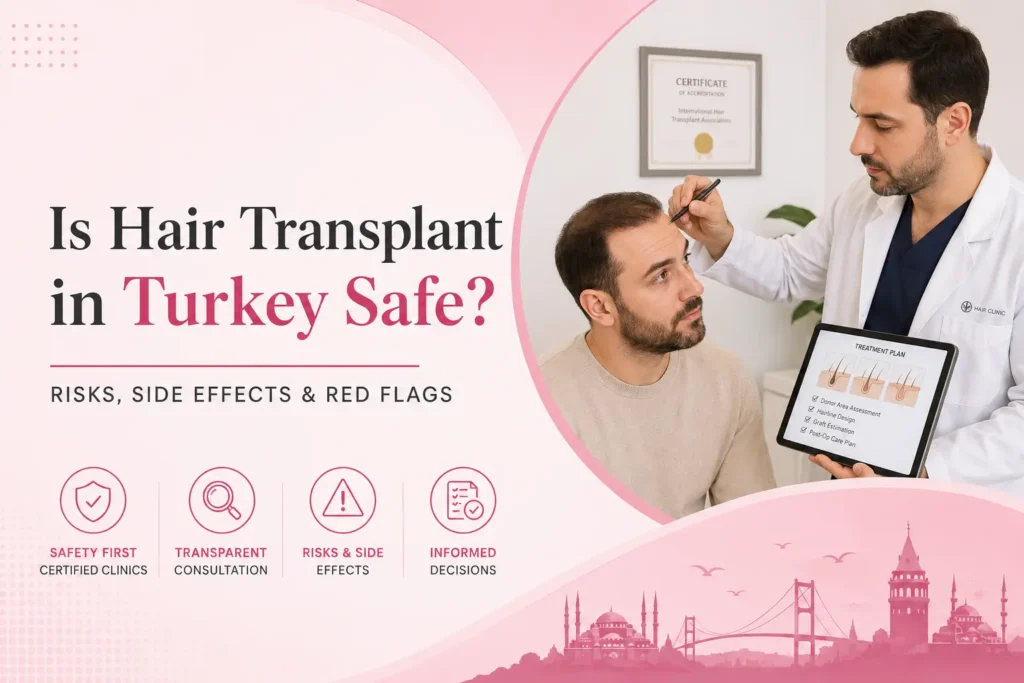
There are many aspects to consider in answering if hair transplant surgery in Turkey is safe. A country where surgery is performed cannot be the sole safety determinant.
The question is hair transplant in Turkey safe therefore needs to be considered in relation to the individual patient, medical team, facility, hair transplant procedure and postoperative care rather than the destination alone.
Patients may also search for whether is Turkey hair transplant safe, whether it is safe to get a hair transplant in Turkey, or whether hair transplant is safe in Turkey. These searches describe the same basic patient safety concern.
Hair transplant surgery involves many risk factors. Patient selection, the state of the donor area, the treatment plan, the expertise of the people performing the surgery, the facility, and the quality of postoperative care all contribute to the outcome of the surgery.
Patient safety in hair restoration surgery also depends on hair loss diagnosis, donor assessment, hairline design, the condition of the hair follicles, followup care and realistic expectations for long-term results.
The NHS notes that hair transplant surgery, while generally safe, is a surgical procedure that carries the risk of bleeding, infection, adverse reactions to anesthesia, scarring, and the procedure failing to grow as intended.
Instead of focusing on the overall safety of Turkey, prospective patients of hair transplant surgery in Turkey should ask if the patient, the medical staff, the facility, and the treatment plan are safe.
Whether it is safe to have a hair transplant in Turkey therefore depends on the individual clinic in Turkey, the people responsible for the surgery, and how complications and followup care are managed.
There is an official system run by the Ministry of Health in Turkey that authorizes health tourism service providers. Authorized health tourism facilities can be found on the HealthTürkiye website. Since 2025, participating health tourism facilities in Turkey are now required to be health tourism authorized under the regulation. This requires additional accreditation and certification of health tourism services.
Turkey, including Istanbul, is a popular destination for hair transplants and medical tourism. Competitive prices, accessibility and transplant packages may attract international patients, but affordability or savings do not establish whether a particular provider is medically safe.
How Safe Is Hair Transplant Surgery?
Modern hair transplantation is an elective, outpatient surgical procedure.
With the availability of modern techniques of surgery like FUE and FUT, big reviews show that even in the hands of skilled surgeons, there are still complications that can be permanent or temporary and surgery should still be considered with some level of risk.
Hair restoration surgery includes different hair transplant procedures. An FUE hair transplant uses Follicular Unit Extraction, while Follicular Unit Transplantation FUT uses a different donor-harvesting method. Neither method removes the general risks associated with hair transplantation surgery, cosmetic surgery or other transplantation surgeries.
A follicular unit contains one or more hairs, and the handling of each follicular unit and its hair follicles can affect the surgical process.
Safety needs to be considered independently from surface level success.
A patient can recover well from surgery without infection of major medical complications and can still be unhappy due to a bad density, a bad hairline or damage to the donor area.
Similarly, a good hairline does not actually mean that good medical practice was utilized throughout the entire procedure.
Choosing a hair transplant clinic should not be about package deals and before and afters; it should be about the entirety of a clinic.
A reputable hair transplant clinic should be evaluated according to patient assessment, qualifications, facility standards, the people performing the surgical stages, postoperative care and the treatment plan rather than advertising alone.
What Are the Common Side Effects of Hair Transplant?
Some of these effects should be expected during normal healing and should not be a cause for alarm.
According to medical reviews, swelling, temporary crusting of the skin, loss of sensation, and shedding of transplanted hair are post operative effects of hair restoration.
Side effects that improve during normal healing are different from complications that become progressively worse or require medical treatment.
Swelling
Swelling is to be expected in the first week and some of the time is around the front of the scalp.
In a recent review, frontal edema was found to be one of the post-operative effects of hair transplants; however, the reported rate varied significantly in the reviewed studies.
An expected improvement from mild swelling is better than an incorrect assumption of swelling worsening, in which case severe pain and new symptoms would be a concern.
Redness and Scabbing
Behind the transplanted grafts, a little bleeding occurs. This would lead to redness and temporary dry crusting.
The NHS states temporary scabbing as a normal effect of hair transplant.
These effects occur during the recovery process and should go away as the scalp heals.
Temporary Numbness
Changes in scalp sensation can occur because the donor and recipient sites undergo multiple small incisions.
Persistent numbness is reported as a complication in some studies of modern hair transplantation. However not all patients experience this.
Shock Loss
Temporary hair loss after surgery is referred to as shock loss or postoperative effluvium.
It can affect transplanted hair as well as surrounding native hair.
Temporary hair loss does not always indicate that the hair follicles have been damaged. The shedding can occur as part of hair growth and recovery and can occur before the growth of new hair occurs.
The longer-term result should therefore not be assessed during this temporary shedding phase.
What Complications Can Occur After Hair Transplantation?
Most patients do not experience serious complications, however this should still be communicated to patients prior to the procedure.
The NHS lists infection, bleeding and scarring as some complications. There are also complications related to the sites of either the donor or recipient of the hair.
Infection
Infection is a recognized surgical risk due to many small openings left after hair transplant surgery.
Infected patients have been reported in several studies reviewed in a recent study.
There are symptoms that can indicate infection. These symptoms include a fever, worsening pain, an unusual discharge, and increased redness. These symptoms should be evaluated, and not considered normal as a part of the recovery process.
A clean and appropriately sterile surgical environment is therefore part of the wider patient safety assessment.
Bleeding
There will be some bleeding during and after the surgery.
There are complications of hair transplants that involve bleeding that requires treatment.
A complete evaluation of the patient’s health is necessary to determine medications and health problems that may have an effect on the surgery.
Poor Wound Healing
Wounds, both donor and recipient, require healing. Poor winds can have aesthetic implications including scarring and may impact tissues surrounding the implant and the tissue that was implanted.
Post operative instructions should be concise and easy to understand with contact information for the medical team for complications with healing.
Clear aftercare and followup care become particularly important when international patients have already returned home.
Scarring
All surgical hair transplantation results in some degree of tissue injury.
In FUT, donor scarring is a linear scar. FUE results in numerous extraction sites.
While modern FUE may lessen the visibility of scarring, it is important to understand that it does not make the procedure scar-free.
Follicular Unit Transplantation and Follicular Unit Extraction therefore produce different donor-site patterns, but neither should be marketed as having no surgical consequences.
Poor Graft Growth
Some transplanted grafts may not grow hair and the resulting cosmetic outcome may be affected.
The NHS states that there is a chance that the graft will not take and the hair will be lost.
Factors which affect grafts survival include donor site, preparation of recipient sites, handling of grafts, storage of grafts, and the actual implantation. Post operative care may also play a role.
The survival of each follicular unit also depends on avoiding unnecessary damage to the hair follicles during extraction, preparation, storage and implantation.
Assessing before and after pictures of a hair transplant should be done after an appropriate healing period and not right after surgery.
Longterm results are more useful than early postoperative photographs when evaluating whether graft growth and density have developed as planned.
Can the Donor Area Be Damaged?
Is there a limit to how much of the donor area can be used?
Since hair transplantation re-distributes existing hair, it is an important consideration to plan how much of the donor area should be used to prevent a thin or unnatural hair distribution.
Hair transplantation does not create unlimited additional hair, so donor preservation remains important even when a patient requests a larger graft count.
Overharvesting
Overharvesting occurs when too much of the donor hair is extracted or if the extraction is sparsely distributed across the donor area.
The ISHRS has listed depleted donor areas among the post-procedural issues caused by substandard hair transplantation and/or poorly delegated hair transplantation.
Arbitrarily increasing graft numbers also does not provide a superior outcome.
The number of grafts intended to be transplanted should consider donor availability, the recipient’s needs, and long-term predictions.
The graft count should therefore be selected according to donor supply and the treatment plan rather than because a transplant package advertises a larger number.
Patchy Donor Density
Poorly conducted FUE extraction can lead to uneven donor density.
It’s not just about the total number of grafts removed, but rather where they are taken from and how extraction is distributed.
FUE donor harvesting is a procedure with a large learning curve and requires skill.
A qualified and experienced team should therefore plan Follicular Unit Extraction according to the donor area’s density and long-term needs.
Can Hair Transplant Results Go Wrong?
Yes. A hair transplant can heal medically without producing a good cosmetic result.
Modern medical reviews includes unnatural hairlines, graft failure and other aesthetic problems among adverse outcomes.
When a hair transplant goes wrong cosmetically, the problem may involve hairline design, poor density, donor depletion, graft direction or poor longterm results rather than a major medical complication.
Unnatural Hairline
The hairline should be designed to compliment the patient’s natural hair, facial features and hairline future balding.
A hairline designed to be too low, straight, poorly designed, or even with good graft survival can be unnatural.
The NHS also states that continued thinning around the transplant should be taken into consideration with the design of the procedure.
Hairline design should therefore be part of long-term planning rather than based only on how low the hairline can be placed on the day of surgery.
Poor Density
Poor density does not mean a complete failure of all grafts.
There are many contributing factors for poor density including donor numbers, thickness, recipient area, distribution of grafts and the number of grafted hairs.
Therefore, an excess density promise is a sign to be suspicious of as it may provide unrealistic expectations to patients.
Guaranteed density or guaranteed success can therefore be considered among the red flags patients should question.
Incorrect Graft Direction
Clinical hairs are best placed at natural hairs’ angles and directions.
In their report, the ISHRS states that poor cosmetic results following hair transplant surgery have been attributed to transplantation of hairs in an abnormal direction.
Failed or Damaged Grafts
Grafts can be damaged at every step of the process from extraction, through preparation, and during implantation.
Although various techniques require distinct phases, neither FUE nor DHI enables graft survival as a default.
The FUE hair transplant procedure, DHI hair transplantation and Sapphire FUE use different technical workflows, but technique names do not make the procedure risk-free.
The skill of the individuals carrying out each phase remains important.
What Are the Risks of Anaesthesia During Hair Transplant?
Hair transplant surgery involves local anaesthesia of the site. For HealthTürkiye, local anaesthesia is the dominant method for hair transplant surgery in Turkey.
The NHS includes allergic reactions to anaesthesia in the potential complications of hair transplant surgery.
Anaesthesia is not a minor, non-medical detail.
It is important for the medical team to know the patient’s medical history, allergies and relevant medications and for them to carry out the necessary measures for patient safety during the surgical procedure.
This is another reason why hair transplantation surgery should not be treated as only a cosmetic service or package.
What Makes Hair Transplant in Turkey Safer or Riskier?
What matters most are not the country itself but rather how the surgery is organized and who will take care of the patient.
A lower price, a luxury hotel, or a large social-media presence do not guarantee medical safety.
For patients asking whether is Turkey safe for hair transplant, the relevant questions concern the medical assessment, responsible physician, clinic standards and followup care.
Medical Assessment
Hair transplantation begins with an adequate diagnosis and patient selection.
Candidates for medical hair transplants have a healthy donor area and a type of hair loss compatible with the procedure. They should not have any health condition(s) that would affect the surgery outcome. Active uncontrolled inflammatory disorders of the scalp and some types of diffuse hair loss may disqualify a patient from consideration for hair transplantation surgery, and/or require additional testing.
Assessment should occur prior to determining technique or number of grafts.
Androgenic alopecia is one common form of hair loss considered in surgical hair restoration, but the cause, stability and pattern of hair loss should still be evaluated before surgery.
Some patients may also use nonsurgical hair loss treatments or supportive treatments such as low-level laser therapy, but these do not replace the medical assessment required before transplantation surgery.
The same safety principle applies to hair transplants for women and female hair transplant procedures, beard transplants and eyebrow transplants. The donor and recipient requirements may differ, but patient selection remains important.
Hair characteristics also affect planning. Patients with tightly curled or Afro-textured hair may require a treatment plan adapted to the donor follicles and extraction process, which is one reason Afro hair transplantation should be assessed individually.
Surgeon Supervision
Patients must know the name and qualifications of the treating physician.
The ISHRS has issued numerous statements and warnings about hair restoration surgery performed by unlicensed individuals or individuals with insufficient training.
The phrase “doctor supervises” does not address who actually performs the surgery.
A clinic may advertise a licensed or board certified surgeon, but patients should still establish who is legally authorized and responsible for each surgical stage. Licensing and board-certification systems can differ between countries.
Terms such as skilled, qualified, experienced or board certified should therefore be supported by verifiable professional information rather than advertising language alone.
Who Performs Extraction and Implantation?
This should be known prior to payment or travel.
A patient may ask:
- Who performs the medical evaluation and hairline design?
- Who performs local anesthesia?
- Who removes the individual hair follicles?
- Who makes the incisions or recipient sites?
- Who places the grafts?
- What is each person’s training and legal right to perform the surgery?
- Who assumes responsibility for the surgery?
This is important because FUE (follicular unit extraction) is often marketed as a minimally invasive surgery, whereas it involves thousands of small surgical incisions.
An advanced device or implantation technique does not replace qualified medical decision-making or appropriate patient safety standards.
Clinic and Facility Standards
For international patients, official authorization is one of many checks.
Turkey’s current system for International Health and Tourism has a framework requiring authorization for facilities and intermediary organizations. The Ministry of Health retains a record of authorized facilities. Further regulated accreditation and certification are part of the current system.
HealthTürkiye has an official service directory of certified providers that allows international patients to verify a given facility.
Having authorization does not ensure a good hairline, but it is more substantial than marketing a practice through online ads or posting to social media.
Turkey and Istanbul are frequently considered destinations for hair transplants. As a destination for hair transplantation, Turkey has different hospitals, hair transplant clinics and other providers, so the fact that treatment is located in the same country does not mean every clinic follows the same standards.
Clinics in Turkey treating international patients should therefore be checked for authorization, clinical hygiene, medical accountability and whether the surgery takes place in an appropriately equipped and sterile environment.
Turkish clinics may advertise affordable prices, competitive pricing, advanced procedures, hotels, transfers and transplant packages. None of these features proves that a particular clinic in Turkey is licensed, accredited or medically appropriate for a specific patient.
A reputable provider should also explain realistic risks rather than offering only marketing claims about success.
Postoperative Follow-Up
Safety does not end with the placing of the grafts.
The treating physician(s) must ensure the patient understands the postoperative care instructions, who will evaluate unexplained post-care symptoms, and the postoperative care follow-up.
Good followup care should explain aftercare, expected side effects, warning symptoms and what the patient should do if a problem develops after returning home.
This is essential for international patients considering surgery, as the medical professionals performing their care may be out of the country by the time any postoperative issue is known.
What Is a Hair Mill and Why Can It Be a Concern?
The phrase “hair mill” is an informal description and is not a medical or legal classification.
“Hair mills” are hair transplant clinics that perform hair transplant surgeries with an extremely high number of cases, and where many vital steps of the surgery are conducted by technicians with very minimal doctor involvement.
Focusing on a high number of cases is not an indication of an unsafe clinic.
A clinic treating multiple patients is therefore not automatically unsafe. The issue is whether the medical team can maintain appropriate standards and accountable supervision for each patient.
The main concern is on who provides the medical and surgical care for each case, how patients are assessed, and whether the clinic can maintain standards for each case.
ISHRS public safety campaigns alert patients to clinics across the globe where unlicensed and unqualified personnel perform surgical stages of hair transplantation. In these clinics, patients report poor hair growth or no hair growth, scarring, unnatural hairlines, and depleted donor areas, as well as grafts growing in the wrong direction. The ISHRS stresses that this is not a problem unique to Turkey, as it is an international problem.
The term black market hair transplant may also be used when unlicensed or unauthorized people carry out surgical procedures. The important issue is the actual legal and medical status of the individuals performing the procedure.
A hair mill can not be defined by a low priced package or a clinic with a high patient volume. The loss of accountable medical oversight is the red flag.
Red flags can therefore include unclear physician involvement, refusal to identify who performs surgical stages, guaranteed results, unrealistic graft counts, unclear facility authorization or inadequate followup arrangements.
What Are the Risks of Traveling Abroad for Hair Transplant?
In and of itself, travel is not a safety concern for hair transplant surgery.
The primary concern is the continuity of care.
Medical tourism can make continuity of care more complicated because a complication may appear only after the patient has returned home.
Patients must understand what will happen if they develop bleeding, an infection, or other complications after returning home.
Limited In-Person Follow-Up
While a clinic may offer online follow-up, that is often a substitute for the chance to look and assess the scalp.
Prior to travel, patients should understand when and for how long they are expected to be near the clinic for the first follow up.
Patients should evaluate each factor when considering a hair transplant in Turkey compared to the UK, as access to follow-up care is equally important as the cost and the technique.
Medical tourism occurs across many countries and destinations, so these continuity-of-care concerns are not unique to Turkey.
Managing Complications After Returning Home
Turkey patients should know who continues to be responsible for postoperative guidance and care once they leave Turkey.
There should be a method to contact the surgical team and a directive as to when local medical assessment is to be performed.
According to ISHRS consumer guidance, patients who have not done enough research to prepare for the regulations and the means to resolve complications after traveling for surgery, should also consider the possibility that they are prepared to sign a waiver.
Who May Have a Higher Risk of Complications?
Not all patients who require transplantation become eligible surgical candidates.
There are several risk factors to consider prior to transplantation surgery such as the type of hair loss, stability of hair loss, scalp conditions, the quantity and quality of donor hair, medical conditions, and whether the hair loss is of inflammatory or scarring nature.
Surgery may not be the best option for patients who have unrealistic expectations and whose expectations cannot be met.
Your evaluation must be more substantial than merely asking how many grafts you can place.
Patients should also be aware that a treatment plan suitable for one person may not be appropriate for another patient with a different hair loss pattern, donor area or medical history.
How Can Hair Transplant Risks Be Reduced?
Although there are no absolute risk-free transplantation surgeries, there are preventive measures that may minimize unwanted complications.
Hair loss must be assessed. The donor area must be checked, health history and the medications that you are currently taking must be disclosed. You must be informed about the estimated graft number and you must be told the name of the surgeon responsible for each step of the surgery.
For hair transplant surgery in Turkey, you can verify the clinic through HealthTürkiye or the Ministry of Health rather than relying on the clinic’s advertisement.
Patients considering a transplant in Turkey should choose according to medical assessment, professional accountability, clinic standards and realistic treatment planning rather than simply choosing the lowest Turkey price.
The total cost of hair transplantation surgery must not be your only basis for evaluating your prospective surgeons.
Hair transplant cost, prices, costs in Turkey, competitive pricing or savings may influence the decision to travel, but these factors do not establish patient safety.
Likewise, an affordable transplant package is not evidence that the procedure is unsafe, but price and packages should not replace checks of the people performing the surgery.
You must not trust a surgeon who offers guaranteed graft survival, guaranteed density, or claims a completely risk-free surgery.
When Should You Contact a Doctor After Hair Transplant?
There is some swelling, aching, and scabbing to be expected during the healing process.
The NHS urges patients to phone the clinic if they experience extreme pain or additional symptoms after a hair transplant.
There are some things that should not be considered normal. These symptoms include high level of redness, large amounts of bleeding, unusual discharges, fever, a high level of pain, and symptoms that are so far off from what is expected during the normal healing process.
If the symptoms are looking serious and the original clinic is unable to evaluate the patient, then it is necessary to go to a local clinic for further medical care.
This is particularly important for medical tourism patients because followup care may need to involve a doctor or hospital in the country where the patient has returned home.
Frequently Asked Questions About Hair Transplant Safety
These hair transplant FAQs address the main questions patients ask about Turkey hair transplant safety, complications and long-term risks.
Are Hair Transplants in Turkey Safe?
They can be.
There are qualified medical staff and a formal system for authorizing clinics as health tourism clinics in Turkey.
However, being a clinic in Turkey does not make a clinic safe or unsafe.
The factors that really make a clinic safe or unsafe are the patient assessment, the qualifications of the medical staff, post-operative assessment and follow up, donor area assessment, medical staff, and the facilities.
Patients may phrase this question in several ways: is Turkey hair transplant safe, is it safe to have a hair transplant in Turkey, is it safe to get a hair transplant in Turkey, is it safe to get hair transplant in Turkey, is Turkey safe for hair transplant, or is hair transplant safe in Turkey.
The wording changes, but the answer remains dependent on the patient, medical team, clinic standards and followup arrangements.
The search phrase hair transplant Turkey is it safe therefore should not be answered only with a general statement about the country.
Hair transplant Turkey safety is ultimately about the standards of the individual procedure and provider.
Can a Hair Transplant Fail?
Yes.
The NHS has recognized a potential risk of a hair transplant not taking. Failure can also be cosmetic rather than complete: hair may grow, but may have poor density or an unnatural appearance.
The final result should therefore be evaluated after an appropriate growth period and not simply according to early postoperative appearance.
Can a Hair Transplant Damage the Donor Area?
Yes.
Poor extraction planning or removal of too many grafts can result in a loss of donor density and a patchy appearance. The donor supply should be treated as a limited resource and should not be used simply to obtain a high number of grafts.
Are Hair Transplant Side Effects Permanent?
What things such as post-operative swelling and scabbing/shedding will resolve with the healing process.
Other complications can be long standing or permanent, such as:
- scars
- donor site depletion (i.e. no more donor sites)
- a less than desired hairline
Whether something is a temporary side effect vs. a complication requires a more in depth discussion with the surgeon.
Medical Sources
- Hair transplant — NHS, United Kingdom. Covers hair transplant side effects, bleeding, infection, anaesthetic reactions, scarring, graft failure and postoperative problems.
- A Scoping Review on Complications in Modern Hair Transplantation: More than Just Splitting Hairs — PubMed / Aesthetic Plastic Surgery. Reviews complications associated with modern FUE and FUT hair transplantation.
- Certificated Health Service Providers — HealthTürkiye / Republic of Türkiye Ministry of Health. Official resource for checking authorized healthcare providers involved in international health tourism.